Showing posts with label History. Show all posts

Tuesday, 25 April 2017

Body and Soul

Out of the Blue: New Short Fiction from Iceland, edited by Helen Mitsios, with a foreword by Sjón. University of Minnesota Press, 183 pp. 

In addition to being an enjoyable read, this anthology of recent short Icelandic fiction in English translation gives an overview of contemporary prose writing from a part of the world where writing, and the profession of writer, are traditionally held in high esteem. The Icelandic author is a representative of his or her nation, travelling the globe with some of the same nonchalance that the ancient Vikings brought to their more goal-oriented excursions.

Some reviewers of the collection have expressed regret that a number of the stories are set not in Iceland but abroad – mostly in regions of southern Europe. Yet given the history of Icelandic culture, with its openness to Roman and Hellenic influences, this does not seem unnatural. The Icelander abroad is a chameleon-like figure, at once distinctive and transparent, changing according to surroundings, and abandoning foreign cultures and languages as quickly as adopting them. 

Auður Jónsdóttir’s ‘Self-Portrait’, the opening story in the book, is a study of the tension between the fragile consciousness of the vulnerable outsider and the actually threatening nature of a foreign environment. The Sardinian beach resort, with its heat, its homeless people and Mafia operatives, turns out to be more forbidding than the austere northern climate it was supposed to replace and compensate for – in the end it’s a threat to the self, and needs to be rejected.

In Kristín Ómarsdóttir’s ‘Afternoon by the Pacific Ocean’ the film stars Greta Garbo and Marilyn Monroe, both of Nordic descent, read Joyce and Icelandic sagas together on an afternoon picnic under the Californian sun:

Marilyn lay down on her side in the fetal position, and with one hand under her cheek, she looked wide-eyed at Greta, who opened Egil’s Saga. They were at the part where Egil wants to marry Asgerdur after returning from a successful raid. Greta started reading with Marilyn watching her. The sun over the Pacific pierced through the curtains of the big window and bathed the actresses’ feet in golden rays.

The stories set in Iceland – and there are more of them in the volume than some reviewers have implied – blend elements of nature, psychology and society to create an inner and outer portrait of individual people whose lives are at once conditioned and set free by a sense of being at the margins, yet able to look into the depths in a way that is unusual and uncanny. The father in Ólafur Gunnarsson’s ‘Killer Whale’ is gripped by a death wish that is linked to archetypical figures of Icelandic natural and human history:

“No, they’re loners,” Olaf said. “They live in their own herds, by themselves. They don’t mix with other whales. They attack them. They feed on them.”

Likewise Gyrðir Elíasson’s ‘The Black Dog’ focuses on a negative, destructive element in Icelandic folklore and national psychology: in a Kafkaesque parable, the author’s own depression materialises in the image of a dog that ‘for some reason’ can be seen ‘only in mirrors’.

Not all of the narratives dwell on the darker side of human nature, and instead explore the quirkier regions of the supernatural. As Sjón points out in his foreword, in place of philosophy and metaphysics medieval Iceland had poetry and tales – ‘debates on the interaction between body and soul, for example, could be conducted through the medium of verses or stories about birds.’  Óskar Árni Óskarsson writes about a pen that possesses a magical power, granting the gift of originality to its poetry-writing owners as it passes from hand to hand – a cheap, unremarkable Biro. And again in parable form, Magnús Sigurðsson presents a series of dream-like narrative reflections, one of which centres on a play between the Latin word lego, ‘I read’, and the etymology of the Danish toy manufacturer Lego.

For the most part the translations by several hands read well, with the occasional lapse where the process becomes too literal a transposition of Icelandic syntax and phrasing. 

In general Helen Mitsios is to be congratulated on having compiled a highly readable and often entertaining miscellany of writing from a European literary culture that is still not as well known to the rest of the world as it ought to be. The characters of these short stories inhabit a realm that lies somewhere between fiction, mythology and poetry, and everywhere in them there is the sense of a lone, reflective wanderer, observing and noting inner and outer realities. It’s almost as if the same narrator were somehow present throughout the entire volume. As a result, the stories are best read in sequence, almost like a collective novel rather than as isolated texts: I found it the most satisfactory way to absorb this fascinating and eminently re-readable book.

Wednesday, 30 March 2011

Five Books

At TheBrowser, a literary website which announces that it is creating a 21st century library of Writing Worth Reading, Rory McTurk discusses five works on Norse culture and Old Icelandic literature, including Vilhelm Grønbech's The Culture of the Teutons, Sigurður Nordal's Icelandic Culture, and Preben Meulengracht Sørensen's Saga and Society. All the books mentioned in the interview are available in English translation.

Friday, 14 January 2011

Purge

I've just finished reading Lola Rogers' translation of Puhdistus (Purge), by Sofi Oksanen. It's a remarkable work - restless, vivid, articulate, emotional, violent, political - and I don't think there is anything quite like it in the rest of world literature. The only book remotely akin to it that I've come across before is a strange Estonian novel from 2004, which has a similar graphic reconstruction of Soviet reality. I think Sofi Oksanen's work does require a knowledge of Estonian and Soviet history if the reader is to understand the thinking, motivation and actions of the characters. One solitary niggling doubt I have is that while the book amounts to an extraordinary tribute to the Estonian people and their survival of decades of Soviet occupation, the characters themselves don't come across as very likeable human beings - but I believe that may be deliberate on the author's part. It's good to see Paul-Eerik Rummo's poetry quoted in the opening of each section.

Wednesday, 15 September 2010

Reading matters

The interesting blog of Swedish military historian and defence analyst Lars Gyllenhaal continues to provide thought-provoking insights into aspects of Nordic and European security, past and present. with references to little-known and little-publicized historical, literary and other documentary sources. Among recent posts to the blog are:

  • a review of a book called If Germany Had Won --  53 Alternative Scenarios, with a chapter containing speculations on questions such as what might have happened if Sweden had been drawn into the Winter War of 1939-40, or had said no to Hitler in 1941.
  • a dissection and general Fisking of the 9/11 “Truth Movement”, with some unexpected words from Noam Chomsky.
  • an examination of Russia’s new defence policy in the light of a recent BBC report, and a look at one puzzling recent development.

Wednesday, 1 September 2010

Resisters

In the second volume of Peter Weiss's long novel - I'm now in the section between pp. 553 and 627 - I notice a sudden change in the narrative technique. For one thing, the sense of "paragraph-lessness" is receding. There are more frequent breaks in the blocks of text, and one is now reading what are almost long but clearly demarcated paragraphs. For another, the specific locale - in this case Sweden and Stockholm - is being described and invoked in a much more concrete and realistic manner than was characteristic of the section devoted to Spain (the second half of volume one). One supposes that a reason for this may be that the author has a greater degree of immediate and long-term familiarity with the places he is describing, The need to insert chunks of art history and Greek mythology into the text seems for the present to have lost its urgency, and the story is developing in a manner that is almost that of traditional nineteenth century fiction - one almost could be reading a story or novel by Tolstoy. The characters converse, they eat and drink, they laugh, they are becoming almost human.

The analogy with Tolstoy also comes to mind in the fact that the characters now being developed and described are historical figures. This is a historical novel, after all. Just as in War and Peace Tolstoy introduces military figures and political leaders into the narrative, Weiss now brings in not only Max Hodann, but a number of other real-life people who worked as political activists in the exiled German Communist anti-Nazi resistance movement. We meet Charlotte Bischoff, who having fled the Third Reich is now in Sweden preparing to return to Germany in order to carry out undergound resistance work there. "Lindner" appears to be the German-Czech resistance worker Hertha Lindner, though from a historical point of view it isn't clear that she was in Sweden during 1939. Weiss now also introduces Rosalinde Ossietzky, daughter of the radical German pacifist Carl von Ossietzky (1889-1938), who in Stockholm tells the narrator and Max Hodann about the torture and murder of her father by the Nazi authorities. She also recalls the actions of some pro-Nazi Norwegian cultural figures, including the novelist Knut Hamsun, who took part in an active campaign to discredit her father and to deny him the award of the Nobel Prize which he received in 1935.

It has to be said that Weiss succeeds in leading these new characters onto the stage quite naturally, without much ideological ballast - they act and talk like real people, and above all one can believe in them. It is only a pity that the author forgot (or perhaps decided not) to include explanatory notes on these figures, who will  probably be unfamiliar to many of his readers, even - or especially - in Germany. There the affinity to Tolstoy breaks down, for Tolstoy's historical characters were all well-known to his readership. However, with the advent of Wikipedia, it's not too hard to keep abreast of the historical and biographical background as one reads - this was hardly the situation of readers of this challenging novel three decades ago.

Although Sweden in 1939 is now a temporary home for many of the political activists being brought to life, most of them are there illegally. Weiss is scathing about the country's Aliens Act of 1938, which in a response to antisemitic protests (among others, by students at Lund and Upsala universities) virtually closed the door to Jewish refugees altogether. As is consistently the case throughout the whole of the Aesthetics, Weiss groups Jewish and Communist refugees together - for him the Holocaust has two elements, a racial one and a political one. Sometimes they overlap, but they are distinct, separate and of equal validity. The reader is left unaided to deal with this debatable historical construct.

Another problem is the account of the international political events of 1939 which led up to the outbreak of war. The account is heavily influenced by Stalinist versions of history, with the Baltic States, for example, being stigmatized as "semi-fascist" and standing in the way of a successful Soviet defence - part of an anti-Soviet conspiracy being cooked up by Great Britain, France and the United States. One feels that, although this Tolstoyan historical digression is put, somewhat unconvincingly, into the mouth of the youthful narrator, who is only in his teens, one can't help feeling that it would have been better if Weiss had left it out, for it leaves an unpleasant taste, even as fiction. The bewilderment of the narrator and his friends as the German-Soviet Credit Agreement of 1939 is signed is well-described, but again there need to be some notes or other signposts for the reader.

I'm now moving on into the closing section of the first part of volume two, in which the narrator visits the island of Lidingö near Stockholm where the Swedish sculptress Ninnan Santesson has put her home at the disposal of the German writer and dramatist Bertolt Brecht and his family. 

Thursday, 25 March 2010

Shady characters? - 2

Yet another example of how Finland and its complex history get distorted in the eyes and minds of Finland's Nordic neighbours. From The Girl With The Dragon Tattoo:

How well do you know the history of Swedish Nazism?”

“I’m no historian, but I’ve read a few books.”

“In 1939 the Second World War began, and in 1940 the Winter War in Finland. A large number of the Lindholm movement joined as Finland volunteers. Richard was one of them and by then a captain in the Swedish army. He was killed in February 1940 — just before the peace treaty with the Soviet Union — and thereby became a martyr in the Nazi movement and had a battle group named after him. Even now a handful of idiots gather at a cemetery in Stockholm on the anniversary of his death to honour him.”
See also: Shady characters?

Friday, 4 December 2009

War notes

Monday is the 70th anniversary of the Winter War between Finland and the Soviet Union, and Helsingin Sanomat is running a number of features connected with the event. In the English-language section, Anna-Stina Nykänen wonders, along with other Finns,  "if Finnish men of today could handle the conditions of the Winter War today."

There is much talk nowadays about conscripts who do not finish their term of service. Nevertheless, more than 80 per cent of those who are called up for duty complete their military service before turning 30. This is more than in the 1930s, when less than 70 per cent did so. At that time many had tuberculosis, Marjor Mälkki says.

But what is worse, malnutrition, or obesity. Before the Winter War many of the men came from such poor conditions that they were actually malnourished.

Many of today’s soldiers suffer from allergies, and there are rumours of barracks with fungus growing in the structures. However, in the 1920s and 1930s, doctors were very critical of the barracks dating back to Tsarist times, where clothes did not dry, and latrines stank.

Today’s conscripts are healthier than before, and their teeth are also.
Meanwhile, with Independence Day coming up on Sunday, members of the newspaper's HS Council respond to the question of the week: Are Finland's War Years Given Too Much Emphasis in the Independence Celebrations? The answers of the Ayes, the Nos and the Don't Knows make interesting reading, as they show how Finnish public opinion divides on the issue.

Tuesday, 17 November 2009

Voces intimae - 4

(continued)

November

3) Mood up – the Himalayas again! [deleted words]

8) Have been in Hades. A valley such as never was.

9) Better already. [hairpin crescendo] Business H:fors.

15) Mood has been good. Not much appetite for work. Hard to learn to work without a stimulus. A must!

21) Have worked well – freudvoll, leidvoll – for a few days. Business tomorrow.

30) Axel Carpelan was here. I admire this fine talent. His powers of discernment are outstanding even though he is physically worn out. Appetite for work has been very poor. Yet this evening it is good!

December

14) In Memoriam, the funeral march, finished. 3 [green box] Op 59

15) Melartin, that neuter, has been with me. A refined nature.

17) A deep valley again! Horribly dark and empty, and concentrated feed! Will the sun never shine again? My life is ebbing away before I have been able to carry out what I had sight of. My business affairs are dragging me down. My destiny! Is this to be the end of my composing = life?

21) Melartin! I admire his method of working. How to achieve this "nulla dies sine linea." And the technique! Starting on the ballet in earnest. [deleted words] And my business affairs! A miracle that I produce anything at all. Not out of the valley yet.

26) Abandoning the ballet because of too little reward for too much time. "Up and at ‘em” again! Damn it, do I sound like that?

27) Himalayas again. Everything bright and strong. Worked like a giant.

28) My throat! Good God! Worked a bit

29) Have even given up the Lottery Music. I am burning my boats deliberately. Holding high the banner of true art. Don’t let go of pathos in life. And one’s "grip".

30) Worked, though ill.

31) Another year. Everything still "pending".


translated from Finland-Swedish by David McDuff

Voces intimae - 1
Voces intimae - 2
Voces intimae - 3

Wednesday, 14 October 2009

Helsinki Square

News that Tallinn may soon have a Helsinki Square (Helsingi väljak) - a proposal to give this name to the area in front of the Old City Harbour A-terminal is being discussed by municipal authorities, according to Tallinn's mayor, Edgar Savisaar. Savisaar also mentioned a proposal to erect a monument to former Finnish President Urho Kekkonen on the same site, noting that Kekkonen's visit to Tallinn in 1964 led among other things to the opening in the following year of regular passenger ferry services between the Estonian and Finnish capitals.

Tuesday, 13 October 2009

Finland as a question, Russia as reply

Next March the Finnish publisher WSOY will release an unfinished work by the poet, author and publisher Paavo Haavikko, who died last year at the age of 77. The book bears the slightly odd title Suomi kysymyksessä, vastauksena Venäjä (literally "Finland in question, Russia in reply"), and is an attempt to trace and analyse the historical relations between Finland and Russia throughout the centuries, concentrating on the genetic myths and memories, and the hatred and hostility that developed in the conversation between the two countries, influenced by official propaganda on both sides.

Monday, 21 September 2009

Hallgrímur Helgason: The Author of Iceland - 2

(continued)

And now, as an initiated member of the Comintern, he stood on the special platform that had been erected beside the Lenin Mausoleum on Red Square for the anniversary of the revolution, within earshot of the Leader himself, the Sun King, the Pharaoh, the Emperor. And I, his comrade, beside him, a 26-year-old kid with a book in the making. What was I? What was I doing there? I was writing The Lights of Peace. And I was acquainting myself with the onward-marching success of communism. It was a big parade. We stood there for three hours, while the Soviet republics marched past one by one, my God there were a lot of them. Whole factories strode past, army divisions, coalmines, collective farms, schools, athletes, children and women. A hundred thousand copies of the super-worker Stakhanov, smiling triumphantly in the face of socialism, the tanned and pockmarked face of socialism, the one with the big moustache that overshadowed all our lives. And everyone was ordered to keep their arms folded on their chest so that no one would go and shoot the fellow. The danger of this might possibly have disturbed the Leader’s concentration as he peered at this endless procession and selected the face of the next person to shoot.

From an ash-grey sky finely-wrought snowflakes descended, fluttering angularly in the calm air like the scraps of paper that Americans pour over their heroes – God was blessing the Revolution – and fighter planes flew overhead in formation, while others flew low over the highest towers of Russian history. All of it a magnificent spectacle, but painfully long-drawn-out. However, we put up with it and stood there for three hours in 5 degrees of frost. People did not walk out of shows that Stalin directed.

‘What must take place is the plain and simple overthrow of the social structure. We must dissolve it in order to be able to attain the dictatorship of the proletariat. Anything else is just rightocracy. The rightocrats are the road-layers of fascism.’

‘But what about democracy? Hasn’t it a…’

‘According to Lenin, in capitalist states the so-called democracy is an empty illusion, a means of oppression. The true democratic republic is the power of the people, the proletariat, a republic is a res publica, and it must be organized by good people. People like Comrade Stalin, Vyacheslav Molotov, Beria…’

We sat on hard bast chairs in the café of Hotel Metropol, trying to slurp away the chill after the march-athon on Red Square. He was teaching me. I drank in every word. We spoke Icelandic even though Kristján’s fiancée, the Swedish Lena, had now joined us. She was pretty but far too guillemot-like for my taste, with a long neck and a beak nose, as thin as a rake. To tell the truth, I could never get rid of the notion that Lena Billén’s body was just too bourgeois. She didn’t even know how to dress in a proletarian manner, with a far-too Parisian hat on her boyish head and long pearl necklaces at her throat, which I knew got on Stjáni’s nerves. One of these days those necklaces would probably strangle her. From time to time I smiled at the Swedish guillemot and looked at the two-year-old girl she held in her arms. A dark-haired moppet, powerfully built. Her name was Nína, and I sometimes suspected that Kristján was her father, but we never discussed it. Another more important matter preoccupied our minds. At the tables around us sat stately party men – with such strangely iron expressions in these imperial surroundings – and silent women who like Lena looked out of the windows, out at the November-grey Pushkin Square, which the first snow of the winter was quickly turning white. Kristján looked quickly around him after he spoke these last words. ‘Stalin, Molotov, Beria.’ Yes, he had spoken them in a positive way, without any mockery. This was his third time in Moscow, and he had now been here for ten months, well-schooled in circumspection. One thoughtless word could wipe out twenty years’ work. I was still trying to get used to this.

‘Kristján, have you any plans for this evening?’ said Lena, in Swedish.

‘Yes, Einar is going to have dinner with us. In our room.’

(to be continued)

translated from Icelandic by David McDuff

The Author of Iceland - 1

Sunday, 20 September 2009

Echoes of the Arctic Sea

Writing à propos of Thomas Berglund's recent article in Svenska Dagbladet on the occasion of the 200th anniversary of the Treaty of Fredrikshamn, at which Sweden had to sign away its territories east of the Gulf of Bothnia to Imperial Russia (Berglund calls it a "national trauma"), Tobias Ljungvall looks back on some of the less well-known aspects of the Finnish independence struggle. He discusses the role of a later independence activist, the writer and revolutionary Konni Zilliacus the elder (1855-1924), whose life, Tobias says, "ought to merit a film or television series". Zilliacus, the author of such venerable but probably now little-read works as Det revolutionära Ryssland, Från ofärdstid och ofärdsår, Korruptionen i Ryssland, and Moskoviter och finnar, was actively involved in the so-called "Grafton Affair" , which involved an unsuccessful attempt to smuggle arms to the Finnish resistance by ship along the Baltic in 1905.

The comments to Tobias' post make rather sad reading: someone has posted part of Silmien Välliin, a Finnish wartime song from 1942, which talks of "shooting the Russians between the eyes", and another (Russian?) commenter has responded with what purports to be a Russian translation of the song's words, but is in fact a totally different text accusing Finns of racism and Nazi sympathies.
See also: The Landmark Year

Tuesday, 1 September 2009

Carl O. Nordling

The Finland-Swedish historian and architect Carl O. Nordling (1919-2007) created an interesting website which is still maintained online in his memory, and also updated from time to time. The site contains numerous essays, articles and archive materials in a number of fields, including Scandinavian and Soviet history, music, literary criticism, anthropology, and Finnish and Finland-Swedish culture. Of particular interest to readers of this blog, perhaps, are the essays and reflections contained in The Finland-Swedes, a compendium of lists and writings relating to Finland-Swedish writers and artists, Finland-Swedish military men and civil servants, Finland-Swedish scientists and Finland-Swedish promoters of the Finnish language.

Among the site's more unusual offerings are a reconstruction of Stalin's speech to the Politburo of August 19, 1939 and the complete text of a book entitled Shakespeare: Who Wrote Hamlet and Why?

(Hat tip: Mari-Ann Kelam)

Monday, 3 August 2009

Ulla-Lena Lundberg: The Marzipan Soldier - 2

[continued]

The milieu in which he is living is familiar. The school is home from home for him, the timetable and food are as they were in the artillery corps. He has always been surrounded by boys. The smells are familiar, nothing repellent, but not enticing either, like the female smells of the cowsheds.

More acrid where men gather. The smell of sweaty feet that is really something, familiar from gym halls and changing rooms. Underarm sweat, too. The smell of dirt that becomes distinct before the Saturday sauna. The smell of urine from the latrine, old tobacco in one's clothes. The smell of rot-gut from the mouths of those who have had a night out and dared to get drunk.

And then the fresh smell of snow in the school yard, the pines, the horse-dung, the fumes from passing lorries, the smell of firewood wherever one turns, smoke from all of Riihimäki's chimneys. Finland at war.

Mealtimes are irregular right from the outset, for Riihimäki receives assiduous attention from the Russian airforce. There are no air-raid shelters under the school, so the recruits are ordered out to the forest when there is an alarm. There they watch the brickwork receive a direct hit, a stack of firewood start to burn and the glassworks sounds like a gigantic breaking of the ice when it is hit. It's like being at the cinema, but in reality. The lads stand and gape as at a giant-sized screen, only throwing themselves to the ground when a flying bomb explodes nearby: Ouch, my ears!

It is undeniably war, but healthy lads with matriculation certificates and artillery corps experience can't be squandered away like cannon fodder. They need to be trained as officers, and so Göran Kummel and those like him selected for NCO training school. School is not something one can escape in this life, even though one thought one was joining the war in order to get the school dust out of one's lungs.

Göran also attracts attention in another way. His handsome artillery corps uniform is the reason why Sunday after Sunday he is detailed to the guard of honour that stands stiffly to attention at the heroes' funerals. One can't help being just a tiny bit flattered at being considered worthy of being displayed on solemn occasions. Washed as he has been taught by Mother, shaven and brushed, dressed in his finery and touchingly young, Göran raises the tone in the church. Still as glass, or almost, he stands with his gaze directed forward, but his features are soft and the lad in uniform as sweet as if he were made of marzipan. He by no means unaware of the fact that Riihimäki's women and girls like to look at him. Furtively or more or less directly, and one doesn't need to be ashamed about that. The guard of honour stands like an emblem of those one is mourning: young, young men with soft features and living blue eyes, fallen for the Fatherland in their first bloom.

translated from Finland-Swedish by David McDuff

The Marzipan Soldier

Thursday, 2 July 2009

Two strands in Nordic literature

Still following the thread that was prompted by the discussion of Greenlandic literature, and particularly by the examples and reflections contained in Karen Langgård's essay, I wonder whether the questions connected with the aspiration towards nationhood may not lie at the centre of the debate on Nordic literature itself.

The uncertainty about national role and identity has had a twofold effect on Nordic consciousness and culture. On the one hand, it has led to a preoccupation among Nordic authors and thinkers with issues of identity, society and community, sometimes expressed in religious terms, but more rooted in the ideas of Hegel, Marx and nineteenth century German sociology. On the other hand, much as in Russia, it has often inspired a reaction against those essentially collectivist concerns, leading to the birth of a kind of ethical universalism that derives from the ideals of the German enlightenment, in particular those expressed in the philosophy of Kant.

Just as the Russian classic authors - Gogol, Tolstoy, Dostoyevsky, Turgenev - go beyond the limitations of the social and historical confusion of their age to create an essentially moral universe in which time and matter play a secondary though none the less vivid role, so the work of the great names of Nordic literature - Kierkegaard, Claussen, Blixen, Ibsen, Strindberg - inhabits a realm in which the ethical and existential concerns of the individual are transformed into a portrayal of all human life, perceived in the eye of the absolute. Perhaps this is the other side of the "religious" coin.

The two strands, the social-communal and the universal, are still present in Nordic literature today, although - just as in Russia during the twentieth century - the former has gained the upper hand. When an author like Pia Tafdrup describes herself not as a Danish poet, but a poet who happens to write in Danish, she is to some extent allying herself with the Nordic universalist tradition, though also with literary universalism everywhere, and with writers who fought the collectivist tyranny (the examples of Mandelstam, Tsvetayeva and Brodsky come to mind). And those Nordic authors who continue to seek their subjects and inspiration in the analysis of social and political issues are harking back to the uncertain murk of Herder, Hegel and nineteenth century nationalism, with its twentieth century consequences.

This is probably a gross oversimplification, but I think it's one that might be worth further inquiry.

Wednesday, 10 June 2009

Living memory

Juhani Salokannel 's biography of Jaan Kross (Sivistystahto, WSOY, 2008) has been translated into Estonian by Piret Saluri, and on Monday the translation was launched in Tallinn at a ceremony attended by Kross's widow Ellen Niit, other members of Kross's family, and Estonian President Toomas Hendrik Ilves, writes Hannu Marttila. In his speech, President Ilves remarked that although the book was written for a readership (i.e. Finns) who had not experienced occupation by a foreign power, it would none the less be instructive for younger Estonians now in their 20s and 30s.

Wednesday, 20 May 2009

Vikings in Chechnya

At Prague Watchdog, German Sadulayev speculates (in a way that's at once both serious and humorous) about the possible presence of the Vikings in 11th century Chechnya, and draws some striking historical analogies.

Sunday, 26 April 2009

The Diary


I recently discovered the website of the Icelandic poet, journalist, novelist and playwright Matthías Johannessen, who for 40 years was the editor of Iceland's main daily newspaper, Morgunblaðið. I met him and talked with him in the late 1970s. When I found the site I was surprised to find that there he has stored the entire enormous volume of his Diary, which he began in 1955 and has continued more or less without a break until the present day. For anyone wishing to learn about the history of Iceland in the 20th century and indeed about the history and culture of Iceland in general, this is a valuable resource. The site also contains poems, essays and interviews.

Recent posts to the Diary include a reflection on the historical, social and economic issues connected with Iceland's newfound aspiration to join the European Union, and an essay-review on a new book by the Norwegian-French magistrate Eva Joly, who was recently employed as a special adviser by the Icelandic government to investigate the possibility that white-collar crime may have played a part in the 2008–2009 Icelandic financial crisis.

The subjects in the Diary range far and wide, and cover not only Icelandic issues but also most aspects of international affairs (over the decades the diarist interviewed an astonishing number of well-known political leaders, writers and intellectuals as, for one reason or another, they passed through his country). Readers may find that the views expressed quite often don't tally with their own, but the texts are always clearly-written and informative, and create a unique picture of how the world can look from the top of the globe.

Monday, 23 March 2009

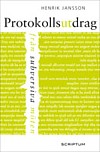
Henrik Jansson - "Excerpts From the Minutes of Subversive Meetings"


Henrik Jansson's 2007 novel Protokollsutdrag från subversiva möten, as it is called in the Swedish original, is a fine and unusual novel. It deserves not only to be translated, but also to be read in Sweden. Because this is a novel written by a Finland-Swede.

It will be argued that many Finland-Swedish authors have joint editions in both Finland and Sweden, for instance Lars Sund and Kjell Westö, but even by Finland-Swedish standards, Jansson's novel is published by a rather small press: Scriptum in Vasa. So it is unlikely that he will be widely read in Sweden.

The novel is nonetheless significant. It tells the story of how Communist youth from the 1970s grew disillusioned, but also weaves into the plot personal details from family life in the 2000s. The former aspect is the more important, perhaps, although Jansson's descriptions of his relationship in the 2000s are convincing.

The Communist youth movement in Finland was quite powerful. Maybe only Pirkko Saisio has written similar novels, but she wrote in Finnish. This is one of the very few Finland-Swedish novels that closely documents the feel, the music, the meetings, the trips to Tallinn, the blue-shirts and the red-shirts. Because even then the youth wings of the Communist movement were split in two. The so-called taistoiter, or hardline Communists, named after the leader of the hardline faction, Taisto Sinisalo, wore the uniform blue shirts, whilst the more liberal wing, which had the weekly Ny Tid as their mouthpiece, wore red uniform shirts.

I know all this because I was, at the time, the classic fellow-traveller. I sympathised with Communism, but could never bring myself to join any party. As I was living in Finland during the 1970s, first as a year-abroad student at Åbo Akademi, and later as an English conversation teacher in Jakobstad and Vasa, I experienced this whole ferment at first hand. When I left Finland in 1980 to go and teach in Umeå, Sweden, my friends were still fervent Communists. By the 2000s, they have become Greens, or have fallen silent.

But Jansson decided, very interestingly I feel, to document what it felt like to be a member of the Finland-Swedish wing of the Communist youth movement (blueshirts, as I believe) and how, in the early 1980s, he threw away all his written Communist material, including newspapers, magazines, minutes of meetings, and so on, something he now regrets. Because it was, to an extent, the documentation of his own life. But with only memory to go on, maybe Jansson has avoided getting bogged down in detail.

Henrik Jansson has always been keen on jazz and rock music. So there are plenty of mentions of Dylan, Donovan and John Coltrane, as well as home-grown bands and singers, plus leftwing composers and martyrs, such as Victor Jara and Theodorakis. And his protagonist has had good and bad relationships with women. So the actual number of political meetings described in detail are rather few, in comparison with the rest of the test.

Jansson swings, sometimes within the same paragraph, between the present (around 2005) and the distant 1970s. But the reader is not led into a labyrinth of narration. It is a readable book.

So I hope that those readers who saw the pathetic antics of the Russian provocateurs and their Finnish supporters today in Helsinki, by way of the online coverage, will one day read Henrik Jansson's novel to see at close quarters what drove young people in the 1970s, often from quite middle-class homes, to become Communists.

Wednesday, 18 March 2009

The Landmark Year

This year marks the 200th anniversary of the separation of Sweden and Finland - for 600 years before 1809 they had been part of the same Swedish kingdom.

In both Finland and Sweden considerable effort is being put into organizing suitable functions and ceremonies to mark the Märkesåret, or "Landmark Year" -- yet one cannot help noticing that so far most of these events seem to have taken place in Sweden, not Finland. For example, yesterday, in the Blue Hall of Stockholm City Hall, where the Nobel Prize Banquet is held on December 10 each year, Sweden's foreign minister Carl Bildt took part in a conference on the future of Finnish-Swedish relations.

Yet the anniversary is not without its painful memories. Earlier this year the spokesperson of Sweden's Environmental (or Green) Party, Maria Wetterstrand, published a dark critique of Sweden's treatment of Finns and Finland in which she wrote of the "class contempt" felt by many Swedes for migrant Finns, the ignorance of Finnish history and of Finland's Swedish-speaking minority which led one Finland-Swedish migrant to Sweden to experience the Kafkaesque situation of being sent on a Swedish-language course for foreigners, even though it was the only language he knew. Wetterstrand believes that Sweden should make a formal apology to Finland for the suffering Finland endured at its hands -- rather like the one made to Ireland by Tony Blair in 1999.

Perhaps it's in the field of literature that Finland and Sweden can really come together, in the manner in which Joyce and Yeats helped Ireland to approach and partially forgive England. For historically Finland's books were written in Swedish - and even the bard of Finnish national consciousness Johan Ludvig Runeberg wrote his epic Fänrik Ståls sägner (The Tales of Ensign Steel), like the rest of his work, in the language of his Swedish forebears.