Showing posts with label Baltic Countries. Show all posts

Wednesday, 12 January 2011

Mistral and Sweden’s security

Ever since the announcement of the controversial Mistral arms deal between France and Russia on Christmas Eve 2010, the Swedish press has been publishing articles about the implications of the deal for Baltic security, and Sweden's security in particular. On January 7 Dagens Nyheter noted that concern about the sale of the Mistral assault ships to Russia was high because these helicopter carriers can be used for landing operations - presumably in the course of a military invasion. Bo Pellnäs, a Swedish defence analyst, commented that although the carriers will be based in Murmansk, they can be moved anywhere. This, against the background of reports that Russia is to increase its military expenditure by 60 percent, and last fall held its largest military exercise in the Baltic Sea since the 1980s, is giving rise to fears in Sweden that the country's security may  be compromised.

On January 5 a member of the Swedish parliament, Mikael Oscarsson, requested a statement from Foreign Minister Carl Bildt on what the deal means for the security of the Baltic Sea as a whole. Oscarsson also said that it was necessary to ask Russia about the purpose of the invasion capability, and that a tightening of Sweden's defence with Poland might be needed.

Now, in an interview published in the Swedish current affairs journal Världen idag (The World Today), Oscarsson says that his concerns are heightened by the internal political situation in Russia in the aftermath of the recent unsolved murders of journalists and the sentencing of Mikhail Khodorkovsky and Platon Lebedev.

"We need greater cooperation between Sweden, Poland and the Baltics, but we should also invite Russia to talks. I'm not one of those who say that the Russians are coming, but we cannot assume that anyone else will defend us. Therefore, we need to respond and ensure that we have a fleet that works."

In Poland, Polskie Radio has taken up Mikael Oscarsson's question, and there are reports that the military ties between Sweden and Poland may strengthen in response to Russia's investment in the new warships.

he U.S. think tank and news agency Stratfor's East Europe analyst Marko Papic says that just five days into the new year Mikael Oscarsson's question to Carl Bildt shows that the geopolitical map may be redrawn.

"The area of Sweden, Poland and Russia will be crucial for European security and political issues in 2011," he said in a statement.

Friday, 10 July 2009

The scope of this blog

Responding to my view of how I see this blog, Eric wrote:
My only plaint so far is that Latvia and Lithuania are not included. Estonia is certainly tied in with Finland. But the Baltic countries do have many aspects of recent history in common. Their literature is fascinating. If we can embrace the whole of Scandinavia, disregarding language background (e.g. with Finnish, Lappish and Greenlandic), we could perhaps take on board the other two Baltic countries. If we have visitors from the Baltic states, maybe we could take on board all three.
I think that to include Latvia and Lithuania would be stretching the frame of reference a bit too far. Greenlandic literature was discussed because there is a genuine possibility that Greenland might become a sixth Nordic state. As far as I'm aware, there's no such possibility at present for Latvia and Lithuania. Also, as anyone who has visited them knows, those countries (especially Lithuania) are culturally distinct from the Nordic states, and while Estonia can be given guest status here because of its close ties with Finland and Sweden, I don't really see how the other two can fit the frame.

A similar problem occurred in the life of Usenet back in the early 1990s, when the newsgroup soc.culture.baltics was formed as a breakaway from groups like soc.culture.soviet and soc.culture.nordic. I think a separate Baltic literature blog might be a more interesting avenue to explore, and maybe you could think about setting one up, Eric? It would certainly be the first of its kind.

My feeling is that there's a lot of Nordic writing, especially in Finnish and Danish, that isn't familiar to readers from outside the region, and I would rather concentrate on exploring those literary areas, rather than widening the focus outside the Nordic region in the way you suggest.

Thursday, 7 May 2009

Fear behind everything

A couple of translated extracts here from Bjarne Nitovuori's review in the Finland-Swedish daily Hufvudstadsbladet of a book about the Soviet occupation of Estonia called Kaiken takana oli pelko (Behind Everything Lay Fear), a book of essays on the subject compiled by Finnish author Sofi Oksanen and Estonian filmmaker Imbi Paju. I hope to receive the book soon (allowing for the vagaries of the Dutch post office) so that I can read it myself. But here is a foretaste, part of the review:

The Estonian ethnologist Terje Anepaio describes how, during the late 1980s and early 1990s rekindled the memory of the two Estonian deportations, in 1941 and 1949, on a grand scale. This began with an article by Evald Laasi in [the cultural weekly] Sirp ja Vasar, published in 1987, when the Soviet Union still existed. But according to Anepaio, interest soon cooled off in the early 1990s as it didn't represent the image that Estonia was aiming for. The new young élite did not wish to represent Estonia as a suffering, unhappy nation, but as one that would soon be able to integrate with the West.

(...)

Lauri Mälksoo shows in a convincing manner that the annexation of Estonia (and the other Baltic states) was an occupation. It is disputed amongst researchers as to whether the Baltic leaders gave in to Soviet pressure to house Soviet military bases on their territory in 1939. But it is completely impossible to regard what happened in summer 1940 - the change of government under military threat, elections held in an unconstitutional manner and an equally illegal decision to join the Soviet Union - as other than a crime against international law, and as an occupation.

(...)

Translated from Swedish by Eric Dickens

Nitovuori goes on to mention other articles by the Finn Jukka Mallinen, the ex-prime-minister of Estonia and historian Mart Laar, and others. I will look more closely at some of the essays, once I have received and read the book myself. The book in question was published earier this year by the WSOY publishing house in Helsinki, and is 565 pages long.

Suffice it to say that the importance of this book is that it is appearing in Finland, a country where attitudes to the occupation of the Baltic countries by Russia have varied over the years, not helped by bouts of self-censorship under the period of Finlandisation (originally a German expression "Finlandisierung", then becoming "suomettuminen" in Finnish) which means the cautious way that Finland dealt with criticism of neighbouring Russia during the Cold War.

Sunday, 29 March 2009

Karl Ristikivi - "Night of Souls"


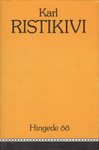
Karl Ristikivi is the subject of two other postings so far on this blog. One deals with his life as an exile in Sweden, the other shows a couple of his poems. This posting consists of two excerpts from his 1953 novel Hingede öö, translated as Night of Souls. The original was first published in Estonian by Eesti Kirjanike Kooperatiiv, the exile Estonian publishing house located in Lund, Sweden. It was reprinted a couple of times after Estonian independence. As far as I am aware, the novel has never been published in translation into any language, even Swedish.

The novel tells of a young man who enters a house in the middle of Stockholm on New Year's Eve, partly to get away from the drunken, yelling crowds, and finds a world where time and space are distorted. He wanders about for hours, meets all kinds of unusual and usual people, attends what looks like the trial of various people for the Seven Deadly Sins, and leaves, some 20 minutes later. The book is vaguely reminiscent of Hermann Hesse's Steppenwolf; there are maybe hints of Alice in Wonderland.

Two excerpts here. The first is from near the beginning of the novel, when the protagonist enters the building. The second is from when he is in limbo, both an existentialist and a national one.

Night of Souls

[First excerpt]

When I arrived at the beam of light, I could see it was coming through a doorway which, unlike all the others on the street, stood wide open.

I realised immediately what the reason for this was, and was overcome by a feeling of mild disappointment. They were no doubt holding a public celebration, seeing in the New Year, this being some cinema or little theatre tucked away in this side street. By this time the performance would already have begun, which would explain why there was no one around outside walking in the direction of this oasis.

I hoped that I would at least be able to enter for a short while. The fact that the door was stood so invitingly open gave the impression that not all the tickets to this place, with its air of an orphanage, had been sold out. So I would at last be able to stay in that light and warmth, bought for a couple of kronor, for that short hour still left of the Old Year. It would, of course, mean abandoning my former plans. But better to end the Old Year with an admission of failure than starting the New with one.

And so I entered by the open door.

***


Wouldst thou be in a dream, and yet not sleep?
Bunyan: The Pilgrim's Progress


The music could now be heard quite clearly, since the following door leading into the hall itself was also open. It was from here that the light had shone through onto the street, since the entrance hall itself was rather dimly lit. The piece they were playing was a piano concerto which I had no doubt heard before but could not immediately place. It reminded me of something which had no connection whatsoever with this evening - the scent of jasmine. I could also see through the open door that people were sitting in rows of seats in the hall but the light which shone towards me was so bright that I could not see anything clearly since my eyes were slightly dazzled by the glare. Apart from the fact that my eyes were a little astigmatic by nature, as it was. Everything looked as if it was being viewed through condensation on the lenses of my spectacles.

For a short moment I felt like retracing my steps, but I forced myself to stay. I looked around the wide, yet low-ceilinged foyer, looking for a ticket window. But I could not see one anywhere. I could only see the dark panelling of the foyer, the beams of the ceiling which looked as if it had been blackened by smoke. The only thing the room contained was a set of coat pegs to my left on which many outer garments were hanging.

(...)

I now approached the door to the hall itself next to which stood two men wearing long black jackets, the likes of which I had not seen since my days at primary school, when the manner in which the schools inspector had fished his handkerchief out through the tails had been an unforgettable experience. They were both middle-aged men, with solemn, distinguished faces, more like English footmen than ordinary Swedish doormen. Under different circumstances I would not have dared enter between these two, but now I was not going to take any notice even should they ask me for my ticket. If I had known how long the performance had already been going on, I would have been able to make it look as if I had just come out for a short while. This is what happens in this country during the interval after the first half of the performance. (From which it should not be concluded that I am suggesting people should make use of this mode of entrance.) But without uttering a word, without even looking in my direction one of them handed me a programme and pointed to his left towards the last two rows where there were still a number of unoccupied seats.

It came as a certain relief that the audience had their backs towards me. The brightly lit hall differed markedly from the somewhat sombre foyer with its somewhat mediaeval atmosphere. Rather, the hall was Rococo, high-ceilinged and light, with pale-coloured parquet flooring with a mid-blue runner down the aisle. The hall was lit up by four chandeliers with electric candles and there also seemed to be some kind of spotlight whose beam was aimed at the other end of the hall where there was some kind of podium. It was a couple of steps up from the rest of the hall and there a young girl in a pink dress was seated half-hidden by a grand piano. I never gave a thought to the fact that the positioning of such a piano was rather odd. Just then there was a pause in the performance and I hastened to reach my seat, disturbing as few people as possible, since my steps still reverberated with disturbing loudness.

There was another matter, apart from the fact I needed no ticket, which I now noticed immediately and which increased my puzzlement. At any rate, there was something which would make me noticeable in this company in a rather unpleasant way. I began to wonder even more at the fact that the serious and grim cherubs had let me enter in the first place. Everyone present was in evening dress, the gentlemen in tails or evening jackets, the ladies wearing evening dresses, the majority of whom also had decorative stoles.

But when I had seated myself in an empty seat in the next to the last row, I breathed a sigh of relief. Right beside this empty seat was sitting a young boy whose dress was even less suited to the occasion than mine. I was at least wearing what could be termed restaurant dress. He was wearing a brown jacket, a black roll-neck sweater, quite worn and patched corduroy trousers and army boots. Nonetheless I did not notice him until I was right next to him and clearly no one else had noticed him either. He stood up to let me pass, and when I excused myself with a silent movement of the lips, he smiled obligingly. This could have been because he regarded me, dressed as I was, as someone supporting and confirming his status in such staid company. Perhaps, I had nevertheless met him somewhere before, without really taking any notice of him. He had that sort of face which looks familiar at first glance, since all its elements are so commonplace.


*

[Second excerpt]


AT THE BORDER


Anyhow, I heard the door slam shut behind me, locking as it did so. I knew it was locked since I turned and tried the handle but could not open it again. I had by then already begun to suspect that it was not the right door and that it had only been left unlocked by accident.

Just then, I heard the distant ringing of bells and the thought flashed through my mind that now, out there in the city, the New Year had begun. Or at least the Old Year was coming to an end. But it was so far away that it left me quite unmoved. I had nonetheless steeled myself against that ringing, which was something I have always feared.

I even received the impression that I counted the strokes and heard that there were twelve. But considered carefully and with hindsight, I could well have been imagining this.

Even more embarrassing was the fact that I have to give an explanation for the rooms through which I had been walking. I had lost interest not only in what had been occurring behind my back, but also what was going on around me. This can best be compared with how a sick patient resigns himself to his condition, satisfied with the mere fact that he is not in pain.

So much had changed compared with my previous life. (Yes, I have said it now and cannot take it back, even if wanted to do so. For I know all too well that too much has been said and can lead many in the wrong direction, searching for an explanation and or conclusion where I did not intend to explain or conclude. But be that as it may, let us term it so for simplicity’s sake, knowing at the same time that one word can have very many meanings.) I had been wandering around, mostly observing and listening, taking in impressions and distilling feelings out of them. I had almost always felt a forbidden joy, a thief's joy, that I had simply wandered into this happy situation by accident, where I was empowered to see, hear and feel. Now, all had changed, perhaps only within me, but in conjunction with that, all that surrounded me appeared too to have changed. Something new had not come to replace the joy of discovery, and this gave me a paralysing feeling of emptiness.


I do not know precisely how I arrived at this small room, which was divided in two by a counter and above it wire mesh. Behind the counter sat an oldish man wearing some kind of dark uniform, and who had pushed his hand out through a small opening.

"Your identity papers, please!"

I had no papers of any kind on me and said so. He smiled regretfully, but also with slight distrust.


"How can that be? You must have some papers. Otherwise I cannot let you through."

"Very well, I can always go back..."

I turned round, in order to leave by the door, but there stood a soldier who was half-barring my way with his rifle. He said nothing and I concluded from the cornflower blue roundel on his cap that we would not understand one another’s language.

I went back to the counter The official had, however, shut the window and was still sitting where he was before now sorting some pink-coloured cards, while a cardboard notice by the window said: "CLOSED".

Someone touched my shoulder. It was a small middle-aged man in a worn and patched grey Wehrmacht uniform, who shook his head in an irritated and weary manner, saying:

"Under no circumstances can you remain here. You'll have to go on!"

I tried to explain: "I can't go anywhere, I haven't got any identity papers," even myself aware of the fact that this was a feeble and naive excuse which would be to no effect. The soldier at the door looked at me with a mocking smile on his lips; he seemed used to such scenes. The official at the counter pushed the last cards into a drawer, locked it and went into a back room accompanied by the jingling of keys.


"Could you not at least give me some advice as to what I ought to do now?" I said again, addressing the man in Wehrmacht uniform. I believe that he even found it difficult to understand my poor German, let alone grasp my situation.

"Forbidden! Forbidden!" was all that he repeated, in the way you talk to children, idiots and foreigners, and he pointed at the sign on the wall which said simply:


VERBOTEN!
INTERDIT!
NIE WOLNO!
AIZLIEGTS!


And lower, above the spittoon:


ÄLÄ SYLJE LATTIALLE!

"Please show me, then, where I can go. Take me along - oh, never mind!" My former torpor was already beginning to suppress my anger. It little mattered what he did, if I was not allowed to stay where I was. That is to say, it was not entirely a matter of indifference, since I was glowering at the soldier at the door.

The man shrugged his shoulders. He twisted his head and looked at his uniform jacket from which all his stripes had been removed.

"I am not permitted to do anything. You must leave, or else..."

"Or else?"

"Or else you will have to solve the problem yourself," he said with resignation. He seemed to have lost the hope that I would ever understand anything, and he was right in so thinking.

Then suddenly a new man rushed out of the back room behind the counter, he was quite similar to the previous two - small of stature, middle-aged and with a wrinkled face. But he was holding some kind of form written in French, issued by either the police or the customs, and he came up to me waving his hands and giving the flurried explanation of which I understood anything apart from the fact that he kept repeating the words: "Interdit!" and "Defendu!" When I did not react, he turned to the German and began to abuse him in fluent German. Although his words sounded anything but pleasant in tone, the German began to laugh on hearing his mother tongue.


*


Translated from Estonian by Eric Dickens

Saturday, 28 March 2009

Friedebert Tuglas - excerpts


Friedebert Tuglas (1886-1971) was a major 20th century Estonian author, and something of an unwilling cosmopolitan. Born in the countryside, he embraced left-wing politics when Estonia was still part of the Russian Empire, and fell foul of the Czarist authorities. After a short time in gaol in 1905, he fled abroad and would not return to Estonia until the Russian Revolution in 1917.

But this long sojourn abroad was the making of him as an author. Many of his best stories, written in what I have termed Gothic Symbolist style, were written either in Finland or Paris. Indeed, Tuglas spent time living with the Ålander family in Åggelby (Oulunkylä) outside Helsinki and lived with a painters colony, including Estonian painters, at Önningeby, Åland. Later in life, he travelled extensive in Europe and the Maghreb, this time voluntarily.

As far as I know, there are only two collections of Tuglas' work translated into English. In 1982, the translator Oleg Mutt, who had lived in New York as a child, but was now trapped in Soviet Estonia, translated five stories and a novella as
Riders in the Sky. In 2007, a collection of a further eight stories, an essay and a novella were published with the Central European University Press in Budapest, in my own English translation: The Poet and the Idiot and other stories.

As the former book has been out of print for many years, and the distribution of the latter book in Britain has been sporadic, I shall here give a few excerpts from my own translations (I am the copyright holder) from some of these works.

The first story is about the desperate plight of a petty thief, Rannus, trying escape prison:


Freedom and Death

[...]

3

Daybreak. In the green sky a faint mist could be seen wafting in large patches, here and there pinks and reds were beginning to spread across the clouds. In the chilly sunrise stood the dark green trunks of trees, as if coated with the greenish mists of the dawn.

The sky grew more and more flushed. And all at once sunrays fell on the clouds. Light wispy ones hovered like towers above the still, dark blue curve of the sea, from which mist rose in long swathes like watery hair.

Then black columns of smoke rose from the factory chimneys into the clean air, and then hooters blew, long and low, like the first heavy stroke of the bow against the double-bass of the day, throwing into the air watery grey spirals of steam.

The day was awakening once more, a new day with people, horses and waggons on all the roads, with strings of carts, trains and ships. A new day over the factories, railway stations and ports, over the blazing chimneys, the thundering rails and the blood-red cranes in the soot-filled harbours.

How Rannus had longed for this day! How much he had imagined his freedom! He had imagined himself emerging in a meadow outside the city, surrounded by dew and a frolicking herd of horses. Or on the beach, where the gentle waves rolled onto the sand between the fishing boats. Or even in the dark of the forest, with cold stars winking through the treetops.

Instead of all this he was still in the prison grounds. In several hours he had done no more that wander around in the prison cellar. And there were bars across the windows and a guard on the rampart – he was almost as much a prisoner as before. In prison, where he would have to stay and to die – within sight of boundless freedom!

He sat is the mouth of the passage, took hold of one bar and started to file another, taking advantage of the growing noise from the street. He had a small three-faceted file used to sharpen saws. But the bars were thick and he would have to file through at least four of them. It was not going to be that easy to escape from here, and the work would take the whole day!

He filed away and at the same time watched everything happening outside. He watched the guard pacing the rampart. He knew this guard, he was number 13. He could imagine his mood from his posture. He followed him walking there and empathised with his boredom, as he put his hand across his mouth and yawned.

As if the filing tired him, or he could not for some reason carry on, so he sat cross-legged like a Turk at the mouth of the passage and watched life before him. It was a long time since he had observed it: those people, vehicles and trees out there on the boulevard!

For him, someone used to tedium and stillness, the bustle out on the street seem to go on for ever and was wearying to him. Weeks and months between four walls with the same routine and the same people had passed unnoticed. How long the hours seemed now!

He noticed of the smallest things and became like a sleuth. He guessed at the nature of passers-by and their professions. He carried on his investigations into them even when they were out of sight. He attributed jobs, friends, wives and children to them. And he sat at the table which had been laid, eating lunch with them.

Then he turned his eyes to the street again. He saw large numbers of horses moving along: chestnut, mouse grey and fawn ones. Waggoners, brewery dray horse drivers in leather aprons on with carts stacked up with beer barrels, and a whole string of carts, where blood red girders made an ear-splitting din.

*

The next excerpts are from my personal favourite among the stories, one based on a folk tale and embroidered to create a tragic story about the neurasthenic pharmacist Jürgens:

The Golden Hoop

1.

Jürgens stepped out through the cemetery portal. He stopped by the gates as if unsure in which direction to proceed.

The evening street was deserted. No one stirred. All was still. Only the faint patter of rain on the sickly foliage of the avenue could be heard. Dusk had fallen.

At the gate two beggars were sitting. On the one side a blind woman, a shawl around her lemon-yellow face, deep depressions where her eyes should have been. On the other, an old man with no legs whatsoever sitting in a low-sided crate like a trough with small wooden wheels underneath. In the hands of the old man, which touched the ground, were a couple of leather- covered wooden rings with whose assistance he could move along.

Jürgens thrust his hand into his pocket as if about to give the beggars something. But he found his gloves and started pulling them on. The gloves were damp. He brought both hands up to his face simultaneously: the gloves smelt of carbolic.

It could be smelt everywhere. The pharmacy had poisoned him through and through. If he had a soul, even that would smell of medicaments.

With great effort he succeeded in sliding the gloves on over his emaciated fingers. He then turned up the collar of his overcoat and started walking. The ground was wet and soft. The drizzle seemed denser than before. Along both sides of the avenue stood houses of one or two storeys. It was almost completely dark now, yet no lights could be seen in any of the windows.

Along the way stood one or two undertaker's and stonemason's. In the window tiny children's coffins glinted along with the one or two silver tassels, wire wreaths, or an angel holding a palm branch.

The doors of the shops were still open, though inside it was dark and not a soul could be seen.
At the bend in the street Jürgens glanced back: both beggars sat motionless in the rain, the old man had sunk back down onto his hands. He resembled a sitting dog.

The pavement consisted of large round flagstones and Jürgens stumbled at nearly every step. This only increased his sullen mood.

He felt that an injustice had been done to him, bringing him needlessly to this wretched place where he had no reason to come.

Naturally, the death of his mother had shaken him. He had admittedly left home twenty years before and had not seen her for the last seven. And he had rarely had the time to spare her a thought. But she had been his mother, after all.

Now it was all over. Death had crossed out the past, as if with a black stroke of the pen.

He had received word of her illness when it was already too late. He found a short letter from his sister, an empty house and his mother's grave. He sent a postcard to his sister, bought a wreath for his mother's grave and intended staying no longer than it took him to sell the house or at least rent it out at a good price.

This thought brought his feelings on an even keel again. Death - it was inevitable, yet always made him anxious. He was not used to such thoughts, nor did he wish to become so. Life was, after all, something quite different.

He turned into the street which led down to the town. A small dark man zig-zagged from the one pavement to the other and lit the gas lanterns with a long pole. From some way off the clatter of a cart could be heard. And this clattering finally woke Jürgens.

His fate and that of his sister came to mind: himself standing behind the counter of the pharmacy from morn till night for twenty years in the stale air of medicaments, and she in a small faraway provincial town supporting her alcoholic husband and with her brood of children constantly growing. Such had been their lives.

One or two times a year they had written to their mother and to one another. He wrote about his salary increases, she about her latest child; and their mother wrote that everything was as it always had been.

Perhaps they too had once had other ambitions in life. But life had not fulfilled its promise. And Jürgens had finally accepted life for what it was.

No, life had not been easy. And he had begun foolishly. He had gone to the big city like so many others from the provinces and had found pleasure in his smart suit of clothes and cavorted with the women there.

But thank heavens that was soon over. He just did not have the passion, at least not for sin.
Women - they required money, health and time. And he did not possess too much of any of these.

First of all he had discovered the value of money and time. And his yellowish consumptive face did not speak of the constitution of a lady-killer.

Then he understood what he needed to lead was a quiet life. A man had commitments and these commitments brought in the money. Everything beyond this was sheer futility.

He had buried himself in the dust of the pharmacy.

(...)

But once again the ringing of the golden hoop woke him. He saw it approaching, waiting for him round the next bend in the road. It seemed to be tired and resting on a rock by the roadside just as he was. One last effort and he would reach it.

His feet were cut, but he took no notice. He was deathly weary but kept on running!

The day drew to a close. He had run in one huge circle. The meadows were growing blue. He turned back in the direction of the town. Its windows gleamed.

He still could hear the sound of the hoop, faintly as if through a mist. There was no one around him any more. He limped at a half-run under the trees. The street seemed full of blue mist. Somewhere the hour struck. He felt a great weariness, as if he had been running for many years.
Then suddenly he realised he was back in a familiar street. Yes, here was the house of his parents.

He reached the gate and stood listening: somewhere in the distance the hoop still tinkled, but its ringing was becoming fainter and fainter, then sounding as if it were right above his head, quivered and stopped as if dissolving into the evening.

He stepped into the garden.

Through the line of tall trees on the other side of the street the low sun threw a broad swathe of light. The whole garden was full of its yellow glow.

He stopped in the middle of the garden and looked around him.

It seemed as if something had changed during the day:

The grass had grown long, wilted and was rotting in places. The trees which had been blossoming that morning were already full of apples which fell now and again all by themselves, bursting open and decaying in the lush grass. The whole garden was full of the odour of rotting trees and mouldering grass.

It was all so strange!

The door to the room stood wide open as before. He stepped inside. The room was empty. But in through the lace curtains streamed a melancholy light. Everything was yellow, too yellow!

And in the yellow light everything seemed that much more sad and abandoned. The simple furniture had aged, the portraits on the walls had grown old, as if they were living people.

He stayed a few moments in the room. All was silent. All was so ghastly! And full of fear, he flung open the door to the other room and leapt inside.

3.

The room was black as pitch. It felt icy cold as the grave.

Jürgens was aghast. Then he remembered: he had left a candle on the table.

Groping he found the candlestick, but the candle had burnt down and the wax had congealed long ago.

He called for Malle but no one answered. He called out a second time, a third, but all was silent.
Muttering angrily to himself, he stumbled through into the kitchen. A couple of times, cobwebs touched his face, he waved around haphazardly trying to brush them aside.

He reached the kitchen, but here it was cold, as if no one had made a fire there in the hearth in ages. From the cold stove he could smell clay. In the darkness the narrow rectangle of the low window shone.

Jürgens listened. All was silent.

Fumbling his way forward, he approached the bed. His knees knocked against the bed board, he stretched out his hand and groped about among the heap of rags.

His fingers touched a human throat, but it was icy cold. He pulled the bedclothes aside and placed his palm on the old woman's chest but it did not stir.

The old woman was dead.

*

The following two excerpts are in a totally different vein. This comes from a commedia dell'arte story that Tuglas wrote in the 1920s, when established as the editor of a literary magazine. This story is the reverse of Virginia Woolf's Orlando - but preceded that novel by three years! Here the Androgyne starts out as a little girl and ages by the hour, ultimately becoming a cruel prince:

The Day of the Androgyne

1

And so: a summer’s morning, sunrise!

In the gardens the clumps of trees were stretching towards the radiant clouds. The rosebushes were bending to the ground, spreading their dew, their cool fragrance. The twitter of the tiniest birds could be heard in the trees and the rosebushes.

The Androgyne stirred at the warbling of a lark that was circling above the pavilion. Now the birdsong could be heard from one side, now from the other through the open windows, like a tiny wake-up call.

But the Androgyne did not open its eyes. It was still unawakened, unborn, still only an inkling of life, the first chord of being. All that it could hear was the twittering of the bird and perceive a quivering of light through its eyelids.

It marvelled, through its sleep, at the fact that it was waking here today in this room, this bed. Who had it been yesterday, where had it been yesterday? It had forgotten. What was the past? – pollen dispersed on the wind.

Only the lark trilled.

Who to wake up as today? The thought was dreamt. To be a young hunter clothed in green, a grey-headed old man or a wandering gypsy with his bells –? To be a shepherdess in green pastures, a swarthy Moor in a palm forest, or a soldier in a distant desert –?

All possibilities were open to the unawakened, unborn Androgyne.

Whether even to be at all this day –? To remain in a state of non-existence like an embryo in its sweet dreams –? To see visions, compared with which ordinary dreams were worldly and real –?
To doze in non-existence for a day, several days – centuries, and wake up in another era – or even on another planet –?

Someone unawakened and unborn has more opportunities than ever!

A thought shadow arose and fell. Only the billowing. Only the trill of the lark.
A pink light quivered through the eyelids of the Androgyne, spread in oval wise, in rings, mixed with the song of the lark. An inkling of light and sound awoke in an apprehension of being.

The moist fragrance of the soil wafted in, along with the smell of roses. From this sensation of soil a branch formed, leaves, a bud, the bud opened up into a bloom. A bumble bee flew around the bloom, landed on it, entered the calyx. It was a sweet thought of the earth!

An instant of deep sleep followed, dark, empty of sensations, like pitch-black night. Then the Androgyne awoke suddenly and opened its eyes. It was in a new world, in which all previous ones were forgotten.

(...)

She burst into laughter and jumped up like a panther. Treading carelessly over the cushions, the tea service and the Moors, she went off in the direction of the pavilion. Her movements were abrupt and manly, the outlines of her face hard as that of an eagle. She vanished in the dark of the pavilion.

Presently, Lord Byron rose. He watched the hermaphrodite figure and on his lips a cynical smile formed.

At the same moment, through the pillars of the Temple of Amor, the sound of a dulcian, a clarino and a theorbo could be heard. And at that same moment Pantalone emerged, accompanied by Brighella who was dressed like a shepherdess.

Pantalone danced with boundless enticement, while Brighella was unstoppable. She fled dancing through the pâcquerette rosebushes, on her face an expression of true love.

Simultaneously, life had returned to all the rest.

Flavio, Cinthio and Prospero came out dancing, along with Narzissa, Ironetta and Brambilla, some in masks, some without. Daphnis and Chloë were dancing with Arcadian grace and Lovelace and Clarissa were dancing with one another, an epistolary distance apart. From the cool of the trees came Leandro and Ardelia, dancing languidly, each on their own.

The turbans of the Turks were like winding instruments, serpents and rankets. The Moors leapt about striking huge gongs, in their hands fans and parasols. Even Pan joined in the dance, oblivious of his age and dress uniform.

The whole area was transformed into a dance floor. The groups came together in pantomime around Pantalone and Brighella, while developing their own individual themes. Here, a majestic sarabande was worked out, there, a solemn chaconne, elsewhere a subtle musette or a stormy bourrée. Even the music varied, covering various themes, coming from different places.

Only Pantalone was self-assured and unyielding. The tempo of his dancing increased to insanity. He brought into play all his material and manly charms, showing off his money pouch and other pouches. All in vain! This drove him into a frenzy and there was sheer madness in his dancing.
He harried Brighella from one edge of the lawn to the other and danced with the most fantastic leaps. Brighella fled with nimble pirouettes, feigning fear and despair.

Pantalone became ever more insistent, ever more obsessive in his movements. And Brighella fled in the direction of the temple of Amor – not knowing whether to submit or seek sanctuary.

But at that instant, on the threshold of the temple portal appeared the Androgyne, radiant as the young Apollo, surrounded by shouting and hand-clapping Moors.

He was wearing a short purple cloak and a Spanish hat with feathers. His carmine coat had a golden belt and his silver hose had been knit in such a wonderful way as to afford his legs a godly slenderness.

***

Translated from Estonian by Eric Dickens

Friday, 27 March 2009

Mati Unt - "Brecht at Night"


What follows is two excerpts - a sneak preview, if you like - of the forthcoming translation of the novel Brecht at Night (originally published in 1996) by the Estonian author Mati Unt. It will be appearing in due course with the Dalkey Archive Press in Illinois, USA. Two earlier novels by the same author have appeared with this press in English translation, here and here.

The novel is a postmodernist one, constructed on the principle of synchronicity. Bertolt Brecht is living in relative comfort in Helsinki in 1940, along with his wife and mistress, after fleeing Nazi Germany and living first in Denmark, now moving on to Finland. His ultimate goal is to travel to the USA by the Trans-Siberian Railway. Meanwhile, a mere 80 kilometres away across the Gulf of Finland, Estonia is being occupied by the Soviet Union. The style is typical for Mati Unt: a large number of short fictional or semi-fictional excerpts, interspersed in this case with poems by Brecht and real Soviet documents pertaining to the occupation. This ties in with the earlier blog articles here about the book of essays about the 1940 and 1949 deportations.

The two excerpts are something of a contrast and highlight the synchronicity of events. The first is from the narrative part of the novel. It depicts Brecht's inability to understand the Finnish and Estonian way of life. In it he is speaking to Hella Wuolijoki, the Estonian-born Finnish playwright with whom he cooperated on his Puntila play. The second excerpt is a small part of one of those documentary inserts, in this case a real article, published by former Estonian KGB agent Vladimir Pool in the Estonian daily Postimees in 1991, and which lists the names and fates of all the members of the Estonian government and the members of parliament. It is written is a sober, factual style, and therefore contrasts starkly with Unt's zany rendering of the way the very bourgeois Brecht perceives Helsinki. This second excerpt describes the fate of the President of Estonia, Konstantin Päts and that of his son Viktor.

In the published version, Brecht will be called just that. In my manuscript, I stuck to the way that Unt called him BB, which has overtones of "baby". He is indeed rather helpless, and his women have to help him. The italicised parts in the two excerpts are part of the novel. Hella is Hella Wuolijoki, Helene is Brecht's wife, and Grete his mistress.


BRECHT AT NIGHT

by Mati Unt

[First excerpt]


BUT NOW IT’S HELLA’S TURN

The next evening Hella is present again. BB was a little befuddled the previous day. It was, after all, his first day in the mists, the North and the night. BB has talked so much about this that his senses have become dulled.

The world outside has not managed to impinge, and his inner world is in a flurry, has changed into politics, philosophy and goodness knows what else.

"Hella, I have to admit that I’ve still not had a walk round your city," admits BB. "I’ve stayed in my room ."

"Take it easy," says Hella in a motherly way.

BB looks at her and thinks that she has a face, yes, a face like the Moon, but that her body is pretty massive too. For some reason it arouses a measure of unease in BB.

"Please sit down, I mean: sit down would you," he says and sees in his mind’s eye how the iron bedstead of the Hospiz sinks under Hella’s weight. But not all the way. Hella is large, but doesn’t weigh an awful lot. The bedsprings creak, but the piece of furniture is far from collapsing. BB would like now to ask Hella how much she weighs. Below the hundred kilo mark, at any rate.

Naturally, he doesn’t ask.

A long pause ensues. I know, thinks BB, that Grete is where she usually is, but where is Helene? She isn’t in her room. She’s in the communal kitchen making coffee. She has popped out for a moment. As for the weather, it’s like it was yesterday. Otherwise, there’s very little to be seen in the sky round here. The part he can see is colorless, in other words, gray.

The pause continues for so long that Brecht is tempted to term it the general pause.

In theater terms, this means a long pause, an impossibly long pause. With such a pause, a great artist proves to himself, the audience, and the critics how ridiculous it is to keep silent for so long. He has a thousand little ploys up his sleeve, facial expressions or slight gestures, with which he can surprise his audience. He draws it out as long as he possibly can. He senses when the audience is growing bored. There is no need to even start coughing. A maestro knows by telepathy when to cut the silence and return to the author’s text. He starts speaking again. The scene continues as if nothing had happened. This is what Hella is doing right now, someone whose plays, which always have a pause at some point or other, are very popular in Finland.

Hella appears to have laid the golden egg.

"Ich liebte eine Deutsche," she then says, "as a young girl I fell in love with a German".

"Oh yes?" says BB cautiously. He is not prepared to enter into intimate relations with Hella. I can’t do everything here under the sun, thinks BB. And Hella is too rotund for BB. Should be bonier, I suppose.

His wife Helene comes in. Grete may soon come and do some stenography, as canonical BB treatment demands.

Hella, who is quite healthy and normal, can see that the woman sitting there scribbling under the palm is ill.

When Grete was 17 years old, a gypsy woman foretold that she would live to the age of 33. Strangely enough, that is what happened: 1908 + 33 = 1941

Hella doesn’t know that Grete is busy stenographing. She thinks that the consumptive woman is doodling. Many people do when listening to a lecture or are thinking third thoughts in some second place.

"You haven’t asked why I said Ich liebte eine Deutsche says Hella, growing a tad nervous."

"Well, why did you?" says BB with the required enthusiasm.

"Our major author Tammsaare wrote a novel with that title."

"Oh did he?"

"He did."

"I understand," says BB, suppressing a yawn.

In fact, BB doesn’t think anything at first. Fine, this "Tammisaari" wrote some novel or other. So what? I suppose those Finns read everything ever written. Something is being written everywhere. This has been caused by the growth of literacy. Literacy pops up all over the place. They all start writing in the end. Once you’ve mastered the alphabet, you start writing. Why shouldn’t "Tammisaari" start writing if he really wants to? It’d enrich culture in general, or some global model or other.

BB maybe doesn’t know about Whorf and Sapir’s theories, which were expounded at about the same time. What can be said about them (in very simplified form) is this: they thought that language determined thought, maybe even behavior. According to this theory, every nation that has its own language has a correspondingly idiosyncratic way of thinking. And it is pleasant to think that in accordance with this theory the Estonians (like the Hopi Indians) are enriching the kaleidoscope of the world.

If it needs enriching, and if this world is necessary in the first place.

If BB had known these theories, he would no doubt have found fault with them. But he doesn’t know them! So he doesn’t find fault with them. He thinks: well, OK. "Tammisaari" fell in love with a German. Many people have fallen in love. And some have even fallen in love with Germans, thinks BB. So, love in what way?

BB poses this question.

"Tammsaare’s novel is about a neurasthenic... and masochistic person, but what is happening to me is positively romantic."

"Are neurasthenia and a romantic disposition opposites?" he asks, just in case.

"I dunno," says Hella, casually.

"Do tell," requests Helene.

Hella smooths her dress over her belly and begins:

"Anyway, I was a schoolgirl and read so much that I became anæmic."

*

[Second excerpt]


WHERE DID THEY ALL VANISH TO?

On 30th July 1940, Päts, along with his son Viktor (the latter was a member of the Riigikogu and thus belonged to the group of government officials), and his daughter-in-law Helgi were sent to the city of Ufa, Russia, by way of an administrative disciplinary order. The domestic servant Olga Tünder traveled along with them of her own free will. On 26th June 1941, all the Pätses were arrested and were taken to the internal penitentiary of the Bashkir Autonomous Soviet Socialist Republic which was run by the People’s Commissar for Security and located in the city of Ufa. Konstantin Päts was incriminated for crimes as set out in Paragraph 58-3, Clause 4 of the Criminal Codex. The President tried on a number of occasions obtain permission to have himself and his family sent abroad. He was also very concerned about the state of health of his grandson, and made the proposal that he himself could be exchanged for Thälmann or Rákosi, but his proposal was refused. The small boy died.

On 14th September 1942, the President was taken, along with his son Viktor, to Moscow, so that investigations could continue and they could be interrogated by the Special Chamber Commission. After the interrogations had taken place, he was sent for a while to the internal penitentiary in the city of Kirov, and on 24th March 1943, without any decision by the courts, he was put on forced medication, in the closed psychiatric hospital in Kazan (Tatarstan). At a special session of the Special Chamber Commission on 29th April 1952, his case was reviewed and he was again subjected to forced medication. By this time, Päts had spent 9 years in a closed psychiatric hospital under a special régime, and his son Viktor was no longer in the land of the living. He had been arrested at the Ivanovo Prison and death had followed on 4th March 1952 in the Butyrka Prison in Moscow.

The organs of the People’s Commissioner of the Interior had wanted to recruit Viktor Päts as his assistant and use him in some scheme or other. But Viktor's proud and unwavering nature did not allow him to make compromises, and so he paid for this with his life.

In June 1941, shortly following his arrest and his being sent to the Pensa Prison, Viktor Päts had been affected so badly by the illegal judgement that he tried to take his own life, by hitting his head repeatedly against the wall of his cell.

[...]

Next in line after the Sverdlovsk oblast regarding these grim statistics comes the Vyatka (Kirov) Oblast. In the city of Kirov itself the following were shot: Hugo-Bernhard Rahamägi and Aleksander Ossipov (as mentioned above), plus members of the Riigikogu Johan Uuemaa (10th April 1942) and Aleksander Saar (1st August 1942). In the Vyatka camps the following government officials died of dystrophy, tuberculosis and other serious diseases, which the prisoners, whose morale had been smashed and were weak on account of hunger, so they could no longer cope with work in the forest : Prime-Minister Kaarel-August Eenpalu (27th January 1942); the Archbishop of the Estonian Roman Catholic Church Eduard Profittlich (22nd February 1942); the General-Chief-of-Staff of the Estonian armed forces, Major-General Juhan Tõrvand (12th May 1942); ministers Mihkel Pung (11th October 1941), Karl Terras (25th December 1942), Karl-August Baars (27th February 1942), August Jürimaa (15th June 1942), Aleksander Jaanson (2nd October 1942), Karl Johannes Viirma (11th November 1942), Karl Ibsberg (27th June 1943); members of the Riigikogu Jaan Põdra (4th February 1942), Joakim Puhk (14th September 1942) and Johannes Orasmaa (24th May 1943), plus Hendrik Lauri as mentioned above, who had been sentenced to be shot when already dead.

Translated from Estonian by Eric Dickens
The pedantic listing of dates of death simply adds to the horror of the cold statistics. This excerpt lasts several pages. It is a strange feeling for the translator to copy these names and dates over into what is otherwise a wacky, tongue-in-cheek text. This is one of the better instances of committed postmodernism, as some postmodernist novels distort the boundaries between reality and fiction. Mati Unt, by contrast highlights them, while maintaining the right to humour.

Different Russias

Writing in the Finnish newspaper Iltalehti, its editor-in-chief Tuomas Keskinen comments that Russian occupation has meant different things for Finland and Estonia. Sweden's defeat by Russia in 1809 and the subsequent treaty that transformed Finland into a Grand Duchy turned out to be a relative blessing for the country after 400 years of Swedish rule. On the other hand, Russia's occupation of Estonia, which Stalin began in the autumn of 1939, was of a wholly different order, and represented an illegal takeover analogous to the land-grabs practiced by the Nazis in Europe earlier in the decade. Keskinen says that the publication of Sofi Oksanen and Imbi Paju's new book, Kaiken takana oli pelko (Fear was behind everything, WSOY, 2009), will help Finns to understand the horrors that were experienced by the people of their smaller neighbour to the south.

Wednesday, 25 March 2009

Norvik Press

Norvik Press, which moved in August 2008 from the University of East Anglia in Norwich to University College London, must surely be the only publishing house of its kind in the UK. It publishes a variety of literature from the Nordic countries.

Looking at the list of authors on the website, you can see that there are ones from different countries, genres and epochs. The press also published two periodicals: the more scholarly Scandinavica, and the magazine that is the shop window for what books are available and being published in the Swedish language, Swedish Book Review.

The website sections entitled Authors, Special Offers and Out of Print give you an overview of what is, and has been, published by the press. Even the Baltic countries are represented:

In 1994, a book of several short-stories from the Scandinavian and Baltic countries, edited and translated by Christopher Moseley was published: From Baltic Shores. Authors include Arvo Valton, Romualdas Lankauskas, Alberts Bels, Bo Carpelan and Suzanne Brøgger.

A more recent Baltic addition is the poetic Estonian novel by Viivi Luik, The Beauty of History (translator: Hildi Hawkins; 2007). This novel has been translated widely, and this translation was launched at the Estonian Embassy in London. It deals with an Estonian country girl who goes to Riga to visit her boyfriend during the Prague Spring in 1968, when the boyfriend risks being called up to go to Czechoslovakia as part of the Soviet troop contingent. He goes off to Moscow to get his exemption certificate, and the Estonian girl is left behind with his mother in the flat in Riga, where this atmospheric novel, full of observation and mood, is set.

But Scandinavia forms the trunk of the tree, including such names as Victoria Benedictsson, August Strindberg, Gunnar Ekelöf, Hjalmar Söderberg, Johan Borgen, Knut Hamsun, Jens Bjørneboe, Suzanne Brøgger, Svend Åge Madsen, Edith Södergran, and Runar Schildt.

The press was started by James McFarlane and Janet Garton, and is now run by Neil Smith.

Saturday, 21 March 2009

Peeter Puide


I have mentioned Peeter Puide on a couple of occasions as the Swedish translator of poetry by Elo Viiding. But he deserves his own entry.

Puide was born in Pärnu, on the west coast of Estonia in 1938. Like so many thousands of other Estonians, he fled the country with his parents to in 1944, when people still had the chance to leave, after the Germans had retreated and the Russians were coming. He spent some time in a Displaced Persons' Camp in Germany, a fate fairly common among Balts at the time, and arrived in Sweden the next year.

Although, he has been living in Sweden ever since, he is still on that most curious list of authors that Sweden maintains, the Immigrantinstitutet's list of "invandrarförfattare". (Ludicrously, even the Swedish novelist Mare Kandre [1962-2005] is on that same list, although she was born in Söderala, Sweden. Only one of her parents is foreign-born. But the Swedish authorities appear to like compiling lists of people with foreign connections.) Here is Peeter Puide's entry.

Here we read that Puide published one collection of poems and a thriller. But it is two middle books, both novels, that are most interesting.

"Till Bajkal, inte längre" (1983) is a complex novel involving, among other things, national mythologies and the lives and poetry of two Estonian poets, Betti Alver (1906-1989) and Uku Masing (1909-1985). The latter was also a theologian, living out his days under modest circumstances in the atheism of Soviet Estonia.

"Samuil Braschinskys försvunna vrede" (1997) has a title that puns the Swedish title of Heinrich Böll's "Katharina Blums försvunna heder". This documentary novel deals with the lives of Jews in Estonia during WWII and caused some controversy as it pointed the finger at Estonians for some of the atrocities. Nowadays, whilst the commission by the Finn Max Jakobson and the former Estonian President Lennart Meri arrived at somewhat different conclusions, it was still very brave for Puide to raise this subject back in the 1980s, when things regarding the Soviet and German occupations of Estonia were still seen in somewhat black-and-white terms.

Along with his father Edgar Puide, Peeter Puide translated Estonian author Mati Unt's first major novel, "Sügisball" (Höstbalen / Autumn Ball) into Swedish. That translation appeared in 1982. Peeter Puide has also translated Estonian poetry into Swedish by Viivi Luik, Tõnu Õnnepalu, Aare Pilv, Kristiina Ehin and, as mentioned on other threads here, Elo Viiding.

Read more about Peeter Puide on the Swedish blog of Enn Kokk (born 1937), another exile Estonian living in Sweden.

As Kokk explains, most curiously, Kokk and Puide, although both having lived for decades in Sweden, had never actually met one another until 2005. That same website also gives an insight into the life of Enn Kokk himself, how he was born in Estonia and ended up in Sweden.

Elo Viiding


One of the most interesting contemporary Estonian poets is Elo Viiding (born 1974). Viiding comes from a literary dynasty. Her grandfather Paul Viiding (1904-1962) was a short-story writer. Her grandmother Linda Viiding (1906-2003) was a translator of Finnish literature. Her father was the major Estonian poet Juhan Viiding (1948-1995).

But despite all this, Elo Viiding stands out as an important poet in her own right.

Elo Viiding's poetry is often zany with strange jumps of associations, as you can even see from the titles of her collections below. Nevertheless, the subject matter of her poetry is commitment to society and its changes. She is often tongue-in-cheek, introducing a healthy dose of humour into her poetry. And, indeed, into her stories. She is not living in the ivory tower of æstheticism. She is pro-women's rights, but has a complex relationship with feminism. Indeed one of the articles on her blog from October 2008 is entitled "Conservative Feminism", where she discusses her attitudes to that phenomenon. One of her most amusing poems, which I myself have translated into English, is entitled "Mothers' Day". In it, Viiding mocks the rather patronising attitude of the Prime Minister who comes to open some Mothers' Day event. She also mocks the expectations of people who expect mothers to fit into a number of neat, rather twee, categories, plus being biologically programmed for the charms of motherhood.

Elo Viiding published her first collections under the pseudonym "Elo Vee". On her father's death, she took back the family name. Her first publication was the chapbook "Telg" (Axis; 1990) which formed part of what are known as "cassettes", i.e. groups of four or five chapbooks by different poets in a cardboard wrapper. After that, she published "Laeka lähedus (roughly: Proximity to Treasure; 1993), "Võlavalgel" (roughly: "In the Light of Debt"; 1995); "V" (idem; 1998, now as Elo Viiding); "Esimene tahe" (roughly: First Volition; 2002); "Teatud erandid" (Certain Exceptions; 2003) and "Selge jälg" (A Clear Trace; 2005). She has also published two collections of short-stories.

Those of you who read Estonian can consult her blog.

Elo Viiding has been translated into several languages, perhaps most of all by the exile Estonian Peeter Puide who, for instance, published translations of Elo Viiding's poetry in two recent issues of the Finland-Swedish cultural weekly "Ny Tid", a periodical which is examined in two other threads of this blog. Puide also translated a selection of her poems into Swedish. This is entitled "För en stämma" and appeared with the Ariel publishing house in 2004, a press that also produces the literary periodical "Ariel".

I myself published the English translation of the poem "Mothers' Day" in an English-language issue of the Swedish literary magazine 00TAL, and a few more of her poems in the Canadian Nordic and Baltic poetry anthology "The Baltic Quintet". I have also sent a short-story of hers to the Dalkey Archive Press in Illinois, for one of their occasional publications. This story mocks how patronising, well-off women used to come over from Sweden and used to lecture their Estonian "sisters" during Soviet times on how to be liberated from their husbands, while not understanding a thing about the material circumstances that governed the role of women in Soviet society - especially those married to poets. Elo Viiding saw this all at first hand as a teenager, when women translators and others visited her poet father, no doubt to name-drop back in Sweden, in the same way that exile Estonians from Sweden used to boast about having met poet Jaan Kaplinski.

Suffice it to say that for all their complexity, and occasional obscurity, most of Elo Viiding's works, with their zany commitment, are eminently translatable.

Ny Tid & Kontur revisited

Issue 12-13 of the Finland-Swedish cultural weekly "Ny Tid" is a double one, plus 1/09 of the occasional insert or supplement "Kontur". There is an exceptional amount of literary material this time round.

Ny Tid

- Two items about the Swedish Nordic Council nominee Johan Jönson and his mammoth 800-page mixed genre work entitled Efter arbetsschema. Article by Lorna Bertram; review by poet Heidi von Wright.

- A review by Otso Harju of the first volume of Hjalmar Bergman's letters.

- An excerpt from Finland-Swede Kira Nalin's first novel Bultar som ett bläckfiskhjärta.

- An article by Claes Andersson entitled 'Navelskådning à la Norén', in effect a review of Lars Norén's En dramatikers dagbok.

- A review, entitled ' "Zur Judenfrage" - Randanmärkningar till ett filosemitiskt livsprojekt', of a book of essays by Mikael Enckell called Om konsten att älska skriften.

- A review by Kristina Rotkirch [pronounced: ROOT-cheerk] of Russian author Olga Slavnikova's prizewinning novel 2017.

- Irmelin Sandman Lilius writes an essay about King Arthur, Merlin and Guinevere.

- Emma Strömberg discusses a poetry forum on the internet.

- A review by Emelie Enckell of the poetry collection Muntliga dikter by Swedish author Andreas Björsten.

- Poems by Finland-Swede Torsten Pettersson.

- Two theatre reviews by Isabella Rothberg of the plays Blaue Frau by Mia Hafrén and Villans hemlighet by several women author-actors: Freja Appelgren, Kontur editor Malin Kivelä, Åsa Nybo and novelist Hannele Mikaela Taivassalo. The latter play is described as a "tvärkonstnärlig föreställning", and as Rothberg says, is full of absurd humour, mysterious women, with the smell of coffee all around. There is Gothic, Sylvia Plath and Jane Eyre among the associations raised.

- A debate article by regular contributor Trygve Söderling (who doubles up as editor of the Finland-Swedish literary periodical 'Nya Argus') about repressive legitimacy in the Finland-Swedish press and Merete Mazzarella's blog.

- A review by former editor, Peter Lodenius, of Czech author Jáchym Topol's new novel in Swedish translation Den gyllene huvudet.

Kontur

- Malin Kivelä discusses a new Swedish translation of Proust.

- An essay-article by Sven-Erik Klinkmann about death and Johnny Cash.

- Poetry by the Estonian author Elo Viiding in Peeter Puide's Swedish translation.

***

Wednesday, 18 March 2009

Vilde, Tuglas, Denmark and Åland


I once wrote an article for the Danish website Epoke, which was a brief survey article about two major Estonian authors who visited, or lived in, Denmark. These two authors are Eduard Vilde (1865-1933) and Friedebert Tuglas (1886-1971). Tuglas was influenced by J.P. Jacobsen. Vilde lived and wrote in Copenhagen.

The website containing my overview, given a nice layout by the people running the blog, is here:

I published a book containing several translated stories by Friedebert Tuglas with the Central European University Press in Budapest, in 2007.

*

The same Tuglas (born Friedebert Mihkelson) actually lived for a short while at Knapans, in Önningeby, on Åland, when visiting three Estonian painters of his acquaintance: Konrad Mägi, Aleksander Tassa and Nikolai Triik. The same painters and writer also lived in France, at La Ruche, an Estonian colony in Paris, at some other date. Tuglas also lived for a while in exile with the Ålander family in Åggelby (Oulunkylä) outside Helsinki.

I once suggested to the curator of the art gallery in Önningeby that they stage an exhibition of the Estonian artists. This did in fact happen some years ago. An Estonian article about the Önningeby exhibition, plus the same three Estonian artists at the Amos Anderson Museum in Helsinki, is here.

Svenska Fonden (Helsinki) contributed €4,000 towards the costs of the Önningeby exhibition. And Anna-Maria Wiljanen wrote her PhD thesis on the artists' colony at Önningeby.

Tuesday, 17 March 2009

Baltic-Russian literature today


While young Russian people are being manipulated to demonstrate and foment unrest in peaceful Helsinki, there is more fruitful literary communication between young authors writing in Russian and living, variously, in the three Baltic countries, plus Saint Petersburg, the Kaliningrad oblast, and Finland.

There have, in the past, been two Russian-language literary periodicals published in Tallinn, Estonia. I think both are now defunct, but they were, firstly, Raduga, which was an occasional addition, in Russian, to the popular Estonian literary monthly Vikerkaar; and a periodical centred around Russian culture in Estonia, including the exploits of Yuri Lotman and the Moscow-Tartu school of semiotics, called Vyshgorod, the name echoing the Upper Town of Tallinn.

Nowadays, there is an initiative, part print, part internet, called Vozdushny Zmei (implying, perhaps, a dragon-shaped kite, or similar), which is published in the Estonian university city of Tartu. In 2/2006, for instance, an issue I happen to have a copy of, there were poems, prose-poetry and short-stories from Riga (Semën Khanin), Vilnius (Yelena Eltang), Saint Petersburg (Aleksandr Skidan), Helsinki (Polina Kopylova), Tallinn (P.I. Filimonov) and Kaliningrad (Igor' Belov),

One leading poet in these circles is Igor' Kotyukh (Igor Kotjuh, in Estonian transliteration), who publishes in both Russian and Estonian. His Estonian collection, containing some translations of his own poems and some originals, appeared in 2007, under the title Teises keeles (In a/the Second Language).

In the 2/2007 issue of Vozdushny Zmei, several Estonian poets were translated into Russian: Doris Kareva, Mathura, Aare Pilv, Triin Soomets, fs, Jürgen Rooste, Kivisildnik and Elo Viiding. The poems were published in parallel text.

Other Baltic-Russian authors include, for example, Aleksei Purin and Vadim Keilin (Saint Petersburg), Denis Kuzmin, Dmitri Krasnov, Ligia Tenina and Nikita Dubrovin (Tallinn), Doxie and Irina Melyakova (Tartu), Tatyana Pertseva (Helsinki), Natalya Antonova, Pavel Nastin and Irina Maksimova (Kaliningrad), Artur Punte and Erika Drungyte (Vilnius), Sergei Timofeev (Riga). Names to look out for, though the quality of what they write can only be judged internationally, once they have been more widely translated.

And one further author to note: the Finland-Swedish author Zinaïda Lindén is, as you can see from her forename, originally Russian.

I cannot deny that the names of all these Baltic-Russian authors, mostly born between 1960 and 1984, were totally unknown to me before receiving some material, sent to me by Igor Kotjuh. Given the fraught nature of Russian-Baltic relations around the Baltic littoral, it is nice to see the occasional glimmer of hope that Balts and Russian-speakers can cooperate at a literary level.

Sofi Oksanen


As you will have read in David's posting "Putin-Jugend in Helsinki", about the Finnish seminar marking the 60th anniversary of the Estonian Deportations of 1949, one author invited will be the prize-winning author Sofi Oksanen. The seminar will take place in Helsinki on 23rd March 2009.

Ms Oksanen has a rather unusual background for a Finnish author, in that she is half-Estonian, and writes about that country. Previous Finnish authors with an Estonian connection include Aino Kallas and Hella Wuolijoki. Oksanen (born 1977) is of a much younger generation. Nevertheless, she can still communicate with older Estonians who remember, for instance, the 1949 deportations, when several thousand Estonians were dubbed "kulaks", then promptly sent to Siberia in cattle trucks.

In December 2008, Sofi Oksanen won the prestigious Finlandia Prize for her latest novel Purge, one dealing with two older women who suffered the Soviet occupation and its aftermath.

BIBLIOGRAPHY [The three links here are, unfortunately, only in Finnish]

Stalinin lehmät, [Stalin's Cows] 2003
Baby Jane, [idem] 2005
Puhdistus, [Purge / Cleansing / Pogrom] 2008

Her first novel Stalin's Cows had, as part of the blurb: "Why are all Estonian women whores?", which was guaranteed to be eye-catching, as Estonia is Finland's next-door neighbour. In this novel, Oksanen interweaves a story of bulimia with one of Brezhnev's bureaucratic oppression of the Baltic countries. The bulimia is, evidently, autobiographical, but given the fact that her mother was born in Estonia, she is not ignorant of the history of that country, either. The novel deals with the shame and stigma involved in the lives of Baltic women who fled to Finland during Soviet times. As Estonia was little discussed in Finland for decades, this book came as a sensation and is evidently a page-turner. It exists only in Swedish translation.

I cannot find much on the internet about her second novel. It is evidently set in urban Helsinki and involves panic attacks.

But her third, Purge is being translated into English by the American translator Lola Rogers, and will appear in the United States. This deals with the complex and paradoxical lives of old Estonian women, about sexual exploitation and prostitution of younger ones who are lured abroad, to Finland or Germany, by the chance of earning lots of money.The guilt of those who stayed behind when others were deported to Siberia from Estonia, and what happened to those who returned is interwoven. While Jaan Kross described the occupation of Estonia from a male point of view, Oksanen has talked with older female Estonian relations and built up her works on what she has heard.The novel was preceded by a play on the same theme that was staged at the Finnish National Theatre. This play exists in an English manuscript version, but has not yet been published.

Both the Finnish and Estonian press make a lot of Oksanen's status as angry young woman regarding women's issues and the distortion of Soviet history as related to Finland and Estonia. She also doubles up as an actress, and can be seen in photographs in Gothic garb. But she does know her onions. Under the Gothic exterior lurks a knowledgeable person. See her photogallery, several webpages long.

Last year, Sofi Oksanen travelled around Estonia with the Helsinki newspaper Helsingin Sanomat and visited a number of manor houses in various states of repair. This reportage can be seen here.

The pictures are in a column to the right of your screen, with the map filling the main part, "Viro" being the Finnish name for Estonia. The photos can be enlarged by clicking on them. The words "Seuraavat 15 kuvaa" at the bottom indicate the link to the next 15 photos.

Sunday, 15 March 2009

Karl Ristikivi the poet


I've been translating poetry by the Estonian author Karl Ristikivi, from a collection mentioned on another thread here. Here is a group of four poems, partly to show what Ristikivi wrote about, but also to bring up that fraught question of footnotes. When you translate a novel, you can give some explanation in the introduction, and then have the choice of footnotes or endnotes, marked or unmarked in the text.

But poetry often involves short texts. The reader should not be overburdened with long explanations. And yet: when there are subtle cultural, geographical or historical allusions, the reader must not be left in the dark. So what does the translator do?

Here is a Ristikivi poem, about homeland and exile, are a couple of poems I've translated, plus the notes. Where should the notes appear?


FERNS

I

Only in Mary’s Land the Mary Fern,
cool fan of the Virgin,
which she on Saint John’s Night
presses dew-decked against her cheek.

Past the ruins, under the ***,
under the old trees
poison root in the sweet earth
Dryopteris filix-mas.

From a gnarled trunk peers a dryad,
night has nine sons.
Nine blooms under the pillow you see,
and you remain alone.

Mary, when will you come to our land
and stroke the fern there?
When did you give it your own name?
Let a miracle occur!

[Translator’s note: Maarjamaa, or Mary’s Land, is the poetic name for Estonia. The fern Dryopeteris filix-mas is usually known as the Common Fern in English. But for the sake of this poem, it has become Mary’s Fern]

*

II

Timid eyes are watchful
day and night long.
The timid gaze is sharp
as the pin of the butterfly catcher,
sees too much and too little,
sees past what is near,
but dare not look far.

Timid eyes are wide
in fear –
lest someone takes from their hand
that which they do not have.

*

III

Ferns on the window
shut by ice crystals the window
on which night has placed its seal.
Like white frozen wings,
icy shadow over vanished cities.

Hazy light from a distant planet
strikes back from a leaden mirror
a million years later.

Time draws an arc like charred paper,
the worm bites its own tail.
The mystery of the hermetically sealed room
cannot be solved by Gideon Fell.

[Translator’s note: Gideon Fell was the fictional detective of 23 novels by John Dickson Carr, a character based, in part, on the English Catholic author of the father Brown detective stories G.K. Chesterton. Gideon Fell often solved cases where a locked room was involved. Ristikivi himself wrote one detective novel – in Swedish. This was later translated into Estonian by Jaan Kross.]

***

A further problem is rhymed couplets. The first three sections of this poem, as reproduced here, are unrhymed, although even they contain half-rhymes at times. You can more or less translate straight, allowing for those allusions. But part four is strictly rhymed. My translation is therefore more approximate and the note "rhyming couplets!" is to remind me, when I revise the draft, to take the rhyme scheme into account:


IV

[rhyming couplets!]

Know this! And yet go bareheaded
even when no one else follows this road.

The fact you no longer believe in the fern flower,
may be your greatest victory.

You have run uphill for long enough,
now going will be easier, when you throw away

everything, you have experienced, so that it will become your tent.
And although the glint of a painful sword in your eyes,

that blinds – its light remains within you.
You no longer need move on, simply walk.

And yet, Sisyphus, your regret at vain labour?
Those days are over. Now enjoy the night of joy.

Now no longer the sun but the changeable moon.
But know this – even the fern was once a tree.

***

I started translating the whole collection of poems, entitled "The Road of [a] Man" and only 75 pages long, years ago, but broke off. My Estonian wasn't up to it. Now, more than a decade later, I was encouraged to have another go by the Estonian Ambassador to the Netherlands, Gita Kalmet. She wasn't just being diplomatic. She genuinely admires this poetry collection. She, a former actress, is on the same wavelength as artistic people, I feel.

Karl Ristikivi - 33 years of Swedish exile


Sweden is usually better than, for instance, Great Britain in identifying and translating major authors from throughout Europe. The literary magazine "Ariel", published in Tollarp, Skåne, at a publishing house of the same name is adequate proof of this. This publishing house also looks across the water to the Baltics.

But even "Ariel" have missed the elephant in the room, an animal symbolic of memory rather than forgetfulness. This "elephant" of Estonian literature is Karl Ristikivi (1912-1977).

I shall not write at length here about this author, as I have already done so on the following blog, i.e. the World Literature Forum, here.

All I want to point out here is that perhaps the greatest exile Estonian novelist, who lived literally half his life in Sweden, is totally unknown and untranslated in that country. Why?

Maybe the sensitive issue of "Baltutlämningen" caused Swedish publishers to be cautious of the Baltic authors that lived in their midst. Maybe the exile Estonian community at the time did not promote him enough among the Swedish-speaking majority. But suffice it to say that Ristikivi wrote around 15 of his novels in Estonian in Swedish exile, living and working initially in Uppsala, then in Stockholm and Solna, where he died. Plus one small volume of poems, which is highly regarded in Estonia. Most of these books were published at the Estonian exile publishing house in Lund.

I have the English translation of virtually the whole of his major existentialist-modernist novel "Hingede öö" (Night of Souls) on my hard disk, but have hitherto failed to interest any publishing house in it. One British publishing house said that this 1953 novel was "dated" and left it at that. Since then, I have tried here and there, but to no avail. (As I have published five books translated from Estonian with Dalkey, Harvill and the CEU Press in Budapest, I do not think that the problem here is my competence as a translator from Estonian.)

"Hingede öö" tells of a young man who enters a house in the middle of Stockholm on New Year's Eve, partly to get away from the drunken, yelling crowds, and finds a world where time and space are distorted. He wanders about for hours, meets all kinds of unusual and usual people, attends what looks like the trial of various people for the Seven Deadly Sins, and leaves, some 20 minutes later. The book is vaguely reminiscent of Hermann Hesse's "Steppenwolf"; there are maybe hints of "Alice in Wonderland".

The rest of Ristikivi's œuvre is more conventional, but of high quality: a trilogy of Crusades novels written in chronicle style; a trilogy of historical biographies about Saint Catherine of Siena, a Welsh bard called David, a Socratic fable about one Johannes Faber; plus several other novels, set in Flanders, Catalonia, Italy and so on, ending up with his swan song "A Roman Diary", published the year he died.

I hope that Sweden, of all countries, will not continue to ignore the works of Karl Ristikivi.

Wednesday, 11 March 2009

Hammershaimb, Aasen, Aavik

Linguistics, the nation and literature.

I regard myself as a literary translator, rather than a linguist as such, but certain linguistic phenomena interest me, such as the creation and restitution of languages. This is where linguistics meets social, and especially literary, needs.

The three men listed in the title are by no means the only linguists who have actually built and formed parts of their respective languages, but they are representative of people who felt it their duty to do something for the written language of their respective countries, so that it would become a usable national language - not least that a national literature could be written in them.

Ivar Aasen (1813-1896) started of what was to become nynorsk. Venceslaus Hammershaimb (1819-1909) created a new spelling for Faroese so that it could become a viable written language. Johannes Aavik (1880-1973) even created neologisms and used Finnish calques to expand the Estonian language, also to make it more suited to writing literature.

Their efforts are not to be divorced from a national (language) consciousness, first perhaps hinted at by Johann Gottfried Herder (1744-1803), who had moved from East Prussia to Riga and was maybe the first leading poet and intellectual to make people, in this case in the Baltic countries, aware of the fact that what many regarded as mere peasant dialects and idioms could be turned into literary languages, by drawing on oral folk tales and poems, committing them to paper, and using words to be found there when writing new poetry. His efforts in turn sparked off the work of, for instance, Johann Snellman (1806-1881) and Elias Lönnrot (1802-1884) in Finland, and Friedrich Kreutzwald (1803-1882) in Estonia.

For more details on all these linguists and men of letters, you can turn to Google. The phenomenon of raising the dignity of a national language is not restricted to northern countries alone. The same was done with, for example, what was to become modern Hebrew, and Afrikaans, which was in effect a breakaway dialect of Dutch.

But my point is that when all these linguistic efforts were made to consolidate national languages, literature, at first poetry, later novels, were an essential and symbiotic part of the efforts. I wonder how linguists, anno 2009, would go about the same tasks. Would literature, as such, still play an equally major part?