Showing posts with label Mare Kandre. Show all posts

Monday, 1 June 2009

Mare Kandre: "Bübin's Offspring" - excerpt


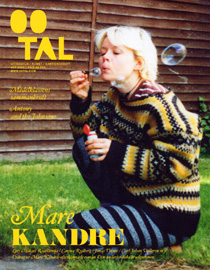
Mare Kandre published Bübins unge in 1987, at the age of 25. Previously, she had published two collections of prose-poetry. This was her first novel. But even here, the book was split up into short sections, almost resembling prose-poems, although there is now a plot to follow. I have divided these sections by an asterisk here, to save space. The photo is from roughly the same time as the novel was written, and was used as the cover of the Swedish literary magazine 00-tal, published in 2006. 00-tal had already published a Mare Kandre issue back in 1993, but this 2006 one was a memorial issue.

In her overview of Kandre's work, Helena Forsås-Scott describes the novel as follows:

"Here the first-person narrator is again a young girl. She is living with a woman and a man known as Bübin and Uncle, but these characters fade away as the central character’s physical growth and development begin to command all attention. As the central character begins to menstruate, the landscape becomes increasingly surreal, the grass standing to the height of tall reeds and the stalks of the nettles growing to the thickness of the trunks of young trees. In the midst of these threatening transformations, the central character now finds herself alone but for the Kid, who suddenly appears as the embodiment of the adolescent’s sense of split and alienation, small and innocent and cosseted by the adults as long as they have remained, the Kid becomes the butt of the confusion and anger raging in the older girl. The torture and killing of the Kid, presented as prerequisites for the adult phase of the central character’s life, convey the extent of the plight of the adolescent girl in this powerful text."


Bübin’s Offspring

Mare Kandre

Summer has arrived –
In the sun everything is kindled and hard.
The trees are billowing sweetness, flies; the earth is silent; the wind stirs the bushes, the dense berry patches, up out of the grass, forcing the junipers up against the wall.
The tall grass reaches up to my thighs.
I’m standing far down, as if in deep water, and pushing aside the trees, pushing aside the bushes.
Because every day you go deeper into the narrow tunnel.
The colours become ever more muted. Sounds are muffled by the yellow water.
It comes nearer. It’s not as if the world is getting smaller, no: you’re going inwards, downwards, into the belly of the great heat –
You can hear stones splitting deep in the earth.

*

It’s Uncle, Bübin and me!
It’s just us –
You can’t really say what it’s like. I walk back and forth in the tall grass under the trees, moving the dry stones around distractedly with my foot.
Bübin’s face is shiny and greasy with sweat. I’m thinking about Uncle. In my ear I can hear a dry white sound, as if something is unfolding inside my head –
I go inside, sit with Bübin, I think the same strange hard thoughts over and over again –
It’s here; it isn’t here –
The stones lie wet and upturned behind me in the grass where I have walked, the dark side upwards. You can see where I have been. The evenings are falling ever later –
Then I go up to my room and sit on the bed, exhausted by all the heat, and can hear Uncle moving about in the room next door, heavy and groaning, as if he is dragging a large dead body back and forth across the floor.

*

Before summer came the trees stood grey and separate, a long way into June, July, as if it daren’t go there, not yet in bloom and withered like me!
The stones sat deep in the frozen earth, impossible to budge, and everything was wide open on account of the dry, yellow light, forced up and yellowed.
I stood at the well in my black coat.
Bübin could see me from the kitchen window. The road down to the village was blown bare and cleansed. I walked, my body hunched with cold. A few berries, frozen black still clung to the bushes. The cold grew more intense. The stones cracked –
This was before we got a pump.
There was water in the well –
It was the fault of the water.
It was when Uncle grew worse and something happened to his eyes, as there was something that would not grow pure.
Yes, we prayed so hard and powerfully in the evening that the prayers left a deep cavity behind in our sleep, but nothing was clarified.
I became ill and lay in bed next to Bübin.
My head was burst open by sweat in her large hand, and I slept a hard, crazy and yet permeable sleep, right across the whole spring.
I could hear Bübin walking in and out of the room, morn and night, but it wouldn’t loosen its grip on me. She would feel my closed face, and I calmly slept the fever out of my body, until the frost had left the ground like a thin, yellow smoke, and I emerged out of closed darkness, thin and worn –
My skin had grown taut.
I knew nothing about the world, no: I sat on a stool in the garden, wrapped up in Bübin’s shawls, and would grow faint and dizzy from just nothing at all!
Everything around me was undeveloped and dead.
But the grass stiffened, blade by blade –
Soon sprang up out of the frozen earth.

*

In the middle of the day, when it was hardest to walk around in the hot air, I am unwillingly following Bübin down to the village to shop –
As soon as we have started to walk between the low, silent wooden houses it grows dark, raw from the damp and the smells.
Bübin is walking in front. I am forced to run after her breathlessly to keep up with her, as if I was afraid she would leave me, be lost.
The houses stand a long way down into the ground, huddled together in a little hollow, and nothing can be heard, we pass no one.
It’s the large, black timbers of the houses that make everything so quiet. The forest pushes in. The village is slowly sinking into the blackish grey ground, house by house, I am wading through dung and filth and the smells make me dizzy and woozy, I have to push hair in mouth and keep on chewing.
The houses are leaning –
I run after Bübin out onto the market place and exhale the sour air. There we stand. I immediately grow light, the dizziness leaves my body.
An old woman is selling fish from large barrels, a tree with a black, sparse crown is growing here, wild and fumbling, as if it wants to leave, straight upwards and at once Bübin places two fish in my empty basket.
We walk between the various stalls –
Everyone knows who Bübin is, she fills my basket with pale, bitter greens, no larger than unripe fruit or stones, as nothing can grow to become sweet and big in the soil around the village, it simply lies there silent and hardened in the meagre shade under roots and grass.
Then we go off to a house on the market place and Bübin enters.
I wait outside with the full basket. I have not yet seen Ildre and Dordi. I sit on my hunkers and draw flowers in the soil –
Further down, a door to one of the old-fashioned houses suddenly opens.
Two men are carrying out a small, light coffin between them. Three women come out. I squat there with my fingers in the soil, watching –
The black tree begins to bend right away: agitated, afraid. I get a dead, harsh taste in my mouth, and the houses stand there dogged and small around the square, the trees stand and sway, it smells, and I want Bübin to come back right away!
I can hear people sitting in the cramped houses, but can’t make out what they are saying. The men, the three women, all look down at the ground in shame –
I turn around and see Bübin coming out of the house, slowly, and with renewed vigour in her step.
A pale child’s face pops up in the overgrown window, but glides away again –
I snatch my basket and run after Bübin, up out of the village.

*
Translated from Swedish by Eric Dickens

Tuesday, 28 April 2009

Mare Kandre: "The Woman and Dr Dreuf" - two excerpts

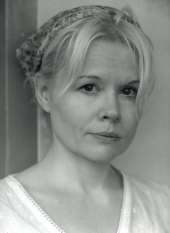
Mare Kandre (1962-2005) has been described on another thread on this blog. Here follows an excerpt from her novel Quinnan och Dr Dreuf (The Woman and Dr Dreuf; 1994) which has already appeared in French and Estonian translation.

Dreuf, an anagram of Freud, is a dwarfish psychoanalyst-misogynist whose dusty surgery is the stage for the duel between himself and one of his female patients.

The two excerpts are taken from the beginning of the novel where Dreuf still assumes that he will maintain the upper hand. It is still in my draft version, so nothing is set in stone. But the mere vocabulary, style and typographical shape of the page will already afford sufficient insights as to where this novel is going. The indents are not possible to reproduce here, but it can be seen that the lines are jagged, like poetry. The whole text is humorous, ironic, and there is an element of self irony on the part of the female side of this duel too, so that it is not a black-and-white agit-prop feminist text, but more of a gentle spoof of both protagonists, plus the shabby cleaner who goes by the name of Mrs Nahkurs, an Estonian word implying skin (and bones?) and tanning. The style and line-breaks continue throughout this 150-page novel.


There was an article a few days ago in the main Swedish daily Dagens Nyheter about Mare Kandre, announcing a recently produced television film by Johan von Sydow about her life and works.


THE WOMAN AND DR DREUF

The gentle mother-of-pearl light of evening fell in misty rays in through the barred windows of Dr Dreuf’s surgery,
(located on the exclusive Skoptophilia Street,
in the central part of the town of Trils).
It had been a long, tiring day,
filled, as usual, with consultations, analyses and bouts of hysteria,
(Yes, feelings, feelings, pure feelings and subjectivity)
and the good doctor,
the famous women’s analyst,
the renowned expert on women and all the perverted illusions, errant wanderings and slumbering lusts that vied for supremacy in her fragile body and brittle mind,
the man who had devoted his life to attempt to liberating woman from her unending mental inferiority,
a little dwarfish old codger wearing a huge pair of black-rimmed spectacles and a creased black suit,
now sat lost in thought at his enormous writing desk,
eyes closed,
carefully massaging his temples.
For Dr Dreuf,
the great man,
had a suspicion of a headache.
Which was perhaps not so surprising given all the emotional drivel he had had to hear for hours.
Maybe because he in every way loved his calling,
but sometimes,
when one pale woman, more neurotic than the previous one, stepped into the large dust-encrusted door and, lying on the couch would entrust him with her spiritual particulars, and there seemed no end to the caravan of those seeking help,
well, then things could become too much even for Dr Dreuf.
- Women, he now sighed, heavily, despairingly,
while he carefully ran the tips of his fingers over his brow and temples in a cack-handed attempt to soothe the pain,
as if it were mere sweat or dust.
- Women...
- Women...
- Women...
In times such as these he would ask himself whether he had not been foolhardy to embark upon this career of his.
Perhaps he should have stuck to entymology which had been his passion as a youth and to which he had devoted every spare moment,
catching exotic butterflies with a net,
pinning the living cabbage butterfly caterpillars with large, sharp pins,
killing stag beetles with ether,
the long-drawn-out agony which he used to eagerly observe through a magnifying glass...
But what’s done is done,
he had now started out along this road once and for all,
and what a rugged road it was!
A highly dangerous, almost unavoidable little path that wound its way right into the most impenetrable jungles that no enlightenment reached of its own accord;
the female psyche!
Yes, in truth, once inside you had to literally chop your way forward,
expecting the worst,
not lose your cool for one single moment or turn your back to or let yourself be seduced by the lovely voice of the analysand,
because, like a huldra she could inveigle you to into entering marches out of which you would never
by yourself,
find your way out.
No, this was nothing for the weak-willed!
The general public really should know what these fragile little twittering beings were in actual fact capable of by way of desires, urges and dark, suppressed passions.
And Dr Dreuf shuddered a deep and very long shudder at the all the things he had found, during his analysis sessions, inside the most attractive big sisters, mothers, maidens, girlfriends and seemingly quite harmless aunts -
The room in which he sat and shuddered as he massaged his aching temples was in fact,
despite his greatness as a scientist,
rather small and modest.
Through one of the barred windows, a dead, completely blackened fruit tree could be made out, and on the outer tip of one of the branches dangled a pathetic little blackened apple,
(It had hung there since time immemorial,
untouched and wizened).
In the next window,
the middle one,
stood a black, one-eared cat gazing out onto the street.
At first sight, you could think that the creature was alive, but in actual fact it was an old pet that had been stuffed, and which Dreuf had not had the heart to bury in the ground.
Shelves covered the walls,
from floor to ceiling.
These shelves were filed with a huge number of fat books,
all the works of Dreuf’s great mentor,
(may he rest in peace!)
Professor Popokoff.
An exposé of the true nature of woman!
A scientific study without parallel in the world of science -
Everything that had been said, was said, and could be said about the elusive nature of the essence of woman could be read in these volumes.
And on each occasion that he could not cope with a phenomenon,
(And this did not happen often)
he would consult the work of Professor Popokoff,
it had been invaluable to him in the practice of his profession over the years,
indeed, he did not really know how he would have coped without it.
Further to these objects, there was a large collection of glass jars in which wombs and ovaries, drenched in spirits, plus the odd female breast were preserved,
even an aborted fœtus of a girl was floating,
curled up defencelessly,
in such a jar of yellowed glass.
And everything in Dreuf’s stuffy little room was covered in dust;
every little object,
even the doctor himself,
(his abundant white hair and his ill-fitting black jacket)
were covered in a thick layer of greying dust.
Because he had strictly forbidden Mrs Nahkurs
(his cleaner)
to even so much as set foot in there with her chlorine-soaked cloth, her feather duster and all the other appurtenances of cleaning.
And like an optical illusion
(And this was really odd,
not one of his visitors every managed to understand the phenomenon)
the wall, windows and door, plus the writing desk, seemed to be slightly lopsided,
everything was leaning,
and whoever entered the room would grow dizzy and almost lose their balance
(Dreuf himself had, over the years, got used to it all and therefore moved with alacrity in there,
it was not until he emerged into the real world, onto streets and squares, that swaying and rocking would ensue for his part).
Apart from the enormous writing desk, behind which Dreuf now sat securely entrenched there was also,
by way of furniture,
the red plush couch, obligatory for every psychoanalyst,
a worn leather armchair,
a small round mahogany table,
and a little sideboard.


[...]

He put the book back on the shelf,
returned to his desk,
climbed up onto his chair,
a little irritated that he had not become any the wiser about this case –
– Yes, do go on.
He gripped his pen resolutely.
– What sort of feelings do you link with that time,
describe what you see,
down to the last detail!
The woman stared blankly in front of her..
It was obvious that she was now entering a state of changed consciousness,
and yet, a moment later she cried out,
in despair –
– No, it’s all gone black, doctor,
I don’t know,
I can’t do it!
And the cloud that was moments before about to form a scene in her mind’s eye evaporated all of a sudden and she covered her face with her hands and sobbed.
Dreuf’s eyes took on a contemptuous, tormented expression.
Not again!
A bout of hysteria must be avoided at all costs.
Calmly and objectively he therefore uttered –
– Calm yourself, calm yourself, my dear young lady,
start all over again, at your own speed,
and remember you are dealing here with an expert,
remember that all my professional life I have been studying the inner essence of woman and have read countless works about what she can and wants,
I know full well that you are all deeply ashamed that you have not been equipped with a male –
At this point he fell abruptly silent, right in mid-sentence and a dark flush spread across his face right up to both ears.
He searched within him for the most polite and considerate expression,
a word that would not awaken sexual urges within her.
Presently, he whispered rapidly, in a barely audible, very quiet voice –
– organs...
And then continued exactly as before –
– and that now, therefore, quite naturally,
feel lost, inferior, deprived, and so on,
but believe you me,
there are no grounds for this fear,
with me you can feel completely safe!
The woman was again lying with her arms at her side.
She was staring blankly ahead of her.
It was hard to tell whether the words had reached her at all.
– There we are, do go on now, where were we,
ah yes, in Paradise,
and are you all alone there,
describe everything you see and feel within you!

***

Translated from Swedish by Eric Dickens

Sunday, 29 March 2009

Lyrikvännen - Tema: Estland


In 2007, the Swedish poetry magazine Lyrikvännen published an issue devoted to Estonian writing. This issue contains poems by a large number of contemporary and older Estonian authors translated into Swedish. It was produced in conjunction with the Göteborg Book Fair Guest of Honour that year: Estonia.

Poets represented include: Betti Alver, Hella Wuolijoki, Jaan Kaplinski, Doris Kareva, Elo Viiding, Hasso Krull, Jürgen Rooste, Asko Künnap, Kalju Kruusa, fs, Kristiina Ehin, Ilmar Laaban, Aare Pilv, Karl Martin Sinijärv, Andres Ehin, Ly Seppel-Ehin, plus other non-theme-issue poetry and articles. One author whose poetry is published here sits on the cusp between Estonia and Sweden: Mare Kandre. Although she was born and bred in Sweden (and lived in Canada as a small child) she is a Swedish author. But her mother is Estonian. Another important author and translator is the Swede of Latvian parentage, Juris Kronbergs, who has almost single-handedly been responsible for introducing Latvian poetry and prose to Sweden over the past 30 years, and is a poet in his own right.

Two Estonian-born translators who have lived for decades in Sweden were responsible for the bulk of the translations: Enel Melberg and Peeter Puide. And Ilmar Laaban, an Estonian exile, translated his own poem included here, years ago. Kalli Klement and Jaan Seim dealt with poetry by some of the Ehin family, represented here by mother, father and daughter.

Tuesday, 10 March 2009

Mare Kandre - "Quinnan och Dr Dreuf"


I will be submitting, on a separate thread at a later stage, a small portion of my draft translation of the novel "Quinnan och Dr Dreuf" by the late Mare Kandre (1962-2005), who was one of the first authors to produce what has since been termed "Swedish Gothic" beginning in the early 1980s. Later on still, when I have gone through that part of the text again, I will again submit the same piece. It will be interesting to then compare additions, omissions and changes, between the two versions. Comments will be welcome.

This tongue-in-cheek novel merits a short "the story so far" description, but you can find a lot of background information on Mare Kandre herself [pronounced MARR-eh KANN-dreh, with short vowels, despite what you hear] in the 2008:2 issue of the Swedish Book Review, where I translated an excerpt of one of her other novels Aliide, Aliide.

Quinnan och Dr Dreuf, is a spoof on Sigmund Freud and his teachings, and is a duel similar to that in Fröken Julie by Strindberg, except in that it is the woman who ultimately gets the upper hand. It is perhaps Mare Kandre's best received novel, and has been translated into French and Estonian.

The somewhat dwarfish Dr Dreuf lives in a house with a dusty surgery full of glass jars containing pickled female foetuses, breasts and wombs, and is visited one day by the Woman (I could not find a satisfactory way of reproducing the old spelling of "quinnan" in English; instead, I capitalised the word "Woman".) The whole novel consists of Dr Dreuf trying to tease the visions that the Woman sees in her head out of her, and interpret them using the theory of Professor Popokoff, one of the mentors of Dreuf.

There are four reviews of this novel at:

http://www.marekandre.se/Recensioner.htm

This is one webpage on the official Mare Kandre website. More insights into the novel can be found at:

http://www.marekandre.se/Swedish%20Womens%20Writing%20p3.htm

This is the appropriate part of a review of Mare Kandre's work, by Helena Forsås-Scott.