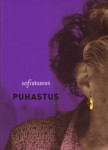
As you will have read in David's posting "Putin-Jugend in Helsinki", about the Finnish seminar marking the 60th anniversary of the Estonian Deportations of 1949, one author invited will be the prize-winning author
Sofi Oksanen. The seminar will take place in Helsinki on 23rd March 2009.
Ms Oksanen has a rather unusual background for a Finnish author, in that she is half-Estonian, and writes about that country. Previous Finnish authors with an Estonian connection include Aino Kallas and Hella Wuolijoki. Oksanen (born 1977) is of a much younger generation. Nevertheless, she can still communicate with older Estonians who remember, for instance, the 1949 deportations, when several thousand Estonians were dubbed "kulaks", then promptly sent to Siberia in cattle trucks.
In December 2008, Sofi Oksanen won the prestigious Finlandia Prize for her latest novel
Purge, one dealing with two older women who suffered the Soviet occupation and its aftermath.
BIBLIOGRAPHY [The three links here are, unfortunately, only in Finnish]
Stalinin lehmät, [Stalin's Cows] 2003
Baby Jane, [idem] 2005
Puhdistus, [Purge / Cleansing / Pogrom] 2008
Her first novel
Stalin's Cows had, as part of the blurb: "Why are all Estonian women whores?", which was guaranteed to be eye-catching, as Estonia is Finland's next-door neighbour. In this novel, Oksanen interweaves a story of bulimia with one of Brezhnev's bureaucratic oppression of the Baltic countries. The bulimia is, evidently, autobiographical, but given the fact that her mother was born in Estonia, she is not ignorant of the history of that country, either. The novel deals with the shame and stigma involved in the lives of Baltic women who fled to Finland during Soviet times. As Estonia was little discussed in Finland for decades, this book came as a sensation and is evidently a page-turner. It exists only in Swedish translation.
I cannot find much on the internet about her second novel. It is evidently set in urban Helsinki and involves panic attacks.
But her third,
Purge is being translated into English by the American translator Lola Rogers, and will appear in the United States. This deals with the complex and paradoxical lives of old Estonian women, about sexual exploitation and prostitution of younger ones who are lured abroad, to Finland or Germany, by the chance of earning lots of money.The guilt of those who stayed behind when others were deported to Siberia from Estonia, and what happened to those who returned is interwoven. While Jaan Kross described the occupation of Estonia from a male point of view, Oksanen has talked with older female Estonian relations and built up her works on what she has heard.The novel was preceded by a play on the same theme that was staged at the Finnish National Theatre. This play exists in an English manuscript version, but has not yet been published.
Both the Finnish and Estonian press make a lot of Oksanen's status as angry young woman regarding women's issues and the distortion of Soviet history as related to Finland and Estonia. She also doubles up as an actress, and can be seen in photographs in Gothic garb. But she does know her onions. Under the Gothic exterior lurks a knowledgeable person. See her
photogallery, several webpages long.
Last year, Sofi Oksanen travelled around Estonia with the Helsinki newspaper
Helsingin Sanomat and visited a number of manor houses in various states of repair. This reportage can be seen
here.
The pictures are in a column to the right of your screen, with the map filling the main part, "Viro" being the Finnish name for Estonia. The photos can be enlarged by clicking on them. The words "Seuraavat 15 kuvaa" at the bottom indicate the link to the next 15 photos.