With the help of the reading groups and subscribers, the company plans to publish 4 or 5 new titles in 2012, including books by Argentinian heavyweight Carlos Gamerro, Russian author Oleg Zaionchkovsky and Swiss writer Christoph Simon. The company now has over 200 subscribers and aims to reach 300 by the end of the year. Reading groups are also thriving, with Swedish and Arabic groups planned for 2012.
Showing posts with label Sweden. translation. Show all posts
Showing posts with label Sweden. translation. Show all posts
Friday, 3 February 2012
And Other Stories
Catharine Mansfield, interviewing Stefan Tobler in Booktrust, writes:

Friday, 4 June 2010
Mankell may bar Hebrew translations of his books
Via Ynetnews:
Swedish crime writer Henning Mankell may prohibit the translation of his popular books into Hebrew after the Israeli attack on a Gaza-bound aid flotilla, he said in an interview published on Thursday.To me there's something wrong about this,but I can't put my finger to it...
"I am a best-selling author in Israel and I must consider seriously whether I should block my books from being translated to Hebrew," the author of the popular Wallander series of detective novels told daily Dagens Nyheter
Tuesday, 15 December 2009
Cold comfort
Swedish crime fiction is very popular in Germany, but it's not so often that German crime fiction is translated into Swedish. Reviewing the third of three recent translations of detective novels by Andrea Maria Schenkel – the three books constitute Schenkel's entire output so far – Bodil Zalesky notes a disturbing trend:
The voices of the main characters are almost completely interchangeable and shorn of identity, which gives me as a reader a sense of discomfort. Perhaps this is the author's intention, and it contributes to the cold undercurrent that persists throughout the book.
Sunday, 19 July 2009
Funds of knowledge
Brave New Words has a post about a new Swedish Encyclopedia of Translators. From the description, it sounds more like a database than an encyclopedia, but if databases are your thing...
Friday, 12 June 2009
Latvia via Swedish
Latvia is not part of this blog, but via the Swedish language you can get more than a sampler of a literature that always tends to fall between two stools: the Estonians go with the Finns, the Lithuanians with the Poles. Latvia remains piggy in the middle.
The Swedish translator Juris Kronbergs has been translating Latvian poetry into Swedish for decades. So anyone wanting to gain insights into what Latvian authors publish could do no worse than look at Kronbergs' translations of poets Vizma Belševica, Imants Ziedonis and Knuts Skujenieks, to name three leading names.
The first of these was the grand old lady of Latvian poetry; two of her sons became poets too. The second wrote a series of prose-poems, his Epiphanies. The third wrote poetry describing his years in the GULag as a result of being sent to Siberia for possessing a copy of the Encyclopedia Britannica (!).
Saturday, 6 June 2009
Bodil Zalesky's literary blog
Bodil Zalesky, one of the founder members of the Salongen literary blog, also has her own literary blog. The latest entry discusses Mikael Enckell's recent book about the German poet Hölderlin.
Zalesky's weblog contains more art and large photographs than Salongen, but there are also Swedish translations of poetry by Paul Celan, Georg Trakl, Elfriede Gerstl, Franz Werfel, Else Lasker-Schüler (there's a lot about her) and other German-language poets. Also reviews of German-language literature and Italian poetry by Ungaretti, Pasolini, etc., and poetry by the Estonian Doris Kareva, translated into Swedish by Peeter Puide. There's even a discussion of an essay by Mikael Enckell about the Jewish dimension of the work of George Eliot (i.e. in Daniel Deronda). Other authors and topics discussed include Simone Weil, Pia Tafdrup, Cesare Pavese, Yiddish poetry, Nina Cassian, Italo Svevo, Erik Blomberg, Janina Degutyte, Viivi Luik, Knuts Skujenieks, Romanian literature, George Steiner, Daniel Hjorth, etc.
Salongen interviews translator Jan Henrik Swahn
Salongen, as already introduced, is a Swedish blogsite that occasionally interviews translators. It has already interviewed Jyrki Kiiskinen (Swedish-Finnish), Margareta Zetterström, Kristina Rotkirch, Janina Orlov, Katarina Warfinge, Lev Hrytsyuk (Swedish-Ukrainian) and Hans Blomqvist.
This time it's the turn of the Swedish author Jan Henrik Swahn who spent the first decade of his life living in Denmark and later even translated his own work into Danish. But Swahn has moved on and now translates into Swedish from an impressive number of languages: English, Greek, Polish, Slovene and Arabic. This suggests that if you are brought up with two languages, you curiosity can reach out to more. Swahn himself says:
"Danska och svenska har jag från barndomen. Kan man då säga att jag valde dem? Denna tidiga dubbla språkerfarenhet har gett upphov till ett tomrum (eller längtan) i mig som jag försökt fylla med andra språk. Jag har sedan länge insett att inte ens all världens språk skulle kunna fylla det tomrummet men det är så dags nu, jag kan inte sluta."
Tuesday, 26 May 2009
Salongen interviews translator Jyrki Kiiskinen
The Swedish literary blog Salongen is run by Bodil Zalesky and Jelena Selin from Berlin. They have written articles on a large number of authors, both Scandinavian and other.
Recently, they interviewed the Helsinki author, journalist and poetry translator Jyrki Kiiskinen, who translates into Finnish. He has previously been editor of the literary magazines Nuori Voima and Books From Finland. Here are a few excerpts from the interview:
Question: Which language(s) do you translate from (and to)? How did you pick these specifically?
I only translate into Finnish, but from Swedish, English, French and Spanish. And I have joined various projects and translators' groups as a poet without knowing the original language involved. I have worked with someone who knew the language. In this way I have also translated from Latvian and Lithuanian.
Question: How do you receive your assignments? Do publishers contact you or what is the procedure?
Normally speaking, publishers are not too thrilled with my projects, they don't really want to publish poetry at all, so I only translate texts I really want to. And I also translate for the sake of my own poetry, I want to expand my own poetic style and learn new techniques. So I translate texts that are lacking within me. And once I've started working on a text, I fight to get it published somewhere.
Question: Is it important to be able to ask the author whose work you are translating questions?
Of course, as it is a natural way of diving into the universe of someone else and get to know the work you are working on. Discussions with the author can becoome very exciting. Asking questions of an author can be a good excuse to come into contact with another human being who has interesting things to say and knows what he is talking about. You can often obtain information more quickly than by consulting encyclopædias back home. And the latter activity is more boring.
Question: Which experiences and qualities is it important for a literary translator to have?
If we are talking about translating poetry, you have to be completely obsessed with language, look for pleasure as with a sweet in your mouth. But you must always return to the original text, once you start enjoying your own language. You should also have a passion about the differences between various languages and be interested in the boundaries between them, i.e. pursue various ways of structuring and viewing the world in these languages, the world which always stands beyond, in silence. You must also be systematic, methodical and yet be prepared to conduct wild experiments at the same time. And then return to the original text. So you have to be faithful and unfaithful, pedantic and wild, search for a precise meaning and be prepared to describe it on the terms of your own language.
Translated from Swedish by Eric Dickens
The rest of the interview can be read in Swedish, here. Kiiskinen has translated, for instance, Octavio Paz, Peter Mickwitz and Göran Sonnevi. Salongen has previously interviewed literary translators Margareta Zetterström, Kristina Rotkirch, Janina Orlov, Katarina Warfinge, Lev Hrytsyuk and Hans Blomqvist. All these interviews can be found on the Salongen website.
Friday, 15 May 2009
Monsters of omission
A film and a play were reviewed on the Newsnight Review (regular arts programme on BBC2 on Fridays at 23:00) this week. The film looked to be a sensitive portrait of child abuse and children's homes, with a good child actor, Molly Windsor. The film director Samantha Morton, herself a victim of abuse and care homes, was interviewed for several minutes. All the names were there.
But when it came to the play Monsters, the Brits turned narcissistic. It was a safely British story, so suitable for viewing by monoglots. The subject was the James Bulger murder. This play has already been tackled on this blog by Harry here but it is tonight's reception I want to focus on.
Presenter Kirsty Wark may have briefly mentioned the name of the playwright Niklas Rådström at the start of the programme, but during the whole item and discussion of the Rådström play, the author was quietly left unmentioned, except by the valiant Kate Mosse, the Orange lady, who mumbled Rådström's surname at one point, saying he was revered or similar in his native Sweden. But no interview with this foreigner or his translator.
The programme went on to mention a book by Anne Michaels, whose name was dropped several times. And once they'd got onto Dan Brown, they were chattering away as if Niklas Rådström had never existed.
I reckon they were scared of having to pronounce a name with an "å" and an "ö". Too much for the average British brain, although most Brits can manage "nickel arse road strum".
And the translator of this play? Not a mention. The Guardian usually links up with the Newsnight Review. So things appearing in the Guardian Review, also appear in the Newsnight Review. I hope the Guardian is feeling European this month and we get the names of more foreigners who can write splashed across the pages of the Guardian Review. Such discoveries will inevitably seep through to the Newsnight Review.
Tuesday, 28 April 2009
Mare Kandre: "The Woman and Dr Dreuf" - two excerpts
Mare Kandre (1962-2005) has been described on another thread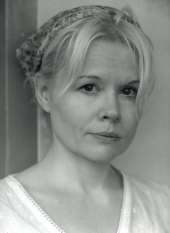 on this blog. Here follows an excerpt from her novel Quinnan och Dr Dreuf (The Woman and Dr Dreuf; 1994) which has already appeared in French and Estonian translation.
Dreuf, an anagram of Freud, is a dwarfish psychoanalyst-misogynist whose dusty surgery is the stage for the duel between himself and one of his female patients.
The two excerpts are taken from the beginning of the novel where Dreuf still assumes that he will maintain the upper hand. It is still in my draft version, so nothing is set in stone. But the mere vocabulary, style and typographical shape of the page will already afford sufficient insights as to where this novel is going. The indents are not possible to reproduce here, but it can be seen that the lines are jagged, like poetry. The whole text is humorous, ironic, and there is an element of self irony on the part of the female side of this duel too, so that it is not a black-and-white agit-prop feminist text, but more of a gentle spoof of both protagonists, plus the shabby cleaner who goes by the name of Mrs Nahkurs, an Estonian word implying skin (and bones?) and tanning. The style and line-breaks continue throughout this 150-page novel.
There was an article a few days ago in the main Swedish daily Dagens Nyheter about Mare Kandre, announcing a recently produced television film by Johan von Sydow about her life and works.
THE WOMAN AND DR DREUF
Translated from Swedish by Eric Dickens
on this blog. Here follows an excerpt from her novel Quinnan och Dr Dreuf (The Woman and Dr Dreuf; 1994) which has already appeared in French and Estonian translation.Dreuf, an anagram of Freud, is a dwarfish psychoanalyst-misogynist whose dusty surgery is the stage for the duel between himself and one of his female patients.
The two excerpts are taken from the beginning of the novel where Dreuf still assumes that he will maintain the upper hand. It is still in my draft version, so nothing is set in stone. But the mere vocabulary, style and typographical shape of the page will already afford sufficient insights as to where this novel is going. The indents are not possible to reproduce here, but it can be seen that the lines are jagged, like poetry. The whole text is humorous, ironic, and there is an element of self irony on the part of the female side of this duel too, so that it is not a black-and-white agit-prop feminist text, but more of a gentle spoof of both protagonists, plus the shabby cleaner who goes by the name of Mrs Nahkurs, an Estonian word implying skin (and bones?) and tanning. The style and line-breaks continue throughout this 150-page novel.
There was an article a few days ago in the main Swedish daily Dagens Nyheter about Mare Kandre, announcing a recently produced television film by Johan von Sydow about her life and works.
THE WOMAN AND DR DREUF
***
The gentle mother-of-pearl light of evening fell in misty rays in through the barred windows of Dr Dreuf’s surgery,
 (located on the exclusive Skoptophilia Street,
 in the central part of the town of Trils).
 It had been a long, tiring day,
 filled, as usual, with consultations, analyses and bouts of hysteria,
 (Yes, feelings, feelings, pure feelings and subjectivity)
 and the good doctor,
 the famous women’s analyst,
 the renowned expert on women and all the perverted illusions, errant wanderings and slumbering lusts that vied for supremacy in her fragile body and brittle mind,
 the man who had devoted his life to attempt to liberating woman from her unending mental inferiority,
 a little dwarfish old codger wearing a huge pair of black-rimmed spectacles and a creased black suit,
 now sat lost in thought at his enormous writing desk,
 eyes closed,
 carefully massaging his temples.
 For Dr Dreuf,
 the great man,
 had a suspicion of a headache.
 Which was perhaps not so surprising given all the emotional drivel he had had to hear for hours.
 Maybe because he in every way loved his calling,
 but sometimes,
 when one pale woman, more neurotic than the previous one, stepped into the large dust-encrusted door and, lying on the couch would entrust him with her spiritual particulars, and there seemed no end to the caravan of those seeking help,
 well, then things could become too much even for Dr Dreuf.
 - Women, he now sighed, heavily, despairingly,
 while he carefully ran the tips of his fingers over his brow and temples in a cack-handed attempt to soothe the pain,
 as if it were mere sweat or dust.
 - Women...
 - Women...
 - Women...
 In times such as these he would ask himself whether he had not been foolhardy to embark upon this career of his.
 Perhaps he should have stuck to entymology which had been his passion as a youth and to which he had devoted every spare moment,
 catching exotic butterflies with a net,
 pinning the living cabbage butterfly caterpillars with large, sharp pins,
 killing stag beetles with ether,
 the long-drawn-out agony which he used to eagerly observe through a magnifying glass...
 But what’s done is done,
he had now started out along this road once and for all,
 and what a rugged road it was!
 A highly dangerous, almost unavoidable little path that wound its way right into the most impenetrable jungles that no enlightenment reached of its own accord;
 the female psyche!
 Yes, in truth, once inside you had to literally chop your way forward,
 expecting the worst,
 not lose your cool for one single moment or turn your back to or let yourself be seduced by the lovely voice of the analysand,
 because, like a huldra she could inveigle you to into entering marches out of which you would never
 by yourself,
 find your way out.
 No, this was nothing for the weak-willed!
 The general public really should know what these fragile little twittering beings were in actual fact capable of by way of desires, urges and dark, suppressed passions.
 And Dr Dreuf shuddered a deep and very long shudder at the all the things he had found, during his analysis sessions, inside the most attractive big sisters, mothers, maidens, girlfriends and seemingly quite harmless aunts -
 The room in which he sat and shuddered as he massaged his aching temples was in fact,
 despite his greatness as a scientist,
 rather small and modest.
 Through one of the barred windows, a dead, completely blackened fruit tree could be made out, and on the outer tip of one of the branches dangled a pathetic little blackened apple,
 (It had hung there since time immemorial,
 untouched and wizened).
 In the next window,
 the middle one,
 stood a black, one-eared cat gazing out onto the street.
 At first sight, you could think that the creature was alive, but in actual fact it was an old pet that had been stuffed, and which Dreuf had not had the heart to bury in the ground.
 Shelves covered the walls,
 from floor to ceiling.
 These shelves were filed with a huge number of fat books,
 all the works of Dreuf’s great mentor,
 (may he rest in peace!)
 Professor Popokoff.
 An exposé of the true nature of woman!
 A scientific study without parallel in the world of science -
 Everything that had been said, was said, and could be said about the elusive nature of the essence of woman could be read in these volumes.
 And on each occasion that he could not cope with a phenomenon,
 (And this did not happen often)
 he would consult the work of Professor Popokoff,
 it had been invaluable to him in the practice of his profession over the years,
 indeed, he did not really know how he would have coped without it.
 Further to these objects, there was a large collection of glass jars in which wombs and ovaries, drenched in spirits, plus the odd female breast were preserved,
 even an aborted fœtus of a girl was floating,
 curled up defencelessly,
 in such a jar of yellowed glass.
 And everything in Dreuf’s stuffy little room was covered in dust;
 every little object,
 even the doctor himself,
 (his abundant white hair and his ill-fitting black jacket)
 were covered in a thick layer of greying dust.
 Because he had strictly forbidden Mrs Nahkurs
 (his cleaner)
 to even so much as set foot in there with her chlorine-soaked cloth, her feather duster and all the other appurtenances of cleaning.
 And like an optical illusion
 (And this was really odd,
 not one of his visitors every managed to understand the phenomenon)
 the wall, windows and door, plus the writing desk, seemed to be slightly lopsided,
 everything was leaning,
 and whoever entered the room would grow dizzy and almost lose their balance
 (Dreuf himself had, over the years, got used to it all and therefore moved with alacrity in there,
 it was not until he emerged into the real world, onto streets and squares, that swaying and rocking would ensue for his part).
 Apart from the enormous writing desk, behind which Dreuf now sat securely entrenched there was also,
 by way of furniture,
 the red plush couch, obligatory for every psychoanalyst,
 a worn leather armchair,
 a small round mahogany table,
 and a little sideboard.


[...]

He put the book back on the shelf,
 returned to his desk,
 climbed up onto his chair,
 a little irritated that he had not become any the wiser about this case –
 – Yes, do go on.
 He gripped his pen resolutely.
 – What sort of feelings do you link with that time,
 describe what you see,
 down to the last detail!
 The woman stared blankly in front of her..
 It was obvious that she was now entering a state of changed consciousness,
 and yet, a moment later she cried out,
 in despair –
 – No, it’s all gone black, doctor,
 I don’t know,
 I can’t do it!
 And the cloud that was moments before about to form a scene in her mind’s eye evaporated all of a sudden and she covered her face with her hands and sobbed.
 Dreuf’s eyes took on a contemptuous, tormented expression.
 Not again!
 A bout of hysteria must be avoided at all costs.
 Calmly and objectively he therefore uttered –
 – Calm yourself, calm yourself, my dear young lady,
 start all over again, at your own speed,
 and remember you are dealing here with an expert,
 remember that all my professional life I have been studying the inner essence of woman and have read countless works about what she can and wants,
 I know full well that you are all deeply ashamed that you have not been equipped with a male –
 At this point he fell abruptly silent, right in mid-sentence and a dark flush spread across his face right up to both ears.
 He searched within him for the most polite and considerate expression,
 a word that would not awaken sexual urges within her.
 Presently, he whispered rapidly, in a barely audible, very quiet voice –
 – organs...
 And then continued exactly as before –
 – and that now, therefore, quite naturally,
 feel lost, inferior, deprived, and so on,
 but believe you me,
 there are no grounds for this fear,
 with me you can feel completely safe!
 The woman was again lying with her arms at her side.
 She was staring blankly ahead of her.
 It was hard to tell whether the words had reached her at all.
 – There we are, do go on now, where were we,
 ah yes, in Paradise,
 and are you all alone there,
  describe everything you see and feel within you!
Translated from Swedish by Eric Dickens
Sunday, 26 April 2009
Swedish Book Review 2009:1
The first issue of the Swedish Book Review for 2009 contains a variety of articles and came out just in time for the London Book Fair.
The first extract follows comments about translating Jonas Hassen Khemiri into English by translator Rachel Willson-Broyles. Some of the difficulties encountered involve his idiosyncratic use of compounds, some of which are neologisms.
David Lagercrantz has written a novel Syndafall i Wilmslow / Fall from Grace in Wilmslow about the Enigma code-breaking machine. Extract introduced and translated by Marlaine Delargy.
Tyst hav / Silent Seas is a book about overfishing, written by Swedish Green Party activist Isabella Lövin. Extract translated by Peter Linton.
Other extracts are from books by Fredrik Sjöberg, Maria Ernestam, Elin Wägner, plus an overview article, first published on the Eurozine, about recent Swedish books by DN editor Jonas Thente, intriguingly entitled Beyond Crime Fiction, Handbags and Designer Suits.
The Bookshelf section contains 15 short reviews of works by for instance Carina Burman, Theodor Kallifatides, Bo Carpelan, Per Wästberg and Robert Åsbacka.
Sunday, 5 April 2009
The Nordic Presence

It turns out that this year once again, as in previous years, the "Nordic presence" at the London Book Fair is to be marked by a reception at - guess where? (As far as I'm aware, all SELTA members receive one of these invitations to an event which is additional to the one held
See also in this blog: Cornering the Market
Sunday, 29 March 2009
Lyrikvännen - Tema: Estland
In 2007, the Swedish poetry magazine Lyrikvännen published an issue devoted to Estonian writing. This issue contains poems by a large number of contemporary and older Estonian authors translated into Swedish. It was produced in conjunction with the Göteborg Book Fair Guest of Honour that year: Estonia.
Poets represented include: Betti Alver, Hella Wuolijoki, Jaan Kaplinski, Doris Kareva, Elo Viiding, Hasso Krull, Jürgen Rooste, Asko Künnap, Kalju Kruusa, fs, Kristiina Ehin, Ilmar Laaban, Aare Pilv, Karl Martin Sinijärv, Andres Ehin, Ly Seppel-Ehin, plus other non-theme-issue poetry and articles. One author whose poetry is published here sits on the cusp between Estonia and Sweden: Mare Kandre. Although she was born and bred in Sweden (and lived in Canada as a small child) she is a Swedish author. But her mother is Estonian. Another important author and translator is the Swede of Latvian parentage, Juris Kronbergs, who has almost single-handedly been responsible for introducing Latvian poetry and prose to Sweden over the past 30 years, and is a poet in his own right.
Two Estonian-born translators who have lived for decades in Sweden were responsible for the bulk of the translations: Enel Melberg and Peeter Puide. And Ilmar Laaban, an Estonian exile, translated his own poem included here, years ago. Kalli Klement and Jaan Seim dealt with poetry by some of the Ehin family, represented here by mother, father and daughter.
Friday, 27 March 2009
Inger Edelfeldt - "For Marie-Claire"

Inger Edelfeldt is many-sided in her creative endeavours. She not only writes novels and short-stories for adults and young people, but also illustrates her own books, designs the covers, and has produced books of comic strips. She began writing in the 1980s with longer prose until, in 1984, came a book of short-stories I fiskens mage. From then onwards her reputation grew and she has now published around a dozen novels and story collections.
Her heroines and heroes are often outsiders, who do not quite fit in. Some are fay, some a little nervous, some childlike, some wilful. Small girls feature, as do pubescent ones.
Inger Edelfeldt has been translated in at least two issues of Swedish Book Review, 2004:2 and 2008:1. In the former issue, she is introduced to English readers perhaps for the first time by Sarah Death, who also translated an excerpt from her then latest novel Skuggorna i spegeln (The Shadows in the Mirror). In 2008, Sarah Death again translated some of Edelfeldt's work where the author herself on the illustrations to her own fairy-tale.
In 2003, one of Edelfeldt's stories Zilver appeared in Dutch translation, published in Groningen, Netherlands. In 2006, a selection of 13 of Inger Edelfeldt's stories (including the one below) was published in the same Wilde Aardbeien series that has recently featured collections of contemporary Icelandic and Faroese poetry.
*
Below is my own translation, dating back originally to 1995, of Inger Edelfeldt's story For Marie-Claire, from the collection "Rit", a translation which has never been published before. To avoid spoiling this tragi-comic story, I shall leave the readers to find out for themselves what is going on. The "sentimental song" referred to was sung by Peter Sarstedt, hence the title.
FOR MARIE-CLAIRE
by Inger Edelfeldt
I left the cake till last, as I had seen that there was a cake shop not far from the flat. I stumbled in with all my carrier bags. I was nervous, even though I had decided not to be. My left eyelid kept quivering, it had been doing so all day. I had seen my reflection in several shop windows, several mirrors: unshaven, pale and staring manically. Me who had thought that I would sail high on the waves of defiance, that grand defiance you can feel at times; a pride which is a protest against all pride. I had already felt it while planning all this. I had been acting the silly coward all day; each time I went in somewhere to buy something I needed, I had taken a deep breath, as if about to dive. But shop assistants are a blasé breed, or perhaps simply diplomatic. Everything had gone smoothly, no need to justify myself. Just friendliness or indifference on their part, while my eyelid was stubbornly, but invisibly I hoped, signalling danger. "You can wrap them all up" was what I said, and so they did. And inside my head there was a voice which kept on saying: It's a free country, it's a free country. Me, who can usually put on such an act. That's what they're always telling me: "You're so damned funny. You could be just about anything you wanted".
It was, in fact, easier when I used to steal the stuff. Easier than buying it. I stole quite a lot from Anneli when we were together. She always told me she was so careless, kept losing things. But she liked to go out and buy new ones. That's what I wanted this time, too. That everything would be newly bought. Clean and bright.
The first thing I saw when I entered the cake shop was a huge wedding cake. I stared at it while I was waiting for someone to serve me. Right on top, there was a little bridal couple made of plastic, standing perfectly straight as if suffering from vertigo. Him in black, her in white. Immediately, a film sequence ran through my head: the bridal couple, life-size now, but still made of plastic, striding across the threshold of their home, turning their expressionless plastic faces towards one another, peeling off their clothes with jerky movements and grabbing at one another: click, scrape, moan, like two tortoises mating.
"It's made of plaster of Paris" said the girl behind the counter, all of a sudden. "But we do real ones to order".
She was a sweet girl and her voice was sort of ironically mature for her years as it is in people who understand more than they are letting on. I liked her immediately. I began to mutter something about how convenient it was that there was such a good cake shop just round the corner from the flat I had just moved into. She flirted with me and that gave me a kick. I kept on babbling. My eyelid was quivering incessantly, but she didn't appear to believe she was standing in front of a lunatic. I bought a cream cake and then I stayed on and drank a cup of coffee, even though I didn't really have time to. There were hardly any customers and we had a little chat. She had also worked in a hospital. Though what did that matter. Sometimes nothing matters apart from Marie-Claire. What you are working with, what's happening out there in the world, whether there's any food in the fridge. All the bloody same. But now, it seemed as if I were afraid, afraid to go up to the flat and carry out my plan. So I sat on. I was in a cold sweat. The girl was sweet, as I mentioned, and seemed level-headed enough, but after a while the only thing I saw was the colour of her lipstick. And it was getting very late. They were coming at seven, and I knew how long preparations would take.
*
Mine is a one-room flat; first a long corridor, then a large bathroom, then the asymmetrical room, making the kitchenette smaller than the bathroom. On that occasion, the whole flat had the suffocating smell of paint, because Leffe and Maria had helped me to do some decorating only a couple of days previously. The room still had a spartan look: an IKEA bed, an IKEA bookcase, a 1950s table and a couple of old chairs which my parents had parted with during the rush to move. A newly acquired antique wall mirror which Leffe and Maria had teased me about on a number of occasions. We did, after all, have our code of honour: style is something you should ignore. Be "yourself". (Whoever that may be.)
I knew I wouldn't be able to cope without Leffe and Maria. Our nightly conversations, our manic defiance, our in-jokes, our stratagems. But then there are all those things you cannot share; then there's Marie-Claire, damnable, wonderful Marie-Claire, who puts everyone else in the shade. I can lie there in the dark and imagine a voice saying to me – the voice of a judge, I am in some kind of court – a voice saying to me: What is it you're up to? And then I answer: I don't know, and in those words lies great relish, I don't mean "randiness", even though there's some of that present, too; no, it's something grander, like inviting someone to crush me to death, and still being able to smile about it. God knows if it isn't some kind of court-martial. God knows if they're not thinking of shooting me. And I shine, shine like some great big, stupid, happy, beautiful, mysterious butterfly, the second before the shot rings out.
Sometimes, I look at photographs of myself. I look long and intently, partly because of the fact that I am an egocentric person but also because I want to catch a glimpse of something, some sign, in that little boy in the pram, the sandbox, out there in the fields, on the football pitch, at school. And sure enough, there is something odd about his looks, his features. As if some chord were sounding deep inside, all the time. There is something deep inside him; a sweet parasite, languid and lovely.
I am mesmerised, obsessed. I don't know whether obsession is interesting to others, can be explained to them. Instead, I ought to achieve something there in the outside world, conquer something, alter something, become something. But Marie-Claire commands my undivided attention; what I do out there, I do no more than half-heartedly.
Anneli often asked me where I would go off to. She could see my eyes suddenly grow vacant and distant, as if I were on drugs. She wanted to get me back to reality at any price. Sometimes I was just about to tell her where I had gone, but I just couldn't bring myself to do so. Suddenly, there was a large pebble in my mouth. And with that pebble in my mouth, all I could say was: "Give me the muesli" or "Let's play Monopoly". And I felt so bloody tragic. But in a way, I enjoy that as well. Hang me high, I shall flutter like a banner in the breeze.
I was twelve, perhaps only eleven, at the time. It was autumn, the air as keen as a knife, but hot as a summer's day. That was when it all began. It must have been a Saturday or Sunday, as I was home in the middle of the day. I took the transistor, a bag of salted licorice and a bundle of comics out into the garden and read some Spiderman story or other, but I felt drowsy and preferred to let my eyes fall shut and listen to the radio.
And that's when I first heard the song, and from the very first bar, I knew it was magical, intended for me, in a way I did not understand. It was quite a sentimental song, an old hit from the sixties or seventies. I didn't really understand all the lyrics, what did go in were the words: Look into my eyes Marie-Claire, and tell me just who you are. Much later, I finally gathered that the song was about a poor girl who had made it in life, knew all the right people of the jet set or the like, and the singer is reminding her of her humble origins. Now, she is perhaps an exclusive call-girl, or a film star, I really don't know. Anyway, I didn't understand all of that at the time.
What happened was, that I was filled with a strange sensation, like the flavour of an unusually succulent sweet, a flavour which spread throughout my body. It was as if the whole of my body were tasting the flavour of that divine sweet with hundreds of thousands more taste buds than I ever knew I had. That sensation coincided with a picture in my head: I knew exactly what the Marie-Claire of the song looked like. She was dressed in white, in a kind of wedding dress made of a soft white material. She was truly ladylike, with glistening lips and heavy eyelashes and those type of earrings which glitter. Her scents were perfumes so expensive that my mother would not have dared use them. She wore red nail varnish. She did nothing, was someone people simply gazed at. Marie-Claire lounged in a hammock in the Indian summer staring up into the azure of the heavens. She was languid and beautiful and enveloped in a kind of aura of ease, as when you lie in a bubble bath. I was panting as if I had been running. I didn't understand a thing, I swear: someone had aimed a magic pistol from another planet at me, so there was no point in trying to grasp anything. I was a young boy with a comic and a packet of fish-shaped salted licorice lying on my chest, and yet at the same time I was a voluptuous woman in a white dress. Everything was charged, the heavens, the trees, the earth, everything shimmered. The wind was blowing, coming from a foreign country. I wanted to laugh, or cry, but I could raise neither laughter nor tears: this was something else, and I simply didn't know what.
Then I remember standing in front of the mirror in my mother's room, that same day, or some other. I couldn't make myself up, but I had a go. And the taste of that divine sweet returned.
The clothes, the small phials of perfume, a pair of white lace gloves.
But I was the kind of child who wanted explanations for everything. I liked to think of myself as Newton under the apple tree, I knew all the theories as to why dinosaurs had become extinct, and I tried to work out my own explanations for such phenomena as ghosts, God, reincarnation, flying saucers and the like. I was what my mother would call "a little chatterbox". It goes without saying that I began to wonder about Marie-Claire. I realised that she had long been a part of me, a number of things I had done and felt were, so to speak, small pebbles leading all the way into her boudoir. So when she exploded like sun at the centre of a firework display that Indian summer's day, she had been on her way for a good while. But where had she come from? I looked everywhere for explanations, even in the Problem Pages of my mum's weeklies. I had eyes like a hawk. Gradually, I gathered that Marie-Claire's sisters, just like flying saucers and elves, appeared here and there and had become the objects of both ridicule and rigorous scientific research. But no one could fathom the mystery; no one could fence in rapture.
And she has followed me through the years. Me, who am I? An insufferable charmer, as Anneli once claimed. A troublemaker on occasions, someone pretty clever. Vacillating about my future. What no one sees is the shadow side, my double nature, the creature within me which I myself can sense, even in everyday matters in a gesture, an intonation I suddenly recognise as hers. I often look at my own face in the mirror.
It was not until I met Anneli that I began to wish that Marie-Claire would hop it. She stood between me and Anneli, I knew right away that I wouldn't be able to tell her anything. When we moved in together I tried to show her the door; Marie-Claire, that is. But she kept on coming back when I was on my own, and would seize hold of me like a fit of the shivers. Anneli travelled away, and with the curtains drawn I would spend days with M-C. She liked Edith Piaf, she thought it s-o-o-o w-o-o-onderful to smoke cigarettes in long holders. She adored pretending to be dumb, and had dreams and desires which made me want to say: stop it now!
Such a limitless person, Marie-Claire. Drop her out of an aeroplane and she'd sail down like an angel in white skirts. Now, she's on her way off to the fountain and turns round with a laugh before stepping into the water. And all the rest she does, and I hardly dare think about. But I'm not trying to be ironic about her, though I do wonder what I'm going to do with her. Now she's gone and made the decision that I'm going to go through with today's plans; or is it me who've decided? Anyway, here I am with my two carrier bags, the table laid for three. My eyelid is still quivering, since I didn't sleep a wink last night, and everything's kind of quivering inside me too, invisibly, in my muscles.
I know that I'm not ridiculous, that I'm not vulgar. I know how I'm dressed and that I'm not overdoing it. One day, I shall drive off with Marie-Claire to a little pension in some godforsaken hole in the country where no one cares a damn what I do, and then she'll be able to sunbathe. I shall be able to sunbathe. At Anneli's place there was a little balcony, and I/she lay there a couple of times on a blanket drinking Campari. But I didn't dare sit up, since the balcony wasn't shielded from the neighbours. I didn't even dare to sit up!
I know exactly how to make up my face to give it her expression. She looks less innocent now than she did at first. I don't know what she'll look like as I grow older. That's something I'd rather not think about. Those big eyes, they almost frighten me. The red hunger of the mouth, the smooth skin. If I want to keep her at bay, I let my stubble grow.
This time, I'm even shaving my armpits. This time, I want to do everything properly; the underwear, the stockings, the black flowing dress, the cutaway.
Then I loosen the pony tail and pin it up my hair with the combs. I used to do waves, but they look rather frumpish. Marie-Claire is no frump. No one is allowed to regard her as such.
And while I am doing all this, and squeezing her feet into her shoes, straightening the neck band and can feel the cool weight of the necklace against the skin, the sharp nip of the clips on the ear lobes, all the while I stand in front of the mirror and look helplessly into those big dark eyes, and when I put the salmon paté on the table and light the candles, I feel my anxiety growing.
She's afraid now; she who is so brave – or should I say foolhardy? Who wants to hitch lifts on strange roads, tempting fate. In fact, she's standing here in a small flat with its IKEA furniture and is growing more and more afraid. She drinks a glass of wine, slumps down into an armchair. Looks at the clock. At the mirror, once more.
Now there are footsteps on the stairs, and now a rustling sound can be heard outside (flowers?), now there is a ring at the door. And in my head everything short-circuits totally. For three leaden seconds I am completely and utterly paralysed. Then I breathe in. I rip off those tight shoes and sneak down the corridor and have a peep through the spy hole in the door. There they stand, Marie and Leffe, looking quite ordinary as always, holding a bunch of tulips. It appears they have heard me approaching, or sense that I am standing there.
"Open up!" says Maria and giggles. "What ever are you doing?" And I feel, with painful intensity, how much they mean to me, how I love them both, there outside the door in their frayed clothes.
There I stand, dumb as a fish, on my side of the door and I know I cannot open it, not under any circumstances. There they are on the outside, and behind them the stairs to the yard and the streets and the squares and the shops and real life where people are drinking coffee and dunking their biscuits and buying toys for their kids and going to work or demonstrating or acting in street theatre groups, or whatever. And here, on this side of the door is standing Marie-Claire, smelling of Patchouli, understanding nothing and wanting to scream out loud. She has come so far. Right up to a shut door.
Now Leffe has begun to drum rhythmically on the doorframe and the whole door shudders with a sound like thunder. I know it's just a joke, but it's driving me round the bend. I've got to say something now and so, after two attempts, I manage to get the words up out of my throat: "Stop it out there!"
He stops. "Why don't you open up?"
"Can't find the sodding key. It's not in the lock. I must have put
it somewhere."
"Gerraway with you, you're just having us on."
"Honest. I just can't find it!" (For God's sake don't let them look
through the keyhole!)
"Have you looked in the rubbish bin?"
"I'll go and have another look. You can ... go for a walk, or
something."
"You're just no good at living alone, are you", chuckles Leffe, "just can't cope with being a bachelor."
I rush back into the room, tear Marie-Claire's clothes off and hide them right at the back of the wardrobe. Then I rush into the bathroom and lather my whole face till it smarts, my eyes sting like hell; get rid of her. And that damned nail varnish, it takes ages to clean my nails. By this time Leffe and Maria have begun whistling "I Bergkungens sal" out there on the stairs.
The smell of perfume, how shall I get rid of that? I pour on masses of after-shave and hope the smells will cancel one another out. Now she's nearly gone; I roll down the sleeves of my jumper all the way, so they won't see that I've shaved my arms. She's gone, and I am trembling like an aspen leaf in the breeze. I gulp down several mouthfuls of wine and sit down for a minute before getting up to open the door. If this was a film, I think to myself, the whole audience would have been pissing themselves by now. I try to see the funny side of it all. But she is something deadly serious, like a religion. Someone has to love her, or I'll die. When I was seventeen, I went to the school welfare officer and sat there with the most unctuous smile I could muster on my face. She looked friendly but pale, she looked as if she knew exactly in what sized portions everything had to doled out.
"Well, here we are then," I said.
"And what's worrying you?" she said.
"I'm a charmer," I said. "I can wiggle my ears."
"You don't have to for my sake," she said. "You can do that when ever you like."
She had a photo of her husband and children on her notice board. They looked terribly normal as if you could buy them at the Co-op. Next to the photo, there was a pre-printed card on which was written: Love me most when least I deserve it: that is when I need love most. I hate pre-printed cards: the whole world is pre-printed. You have to be pre-printed to be happy. Dear Lord, let me be pre-printed in thy sight, amen.
"Is there a girl?" she said.
I had a fit of the giggles.
So she looks at me and waits a short while, and then says: "Perhaps there's a boy?"
Then I had another fit of the giggles. Whereupon she looked at me even more intensely and said: "If you just keep on laughing at everything I say, then I won't be able to help you, will I?"
"No, no", I said, "I understand that, but it's not actually me it's about." Then she became as silent as the grave and in that silence I burst into tears, and I have never experienced anything so desolately humiliating in all my life as crying in front of that dumb cow. She looked at me as if I were one great big gift-wrapped box of chocolates. "That's very good," she said. That's very good!
And I knew I would never be able to let her into the mysteries of my secret.
Leffe bangs on the door again and yells: "Shall we call a locksmith?"
I cast one last searching glance in the mirror, my face looks naked and tired. Everything is under control, even though my eyelid is still quivering. I walk across the hallway and open the door.
"Hi," is what I say to my two best friends.
Maria hands me the tulips, white tulips. Marie-Claire's white tulips.
"Where was the key, then?" she enquires.
"You're never going to believe this, but it was in the teapot."
They both roar with laughter. They enter the flat and we eat and drink and chat, and I think to myself: thank the good Lord that I've got you two. Leffe really is Leffe and Maria really Maria. It feels secure sitting here with them and it simply doesn't matter what we talk about, the main thing is the sound of their voices and the fact they're here. Like a fire to warm yourself by.
But when I glance in the mirror again, I can still see Marie-Claire there, her eyes and her mouth which is pleading for life to be boundless, one boundless mystery, a rite, a feast, a sacrifice, an offence against the law. She is trapped on the other side of the looking-glass, in her looking-glass world.
And I am so dog-tired, I just want to go to bed and sleep, between them perhaps, Leffe and Maria, just like a little child.
*
Translated from Swedish by Eric Dickens
Lyrikvännen - Tema: Helsingfors

The Swedish poetry magazine Lyrikvännen (editor: Jonas Ellerström) has produced a double issue, 1-2/2009, focussing on poetry from Helsinki / Helsingfors. Lyrikvännen claims to be "the largest poetry magazine in Scandinavia", so poetry published in and about Helsinki will be highlighted throughout the region.
The issue contains both Swedish-language poetry and poetry translated into Swedish from Finnish. Finnish poets include Riina Katajavuori, Helena Sinervo, Tomi Kontio, Merja Virolainen and Anni Sumari; and Finland-Swedes include Stella Parland, Claes Andersson, Agneta Rahikainen, Märta Tikkanen and Catharina Gripenberg. A full list of contents can be found, for instance, here.
This, among other things, a handy way for those that can read Scandinavian languages but not Finnish to gain insights into contemporary poetry in that language, and acquaint themselves with a number of Finland-Swedish authors.
Wednesday, 25 March 2009
Swedish Book Review - Contemporary Finland-Swedish Fiction

Swedish Book Review, published in London, has had several articles about, or short translations of, Finland-Swedish material in issues since the year 2000. But halfway through the decade, the editor Sarah Death decided to have a Finland-Swedish issue as a supplement to the review for 2005. The guest editor was Neil Smith, who also regularly publishes the Swedish Book Review with Norvik Press, now housed at University College London. And what is interesting is that this supplement concentrates on contemporary Finland-Swedish literature, i.e. what is being written now.
The introductory article is by Maria Antas of FILI, the Finnish Literature Centre in Helsinki, and she gives some insights into recent prose works by Ulla-Lena Lundberg, Lars Sund, Anders Larsson, Erik Wahlström, Zinaida Lindén, Merete Mazzarella, Robert Åsbacka, Sabine Forsblom, Monika Fagerholm, Mikaela Sundström, Kjell Westö, Henrik Jansson, Peter Sandström, Fredrik Lång, and a few others. These names alone are proof of the continuing vitality of Finland-Swedish literature during the 2000s, despite the fact that the language is spoken as mother-tongue by only about 6% of the total Finnish population.
There follows a compilation by Neil Smith called "Collected Thoughts", where various Finland-Swedish publishers, academics and critics are interviewed and asked to answer five questions about the characteristics, scope, and viability of Finland-Swedish literature today. These people are also asked to identify authors worth translating into English and introducing to the English-speaking world. Some of the most interesting answers come from the freelance researcher Trygve Söderling, who points to the shift in background of Finland-Swedish writers nowadays. He notes that writers no longer come from traditional Finland-Swedish cultural families, with major authors now also coming from what he terms the "periphery". Zinaida Lindén even comes originally from Saint Petersburg. Söderling also notes the strong tradition, with pioneers such as Södergran, Diktonius and Björling. Finally, Finland-Swedish literature sits on the cusp between the Swedish culture of Sweden and the Finnish-speaking one of Finland.
The rest of the special supplement is devoted to introductions to specific contemporary authors, plus excerpts from their recent work. So, for instance, there is a story entitled 1968 from Kjell Westö's recent collection (translator: Sarah Death); an excerpt from Lars Sund's 1991 novel Colorado Avenue (translator Laurie Thompson); an interview with Fredrik Lång and an excerpt from his novel Ryska kusinen (translator: Neil Smith); an excerpt from Zinaida Lindén's novel I väntan på en jordbävning (translator: Silvester Mazzarella); an excerpt from Robert Åsbacka's novel Fallstudie (translator: Henning Koch); an excerpt from Candida by Pirkko Lindberg (translator: David McDuff); plus further excerpts from works by Henrik Jansson, Erik Wahlström, Sabine Forsblom, Mathias Nystrand, and others. The list is too long to give here in full.
These authors represent four geographical areas of Finland: Nyland & Greater Helsinki; the Åland Isles; Ostrobothnia; plus the area around Åbo including the parts of archipelago. This is where what is left of the Swedish-speaking minority of Finland still live. Åland is still around 90% Swedish-speaking, but the percentages are far lower in the other three regions.
A couple of terminological matters are interesting. For this supplement, the editor decided to call Helsinki by its Swedish name Helsingfors, a name that was current in English too until the 1930s. Another word introduced - and a very useful one too - is the word Finlandic, which should be used much more in the English language. Using Finlandic gets rid of the eternal confusion, when using the word Finnish to describe the country as a whole, and the specifically Finnish-speaking majority. When speaking about matters that concern both language groups, Finlandic would be much better. This distinction is made in the Swedish language. But decades of English usage mean that it would be hard to introduce this term in Britain and the USA.
I really hope that British and U.S. publishers, critics, reviewers and comparative literature academics read this supplement, so that they become acquainted with a literature that has been going since about 1890, and is still alive today. During this short period for a literature, a lot has been achieved, not least, as Maria Antas points out because there is a Swedish-speaking hinterland, i.e. Sweden itself, that speaks the same language and will buy Finland-Swedish books. Plus the fact that history has been somewhat different in Finland than it has in Sweden.
Saturday, 21 March 2009
The Meeting
We're looking forward to receiving reports of last Wednesday's spring meeting in London of SELTA, the Swedish-English Literary Translators' Association, of which three of us are members but with whose committee we have recently had one or two differences of opinion. SELTA Members who attended the meeting are welcome to send us their impressions of the event by email.
See also in this blog: The Changes at SELTA
SELTA, and the need to move on
The Changes at SELTA - 2
The Changes at SELTA - 3
Peeter Puide

I have mentioned Peeter Puide on a couple of occasions as the Swedish translator of poetry by Elo Viiding. But he deserves his own entry.
Puide was born in Pärnu, on the west coast of Estonia in 1938. Like so many thousands of other Estonians, he fled the country with his parents to in 1944, when people still had the chance to leave, after the Germans had retreated and the Russians were coming. He spent some time in a Displaced Persons' Camp in Germany, a fate fairly common among Balts at the time, and arrived in Sweden the next year.
Although, he has been living in Sweden ever since, he is still on that most curious list of authors that Sweden maintains, the Immigrantinstitutet's list of "invandrarförfattare". (Ludicrously, even the Swedish novelist Mare Kandre [1962-2005] is on that same list, although she was born in Söderala, Sweden. Only one of her parents is foreign-born. But the Swedish authorities appear to like compiling lists of people with foreign connections.) Here is Peeter Puide's entry.
Here we read that Puide published one collection of poems and a thriller. But it is two middle books, both novels, that are most interesting.
"Till Bajkal, inte längre" (1983) is a complex novel involving, among other things, national mythologies and the lives and poetry of two Estonian poets, Betti Alver (1906-1989) and Uku Masing (1909-1985). The latter was also a theologian, living out his days under modest circumstances in the atheism of Soviet Estonia.
"Samuil Braschinskys försvunna vrede" (1997) has a title that puns the Swedish title of Heinrich Böll's "Katharina Blums försvunna heder". This documentary novel deals with the lives of Jews in Estonia during WWII and caused some controversy as it pointed the finger at Estonians for some of the atrocities. Nowadays, whilst the commission by the Finn Max Jakobson and the former Estonian President Lennart Meri arrived at somewhat different conclusions, it was still very brave for Puide to raise this subject back in the 1980s, when things regarding the Soviet and German occupations of Estonia were still seen in somewhat black-and-white terms.
Along with his father Edgar Puide, Peeter Puide translated Estonian author Mati Unt's first major novel, "Sügisball" (Höstbalen / Autumn Ball) into Swedish. That translation appeared in 1982. Peeter Puide has also translated Estonian poetry into Swedish by Viivi Luik, Tõnu Õnnepalu, Aare Pilv, Kristiina Ehin and, as mentioned on other threads here, Elo Viiding.
Read more about Peeter Puide on the Swedish blog of Enn Kokk (born 1937), another exile Estonian living in Sweden.
As Kokk explains, most curiously, Kokk and Puide, although both having lived for decades in Sweden, had never actually met one another until 2005. That same website also gives an insight into the life of Enn Kokk himself, how he was born in Estonia and ended up in Sweden.
Elo Viiding

One of the most interesting contemporary Estonian poets is Elo Viiding (born 1974). Viiding comes from a literary dynasty. Her grandfather Paul Viiding (1904-1962) was a short-story writer. Her grandmother Linda Viiding (1906-2003) was a translator of Finnish literature. Her father was the major Estonian poet Juhan Viiding (1948-1995).
But despite all this, Elo Viiding stands out as an important poet in her own right.
Elo Viiding's poetry is often zany with strange jumps of associations, as you can even see from the titles of her collections below. Nevertheless, the subject matter of her poetry is commitment to society and its changes. She is often tongue-in-cheek, introducing a healthy dose of humour into her poetry. And, indeed, into her stories. She is not living in the ivory tower of æstheticism. She is pro-women's rights, but has a complex relationship with feminism. Indeed one of the articles on her blog from October 2008 is entitled "Conservative Feminism", where she discusses her attitudes to that phenomenon. One of her most amusing poems, which I myself have translated into English, is entitled "Mothers' Day". In it, Viiding mocks the rather patronising attitude of the Prime Minister who comes to open some Mothers' Day event. She also mocks the expectations of people who expect mothers to fit into a number of neat, rather twee, categories, plus being biologically programmed for the charms of motherhood.
Elo Viiding published her first collections under the pseudonym "Elo Vee". On her father's death, she took back the family name. Her first publication was the chapbook "Telg" (Axis; 1990) which formed part of what are known as "cassettes", i.e. groups of four or five chapbooks by different poets in a cardboard wrapper. After that, she published "Laeka lähedus (roughly: Proximity to Treasure; 1993), "Võlavalgel" (roughly: "In the Light of Debt"; 1995); "V" (idem; 1998, now as Elo Viiding); "Esimene tahe" (roughly: First Volition; 2002); "Teatud erandid" (Certain Exceptions; 2003) and "Selge jälg" (A Clear Trace; 2005). She has also published two collections of short-stories.
Those of you who read Estonian can consult her blog.
Elo Viiding has been translated into several languages, perhaps most of all by the exile Estonian Peeter Puide who, for instance, published translations of Elo Viiding's poetry in two recent issues of the Finland-Swedish cultural weekly "Ny Tid", a periodical which is examined in two other threads of this blog. Puide also translated a selection of her poems into Swedish. This is entitled "För en stämma" and appeared with the Ariel publishing house in 2004, a press that also produces the literary periodical "Ariel".
I myself published the English translation of the poem "Mothers' Day" in an English-language issue of the Swedish literary magazine 00TAL, and a few more of her poems in the Canadian Nordic and Baltic poetry anthology "The Baltic Quintet". I have also sent a short-story of hers to the Dalkey Archive Press in Illinois, for one of their occasional publications. This story mocks how patronising, well-off women used to come over from Sweden and used to lecture their Estonian "sisters" during Soviet times on how to be liberated from their husbands, while not understanding a thing about the material circumstances that governed the role of women in Soviet society - especially those married to poets. Elo Viiding saw this all at first hand as a teenager, when women translators and others visited her poet father, no doubt to name-drop back in Sweden, in the same way that exile Estonians from Sweden used to boast about having met poet Jaan Kaplinski.
Suffice it to say that for all their complexity, and occasional obscurity, most of Elo Viiding's works, with their zany commitment, are eminently translatable.
Hidden Lands

The Swedish poet Karin Boye (1900-1941) ranks with some of the foremost poets of twentieth century Europe in the depth and far-sightedness of her literary project, which underscored and examined the collapse of values, the bloody wars and the rise of the brutal totalitarianism that characterized the the early part of the century. Boye belongs with Giuseppe Ungaretti, T.S. Eliot, Saint-John Perse and a number of other poets of modern Europe who moved from an early fascination with power and aesthetic extremes to a more general, cosmic view of humanity. Using her own experience of psychoanalysis, she charted the inner and outer significance of political fascism for the individual, showing in allegorical and acutely personal terms how it imprisoned the psyche and ultimately destroyed the soul. In Sweden, she was a modernist before the advent of poetic modernism there.
The Karin Boye Society has created a website which chronicles and documents the poet's life and work. My own translations of her poems are linked to there, and I have placed online the entire contents of my Complete Poems of Karin Boye (1994), which includes a biographical profile.
Subscribe to:
Posts (Atom)