Tobias Ljungvall's interesting and well-researched Swedish-language blog on global current affairs, with a special emphasis on Russia and North-Eastern Europe, has a new Web address:
http://anteckningar.fragebyran.se/
Subjects of recent posts include the politics of Swedish snuff, conspiracy theory and the Haiti earthquake, and Russia's recent ratification of an international agreement aimed at speeding up the work of the European Court of Human Rights (ECHR).
Showing posts with label Politics. Show all posts
Showing posts with label Politics. Show all posts
Monday, 1 February 2010

Monday, 23 November 2009
Land of one language? - 2
The renewed and often bitter debate about the position of the Swedish language in Finland continues to cause waves in Finnish cultural and political life. Last week Anna-Maja Henriksson, chair of the Swedish Assembly (Folketinget) which promotes the interests of Finland's Swedish-speaking minority warned that if the anti-Swedish trend continues (the future of the country's Swedish-language television service is currently in doubt) the Åland Islands may seek separation. At present Åland (in Finnish, Ahvenanmaa) enjoys a special autonomous status within Finland, enabling the province to conduct its affairs entirely in Swedish, without the need for the people who live there to learn and speak Finnish at all.
This statement, which Ms. Henriksson subsequently modified, saying she had been misunderstood, caused outrage in the comments section of the Helsingin Sanomat article in which it appeared, and she began to receive threats and accusations of treason.
Polarization around the issue does appear to be gathering momentum, though the discussions I've read generate more heat than light. Today's issue of Hufvudstadsbladet leads with a story about Finland-Swedish hospital patients and their experiences, suggesting that Finland-Swedes demand more of the public health services than Finns do. On the other hand, most of Finland's medical personnel don't speak much or any Swedish, especially those doctors and specialists who have migrated to Finland from abroad.
Finland's current prime minister, Matti Vanhanen, is the first politician to hold the post who in meetings with his Nordic colleagues uses English, not Swedish, as a means of communication.
Svenskfinland in English has much more on all the related issues - seen from a Finland-Swedish viewpoint, of course.
See also: Land of one language?
This statement, which Ms. Henriksson subsequently modified, saying she had been misunderstood, caused outrage in the comments section of the Helsingin Sanomat article in which it appeared, and she began to receive threats and accusations of treason.
Polarization around the issue does appear to be gathering momentum, though the discussions I've read generate more heat than light. Today's issue of Hufvudstadsbladet leads with a story about Finland-Swedish hospital patients and their experiences, suggesting that Finland-Swedes demand more of the public health services than Finns do. On the other hand, most of Finland's medical personnel don't speak much or any Swedish, especially those doctors and specialists who have migrated to Finland from abroad.
Finland's current prime minister, Matti Vanhanen, is the first politician to hold the post who in meetings with his Nordic colleagues uses English, not Swedish, as a means of communication.
Svenskfinland in English has much more on all the related issues - seen from a Finland-Swedish viewpoint, of course.
See also: Land of one language?
Tuesday, 10 November 2009
Land of one language?

Last month the youth wing of the Perussuomalaiset (True Finns) party demanded (Turun Sanomat) that Finland should become a monolingual country, and that the special official status accorded to Swedish should be removed, "because the language legislation does not correspond to the real declaration of will in our country". In their statement, the campaigners said that too much of Finnish taxpayers' money was being spent on maintaining Swedish as the country's second language relative to the small area in which Swedish is actually spoken. Alluding to the growing numbers of Russian-speaking migrants to Finland, they asked if Russian. too, would be made an official language when the numbers of Russian-speakers reached the same proportions as those of Swedish-speaking Finns.the climate within the government had changed to the disadvantage of Swedish-speaking people over the past two legislative periods... "There has been a change of generation and today's politicians do not relate to the Swedish language in the way earlier ones did"...(Helsinki Times)
In the Swedish-language Hufvudstadsbladet it's possible to follow an ongoing discussion of the issue. Some of the contributions illustrate the intensity and bitterness of some of the debate. Excerpts:
- Our history with Sweden was horrible and vile. We don't want a Little Sweden here in Finland any more.
- It is simply that there is no need to learn Swedish. Everywhere in Scandinavia one can get by with Finnish and English.
- Swedish Finland (Svenskfinland) - that's not something one talks about in Finnish. What is it , exactly?
- In the metropolitan area nearly all Finland-Swedes speak "proper" Finnish. But there must be something wong with the Swedish teaching in Finnish schools, because Finns don't learn Swedish? The majority of Swedish teachers in Finnish schools don't know Swedish well enough and are also incapable of inspiring their students to learn it.
Friday, 11 September 2009
Goliath
Jari Tervo's new satirical novel Koljatti (Goliath) has caused something of a stir in Finland, where the country's current prime minister has found himself mirrored in terms that are none too flattering. Commenting in Parnasso on the book's portrayal of the clash between media and politics, Jarmo Papinniemi quotes one passage where the central character ruminates on the nature of political reporting:
This is modern journalism.
It uses the tools of crime scene investigators. No longer do they wear baseball caps with the word "PRESS" on them. Now the caps say "CSI". Politics is crime.
Journalism is a trial in which the media is both judge and accuser. The defence is a formality, and it should be confessional in nature.
Monday, 30 March 2009
What Estonians translate - poetry & history
To dispel any illusions that the Estonians are still living in the era of wooden spoons, post-Soviet rural ruin, and the Kalevipoeg epic poem, a brief examination of their Ninniku online website, where contemporary and modern poetry is translated. The current issue contains poetry by Rumi, Plath, Creeley, Dove, Loy, Stein, H.D., Neruda, Hölderlin, Rilke, Hesse, Grass, Augustin, plus several Japanese poets.
Several leading Estonian poets double up as translators, something that more British poets could learn from. So, in older issues, the poet and novelist Tõnu Õnnepalu has translated Pessoa; poet Hasso Krull has translated Mohammad Dib and Tahar ben Jelloun from the French, and also Finnish poetry by Jouni Tossavainen; Maarja Kangro has translated Zanzotti from the Italian; Lauri Kitsnik has translated Fujii Sadakazu from the Japanese. The former head of the Estonian Writers' Union and translator of novels by Kafka, Döblin, etc., Mati Sirkel, has translated poetry by Claes Andersson. The editor of the literary magazine Vikerkaar (Rainbow) Mart Väljataga has taken on Brecht.
*
And: historically:
Although Estonia was busy publishing its own younger poets, this tradition of looking West for poetry was already there during the early years of Estonian independence back in the 1920s. If you leaf through a copy of the literary magazine Looming (Creative Endeavour) from the year 1924, you will find Estonian translations of a part of Childe Harold and contemporary Italian poetry. In 1928, you had the Czech Symbolist Vrchlický. In 1934, you had more Byron, some Alexander Pope, plus poetry by Aleksis Kivi. In 1936 there was Kipling. In 1937, you had Swinburne and Pushkin. In 1939, there were Fröding and Dante.
In early 1940, there was no translated poetry, but an article about translating poetry. Plus plenty of articles covering literature from abroad, like one by Jerzy Kaplinski, the father of the poet Jaan Kaplinski, discussing the Pole Tetmajer; and one about Wells; about new English poetry (mostly Eliot and Auden); about the English novel; a story by E.M. Forster; about Paris theatre life; about the Goncourt brothers; etc. No big panic about the Molotov-Ribbentrop Pact, then in force.
Then: wham!
Two issues did not appear. And when Looming returned in August 1940, others were looming at the helm. Suddenly, there were things about Gorki and Mayakovski, and no poetry at all from further west. The September issue started with "A Selection of Poetry From the Peoples of the Soviet Union". There were five poems: Russian, Checheno-Ingushetian (2), Mordvinian, and Georgian, translated, presumably from the Russian, by leading poet Marie Under, who later fled to Sweden. There was Pushkin and an article about the Russian historical novel. And October, ah, October. This issue starts with two full-page photos of Lenin and Stalin. There is a poem with the predictable title: October. And there is an article explaining what Socialist Realism is all about. From then onwards, half of each issue was filled with Russian material... The Western poets were gone.
Several leading Estonian poets double up as translators, something that more British poets could learn from. So, in older issues, the poet and novelist Tõnu Õnnepalu has translated Pessoa; poet Hasso Krull has translated Mohammad Dib and Tahar ben Jelloun from the French, and also Finnish poetry by Jouni Tossavainen; Maarja Kangro has translated Zanzotti from the Italian; Lauri Kitsnik has translated Fujii Sadakazu from the Japanese. The former head of the Estonian Writers' Union and translator of novels by Kafka, Döblin, etc., Mati Sirkel, has translated poetry by Claes Andersson. The editor of the literary magazine Vikerkaar (Rainbow) Mart Väljataga has taken on Brecht.
*
And: historically:
Although Estonia was busy publishing its own younger poets, this tradition of looking West for poetry was already there during the early years of Estonian independence back in the 1920s. If you leaf through a copy of the literary magazine Looming (Creative Endeavour) from the year 1924, you will find Estonian translations of a part of Childe Harold and contemporary Italian poetry. In 1928, you had the Czech Symbolist Vrchlický. In 1934, you had more Byron, some Alexander Pope, plus poetry by Aleksis Kivi. In 1936 there was Kipling. In 1937, you had Swinburne and Pushkin. In 1939, there were Fröding and Dante.
In early 1940, there was no translated poetry, but an article about translating poetry. Plus plenty of articles covering literature from abroad, like one by Jerzy Kaplinski, the father of the poet Jaan Kaplinski, discussing the Pole Tetmajer; and one about Wells; about new English poetry (mostly Eliot and Auden); about the English novel; a story by E.M. Forster; about Paris theatre life; about the Goncourt brothers; etc. No big panic about the Molotov-Ribbentrop Pact, then in force.
Then: wham!
Two issues did not appear. And when Looming returned in August 1940, others were looming at the helm. Suddenly, there were things about Gorki and Mayakovski, and no poetry at all from further west. The September issue started with "A Selection of Poetry From the Peoples of the Soviet Union". There were five poems: Russian, Checheno-Ingushetian (2), Mordvinian, and Georgian, translated, presumably from the Russian, by leading poet Marie Under, who later fled to Sweden. There was Pushkin and an article about the Russian historical novel. And October, ah, October. This issue starts with two full-page photos of Lenin and Stalin. There is a poem with the predictable title: October. And there is an article explaining what Socialist Realism is all about. From then onwards, half of each issue was filled with Russian material... The Western poets were gone.
Sunday, 29 March 2009
Jørgen Kieler - "Resistance Fighter"

I mostly translate fiction and poetry. However, one book that I originally translated for the money but ended up being fascinated by was Resistance Fighter, the memoirs of the Danish Resistance fighter Jørgen Kieler. I do not know whether it has sold well, so here is an excerpt to draw it to the attention of potential readers. My translation appeared in 2007.
At the start of WWII, Kieler was a medical student whose parental home was on the main square of the small Danish town of Horsens. He went to study in Copenhagen. When war broke out and Denmark was occupied by Germany, Kieler joined the Resistance, first helping to smuggle Jews over the sound to neutral Sweden, then helping to run an underground newspaper. He later joined a team of dedicated Resistance fighters whose task it was to sabotage the factories of Danes collaborating with the German Nazi occupation. He was finally caught by the Germans and sent to the underground aeroplane factory Porta Westphalica.
The passages below describe that underground factory, which employed slave labour.
PORTA WESTPHALICA
In February 1944, the Royal Air Force and the US Air Force changed their tactics. Instead of systematically carpet-bombing the German industrial districts of cities they began to employ precision bombing of the German aircraft industry. This was made possible by advances in radar techniques, and had catastrophic consequences for the Luftwaffe. The German Ministry of Supply therefore found an answer to this threat. They planned the construction of 20 underground industrial plants, each of between 5,000 and 50,000 square metres in area. The head of the concentration camp programme was now Himmler, and he became the biggest supplier of cheap labour, which he termed "die neuen Höhlenmenschen" (the new cave-dwellers).
One of the first of these plants to be established was at Barkenhausen, near Minden, where the River Weser breaks through what are termed the Westphalian Alps on its way to the North Sea, dividing these hills into an eastern ridge called the Wesergebirge and a western one, the Wiehengebirge. This is where Porta Westphalica (i.e. the Westphalian Gateway) is situated. Before the Second World War, it was known for its natural beauty and its spas. The labour camp Porta Westphalica was established here, an outsourcing camp of the main camp Neuengamme. At first, an old sandstone quarry was exploited - Jakobsberg - in the Wesergebirge on the eastern bank of the River Weser. Then the underground parts of this mine were expanded to also include the Wiehengebirge. Galleries - what the Germans termed Stoller - were bored out of the rock at a total length of 20 kilometres. These galleries connected factory workshops and machine halls of varying sizes with ceiling height of up to 40 metres to enable large cranes to work there. This was where the fuselages and technical equipment of new fighter planes were assembled. But first of all, an underground city had to be prepared.
For this purpose, professional mineworkers from the Saar were called in. Himmler gave these professionals an auxiliary workforce consisting of some 1,500 concentration camp prisoners. The first 250 or so of these came from the Soviet Union and Poland. They had been sent to the concentration camp Buchenwald as early as March 1944 and their first task was to prepare the hall to receive prisoners. This was part of Hotel Kaiserhof, a rather elegant timber-framed building where the SS had occupied all the rooms themselves. The restaurant continued to cater for the local population who were therefore well acquainted with the prison camp in the banqueting hall behind, where large banquets had taken place before the War for up to 2,500 guests. This was the place where the "cave-dwellers" were to work for the German aircraft industry.
Over the spring and summer, the number of prisoners had increased to around 1,000. These were from various East European countries, and in September, 500 extra prisoners arrived mostly from Denmark, France and the Netherlands. The Danish prisoners, 98 in number, were members of the Resistance and were regarded as political prisoners. We represented various political affiliations within the Resistance, but there were, in fact, few Communists. Most of these had ended up in Sachsenhausen or Stutthof.
(...)
As we were marching over the bridge, we saw ahead of us a two-storey timber-framed building with bay and dormer windows and small turrets. This was Hotel Kaiserhof. On our way to the hotel we passed one of the local end stations of the local railway. Only some time later did we realise that the railway led to a larger town, Minden, a little to the north.
The sight of the hotel had been encouraging. So the rumours at Neuengamme were true. We would be staying in a hotel. But there was no red carpet, and it soon became clear to us that the front door with the pompous stairway was meant for the masters of the manor and that we were consigned to the back entrance. Behind the hotel was a large building by whose entrance there were still a number of posters which told us that this was a theatre. Between the long wall of this building and the ridge was a path leasing to a yard surrounded by barbed wire which was enclosed on two sides by the backs of the hotel and the Theatre. It was along this path that we were to make our entrance into KZ-Lager Porta Westphalica. Our initially positive impression of the sight of Hotel Kaisershof gave way to fears when I read, in the yard an inscription written in charcoal on the white wall. In large letters the Latin inscription could be seen: HIC MORTUI VIVUNT.
(...)
The Theatre was a large hall, 80 by 30 metres. The windows were blacked out and covered with barbed wire. There was no heating. One end of the hall had blocks of bunks, stacked up vertically in fours and in rows of two. The bunks normally had a straw mattress and two thin blankets. The prisoners were not given a fixed sleeping place and as there were not enough bunks for everyone, there was always daily scrummage for a place to sleep and for blankets as two or three men ended up sleeping in the same bunk without blankets.
(...)
Outside the hall was an unmade yard which was about as big as the Theatre itself. This was later doubled in size. A number of large leafy trees indicated that the yard was originally for the delight of theatregoers who had come out of the Theatre during the interval. Now it had become an assembly point for the columns of workers going to and from their work. On rainy days it would be reduced to a muddy pool. But whatever the weather, the prisoners had to queue up here for their food rations. They would walk past the kitchen where the chef stood and dealt out the food. Any attempt to keep the Theatre clean was, under such circumstances, doomed to failure right from the start.
(...)
The prisoners came from 17 different nations. Including those who came towards the end of October, there were now some 1,500 prisoners. Most of these were from the Soviet Union, including the Asian parts. There were also many Poles, around 200 Frenchmen and some Germans. Otherwise, there were men from the Netherlands, Belgium, Spain and Italy, Czechoslovakia, Yugoslavia, Bulgaria, Greece and the Baltic countries. We were a motley crew. Some had been partisans, others from the Resistance, like we were. Some were prisoners-of-war or subject to forced labour, or ones who had tried to escape or broken the rules at their place of work. Others were free labourers who had broken their contracts, plus finally a number of criminals. Most of the German prisoners wore the green triangle of the criminal (Berufsverbrecher), or the black one for asocial elements. The chef wore a purple one; he was a Jehovah’s Witness. There were no Jews or gypsies in the camp. As for language, this was the Tower of Babel, although the common language was naturally German.
We Danes were a homogeneous group and were regarded as a unit, and also with a degree of respect as we had been in the Resistance. Only the Soviet and French prisoners had such a clearly defined national identity as we had.
Translated from Danish by Eric Dickens
At the start of WWII, Kieler was a medical student whose parental home was on the main square of the small Danish town of Horsens. He went to study in Copenhagen. When war broke out and Denmark was occupied by Germany, Kieler joined the Resistance, first helping to smuggle Jews over the sound to neutral Sweden, then helping to run an underground newspaper. He later joined a team of dedicated Resistance fighters whose task it was to sabotage the factories of Danes collaborating with the German Nazi occupation. He was finally caught by the Germans and sent to the underground aeroplane factory Porta Westphalica.
The passages below describe that underground factory, which employed slave labour.
PORTA WESTPHALICA
In February 1944, the Royal Air Force and the US Air Force changed their tactics. Instead of systematically carpet-bombing the German industrial districts of cities they began to employ precision bombing of the German aircraft industry. This was made possible by advances in radar techniques, and had catastrophic consequences for the Luftwaffe. The German Ministry of Supply therefore found an answer to this threat. They planned the construction of 20 underground industrial plants, each of between 5,000 and 50,000 square metres in area. The head of the concentration camp programme was now Himmler, and he became the biggest supplier of cheap labour, which he termed "die neuen Höhlenmenschen" (the new cave-dwellers).
One of the first of these plants to be established was at Barkenhausen, near Minden, where the River Weser breaks through what are termed the Westphalian Alps on its way to the North Sea, dividing these hills into an eastern ridge called the Wesergebirge and a western one, the Wiehengebirge. This is where Porta Westphalica (i.e. the Westphalian Gateway) is situated. Before the Second World War, it was known for its natural beauty and its spas. The labour camp Porta Westphalica was established here, an outsourcing camp of the main camp Neuengamme. At first, an old sandstone quarry was exploited - Jakobsberg - in the Wesergebirge on the eastern bank of the River Weser. Then the underground parts of this mine were expanded to also include the Wiehengebirge. Galleries - what the Germans termed Stoller - were bored out of the rock at a total length of 20 kilometres. These galleries connected factory workshops and machine halls of varying sizes with ceiling height of up to 40 metres to enable large cranes to work there. This was where the fuselages and technical equipment of new fighter planes were assembled. But first of all, an underground city had to be prepared.
For this purpose, professional mineworkers from the Saar were called in. Himmler gave these professionals an auxiliary workforce consisting of some 1,500 concentration camp prisoners. The first 250 or so of these came from the Soviet Union and Poland. They had been sent to the concentration camp Buchenwald as early as March 1944 and their first task was to prepare the hall to receive prisoners. This was part of Hotel Kaiserhof, a rather elegant timber-framed building where the SS had occupied all the rooms themselves. The restaurant continued to cater for the local population who were therefore well acquainted with the prison camp in the banqueting hall behind, where large banquets had taken place before the War for up to 2,500 guests. This was the place where the "cave-dwellers" were to work for the German aircraft industry.
Over the spring and summer, the number of prisoners had increased to around 1,000. These were from various East European countries, and in September, 500 extra prisoners arrived mostly from Denmark, France and the Netherlands. The Danish prisoners, 98 in number, were members of the Resistance and were regarded as political prisoners. We represented various political affiliations within the Resistance, but there were, in fact, few Communists. Most of these had ended up in Sachsenhausen or Stutthof.
(...)
As we were marching over the bridge, we saw ahead of us a two-storey timber-framed building with bay and dormer windows and small turrets. This was Hotel Kaiserhof. On our way to the hotel we passed one of the local end stations of the local railway. Only some time later did we realise that the railway led to a larger town, Minden, a little to the north.
The sight of the hotel had been encouraging. So the rumours at Neuengamme were true. We would be staying in a hotel. But there was no red carpet, and it soon became clear to us that the front door with the pompous stairway was meant for the masters of the manor and that we were consigned to the back entrance. Behind the hotel was a large building by whose entrance there were still a number of posters which told us that this was a theatre. Between the long wall of this building and the ridge was a path leasing to a yard surrounded by barbed wire which was enclosed on two sides by the backs of the hotel and the Theatre. It was along this path that we were to make our entrance into KZ-Lager Porta Westphalica. Our initially positive impression of the sight of Hotel Kaisershof gave way to fears when I read, in the yard an inscription written in charcoal on the white wall. In large letters the Latin inscription could be seen: HIC MORTUI VIVUNT.
(...)
The Theatre was a large hall, 80 by 30 metres. The windows were blacked out and covered with barbed wire. There was no heating. One end of the hall had blocks of bunks, stacked up vertically in fours and in rows of two. The bunks normally had a straw mattress and two thin blankets. The prisoners were not given a fixed sleeping place and as there were not enough bunks for everyone, there was always daily scrummage for a place to sleep and for blankets as two or three men ended up sleeping in the same bunk without blankets.
(...)
Outside the hall was an unmade yard which was about as big as the Theatre itself. This was later doubled in size. A number of large leafy trees indicated that the yard was originally for the delight of theatregoers who had come out of the Theatre during the interval. Now it had become an assembly point for the columns of workers going to and from their work. On rainy days it would be reduced to a muddy pool. But whatever the weather, the prisoners had to queue up here for their food rations. They would walk past the kitchen where the chef stood and dealt out the food. Any attempt to keep the Theatre clean was, under such circumstances, doomed to failure right from the start.
(...)
The prisoners came from 17 different nations. Including those who came towards the end of October, there were now some 1,500 prisoners. Most of these were from the Soviet Union, including the Asian parts. There were also many Poles, around 200 Frenchmen and some Germans. Otherwise, there were men from the Netherlands, Belgium, Spain and Italy, Czechoslovakia, Yugoslavia, Bulgaria, Greece and the Baltic countries. We were a motley crew. Some had been partisans, others from the Resistance, like we were. Some were prisoners-of-war or subject to forced labour, or ones who had tried to escape or broken the rules at their place of work. Others were free labourers who had broken their contracts, plus finally a number of criminals. Most of the German prisoners wore the green triangle of the criminal (Berufsverbrecher), or the black one for asocial elements. The chef wore a purple one; he was a Jehovah’s Witness. There were no Jews or gypsies in the camp. As for language, this was the Tower of Babel, although the common language was naturally German.
We Danes were a homogeneous group and were regarded as a unit, and also with a degree of respect as we had been in the Resistance. Only the Soviet and French prisoners had such a clearly defined national identity as we had.
Translated from Danish by Eric Dickens
Monday, 23 March 2009
Henrik Jansson - "Excerpts From the Minutes of Subversive Meetings"
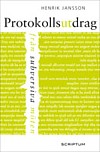
Henrik Jansson's 2007 novel Protokollsutdrag från subversiva möten, as it is called in the Swedish original, is a fine and unusual novel. It deserves not only to be translated, but also to be read in Sweden. Because this is a novel written by a Finland-Swede.
It will be argued that many Finland-Swedish authors have joint editions in both Finland and Sweden, for instance Lars Sund and Kjell Westö, but even by Finland-Swedish standards, Jansson's novel is published by a rather small press: Scriptum in Vasa. So it is unlikely that he will be widely read in Sweden.
The novel is nonetheless significant. It tells the story of how Communist youth from the 1970s grew disillusioned, but also weaves into the plot personal details from family life in the 2000s. The former aspect is the more important, perhaps, although Jansson's descriptions of his relationship in the 2000s are convincing.
The Communist youth movement in Finland was quite powerful. Maybe only Pirkko Saisio has written similar novels, but she wrote in Finnish. This is one of the very few Finland-Swedish novels that closely documents the feel, the music, the meetings, the trips to Tallinn, the blue-shirts and the red-shirts. Because even then the youth wings of the Communist movement were split in two. The so-called taistoiter, or hardline Communists, named after the leader of the hardline faction, Taisto Sinisalo, wore the uniform blue shirts, whilst the more liberal wing, which had the weekly Ny Tid as their mouthpiece, wore red uniform shirts.
I know all this because I was, at the time, the classic fellow-traveller. I sympathised with Communism, but could never bring myself to join any party. As I was living in Finland during the 1970s, first as a year-abroad student at Åbo Akademi, and later as an English conversation teacher in Jakobstad and Vasa, I experienced this whole ferment at first hand. When I left Finland in 1980 to go and teach in Umeå, Sweden, my friends were still fervent Communists. By the 2000s, they have become Greens, or have fallen silent.
But Jansson decided, very interestingly I feel, to document what it felt like to be a member of the Finland-Swedish wing of the Communist youth movement (blueshirts, as I believe) and how, in the early 1980s, he threw away all his written Communist material, including newspapers, magazines, minutes of meetings, and so on, something he now regrets. Because it was, to an extent, the documentation of his own life. But with only memory to go on, maybe Jansson has avoided getting bogged down in detail.
Henrik Jansson has always been keen on jazz and rock music. So there are plenty of mentions of Dylan, Donovan and John Coltrane, as well as home-grown bands and singers, plus leftwing composers and martyrs, such as Victor Jara and Theodorakis. And his protagonist has had good and bad relationships with women. So the actual number of political meetings described in detail are rather few, in comparison with the rest of the test.
Jansson swings, sometimes within the same paragraph, between the present (around 2005) and the distant 1970s. But the reader is not led into a labyrinth of narration. It is a readable book.
So I hope that those readers who saw the pathetic antics of the Russian provocateurs and their Finnish supporters today in Helsinki, by way of the online coverage, will one day read Henrik Jansson's novel to see at close quarters what drove young people in the 1970s, often from quite middle-class homes, to become Communists.
It will be argued that many Finland-Swedish authors have joint editions in both Finland and Sweden, for instance Lars Sund and Kjell Westö, but even by Finland-Swedish standards, Jansson's novel is published by a rather small press: Scriptum in Vasa. So it is unlikely that he will be widely read in Sweden.
The novel is nonetheless significant. It tells the story of how Communist youth from the 1970s grew disillusioned, but also weaves into the plot personal details from family life in the 2000s. The former aspect is the more important, perhaps, although Jansson's descriptions of his relationship in the 2000s are convincing.
The Communist youth movement in Finland was quite powerful. Maybe only Pirkko Saisio has written similar novels, but she wrote in Finnish. This is one of the very few Finland-Swedish novels that closely documents the feel, the music, the meetings, the trips to Tallinn, the blue-shirts and the red-shirts. Because even then the youth wings of the Communist movement were split in two. The so-called taistoiter, or hardline Communists, named after the leader of the hardline faction, Taisto Sinisalo, wore the uniform blue shirts, whilst the more liberal wing, which had the weekly Ny Tid as their mouthpiece, wore red uniform shirts.
I know all this because I was, at the time, the classic fellow-traveller. I sympathised with Communism, but could never bring myself to join any party. As I was living in Finland during the 1970s, first as a year-abroad student at Åbo Akademi, and later as an English conversation teacher in Jakobstad and Vasa, I experienced this whole ferment at first hand. When I left Finland in 1980 to go and teach in Umeå, Sweden, my friends were still fervent Communists. By the 2000s, they have become Greens, or have fallen silent.
But Jansson decided, very interestingly I feel, to document what it felt like to be a member of the Finland-Swedish wing of the Communist youth movement (blueshirts, as I believe) and how, in the early 1980s, he threw away all his written Communist material, including newspapers, magazines, minutes of meetings, and so on, something he now regrets. Because it was, to an extent, the documentation of his own life. But with only memory to go on, maybe Jansson has avoided getting bogged down in detail.
Henrik Jansson has always been keen on jazz and rock music. So there are plenty of mentions of Dylan, Donovan and John Coltrane, as well as home-grown bands and singers, plus leftwing composers and martyrs, such as Victor Jara and Theodorakis. And his protagonist has had good and bad relationships with women. So the actual number of political meetings described in detail are rather few, in comparison with the rest of the test.
Jansson swings, sometimes within the same paragraph, between the present (around 2005) and the distant 1970s. But the reader is not led into a labyrinth of narration. It is a readable book.
So I hope that those readers who saw the pathetic antics of the Russian provocateurs and their Finnish supporters today in Helsinki, by way of the online coverage, will one day read Henrik Jansson's novel to see at close quarters what drove young people in the 1970s, often from quite middle-class homes, to become Communists.
Tuesday, 17 March 2009
Sofi Oksanen

As you will have read in David's posting "Putin-Jugend in Helsinki", about the Finnish seminar marking the 60th anniversary of the Estonian Deportations of 1949, one author invited will be the prize-winning author Sofi Oksanen. The seminar will take place in Helsinki on 23rd March 2009.
Ms Oksanen has a rather unusual background for a Finnish author, in that she is half-Estonian, and writes about that country. Previous Finnish authors with an Estonian connection include Aino Kallas and Hella Wuolijoki. Oksanen (born 1977) is of a much younger generation. Nevertheless, she can still communicate with older Estonians who remember, for instance, the 1949 deportations, when several thousand Estonians were dubbed "kulaks", then promptly sent to Siberia in cattle trucks.
In December 2008, Sofi Oksanen won the prestigious Finlandia Prize for her latest novel Purge, one dealing with two older women who suffered the Soviet occupation and its aftermath.
BIBLIOGRAPHY [The three links here are, unfortunately, only in Finnish]
Stalinin lehmät, [Stalin's Cows] 2003
Baby Jane, [idem] 2005
Puhdistus, [Purge / Cleansing / Pogrom] 2008
Her first novel Stalin's Cows had, as part of the blurb: "Why are all Estonian women whores?", which was guaranteed to be eye-catching, as Estonia is Finland's next-door neighbour. In this novel, Oksanen interweaves a story of bulimia with one of Brezhnev's bureaucratic oppression of the Baltic countries. The bulimia is, evidently, autobiographical, but given the fact that her mother was born in Estonia, she is not ignorant of the history of that country, either. The novel deals with the shame and stigma involved in the lives of Baltic women who fled to Finland during Soviet times. As Estonia was little discussed in Finland for decades, this book came as a sensation and is evidently a page-turner. It exists only in Swedish translation.
I cannot find much on the internet about her second novel. It is evidently set in urban Helsinki and involves panic attacks.
But her third, Purge is being translated into English by the American translator Lola Rogers, and will appear in the United States. This deals with the complex and paradoxical lives of old Estonian women, about sexual exploitation and prostitution of younger ones who are lured abroad, to Finland or Germany, by the chance of earning lots of money.The guilt of those who stayed behind when others were deported to Siberia from Estonia, and what happened to those who returned is interwoven. While Jaan Kross described the occupation of Estonia from a male point of view, Oksanen has talked with older female Estonian relations and built up her works on what she has heard.The novel was preceded by a play on the same theme that was staged at the Finnish National Theatre. This play exists in an English manuscript version, but has not yet been published.
Both the Finnish and Estonian press make a lot of Oksanen's status as angry young woman regarding women's issues and the distortion of Soviet history as related to Finland and Estonia. She also doubles up as an actress, and can be seen in photographs in Gothic garb. But she does know her onions. Under the Gothic exterior lurks a knowledgeable person. See her photogallery, several webpages long.
Last year, Sofi Oksanen travelled around Estonia with the Helsinki newspaper Helsingin Sanomat and visited a number of manor houses in various states of repair. This reportage can be seen here.
The pictures are in a column to the right of your screen, with the map filling the main part, "Viro" being the Finnish name for Estonia. The photos can be enlarged by clicking on them. The words "Seuraavat 15 kuvaa" at the bottom indicate the link to the next 15 photos.
Ms Oksanen has a rather unusual background for a Finnish author, in that she is half-Estonian, and writes about that country. Previous Finnish authors with an Estonian connection include Aino Kallas and Hella Wuolijoki. Oksanen (born 1977) is of a much younger generation. Nevertheless, she can still communicate with older Estonians who remember, for instance, the 1949 deportations, when several thousand Estonians were dubbed "kulaks", then promptly sent to Siberia in cattle trucks.
In December 2008, Sofi Oksanen won the prestigious Finlandia Prize for her latest novel Purge, one dealing with two older women who suffered the Soviet occupation and its aftermath.
BIBLIOGRAPHY [The three links here are, unfortunately, only in Finnish]
Stalinin lehmät, [Stalin's Cows] 2003
Baby Jane, [idem] 2005
Puhdistus, [Purge / Cleansing / Pogrom] 2008
Her first novel Stalin's Cows had, as part of the blurb: "Why are all Estonian women whores?", which was guaranteed to be eye-catching, as Estonia is Finland's next-door neighbour. In this novel, Oksanen interweaves a story of bulimia with one of Brezhnev's bureaucratic oppression of the Baltic countries. The bulimia is, evidently, autobiographical, but given the fact that her mother was born in Estonia, she is not ignorant of the history of that country, either. The novel deals with the shame and stigma involved in the lives of Baltic women who fled to Finland during Soviet times. As Estonia was little discussed in Finland for decades, this book came as a sensation and is evidently a page-turner. It exists only in Swedish translation.
I cannot find much on the internet about her second novel. It is evidently set in urban Helsinki and involves panic attacks.
But her third, Purge is being translated into English by the American translator Lola Rogers, and will appear in the United States. This deals with the complex and paradoxical lives of old Estonian women, about sexual exploitation and prostitution of younger ones who are lured abroad, to Finland or Germany, by the chance of earning lots of money.The guilt of those who stayed behind when others were deported to Siberia from Estonia, and what happened to those who returned is interwoven. While Jaan Kross described the occupation of Estonia from a male point of view, Oksanen has talked with older female Estonian relations and built up her works on what she has heard.The novel was preceded by a play on the same theme that was staged at the Finnish National Theatre. This play exists in an English manuscript version, but has not yet been published.
Both the Finnish and Estonian press make a lot of Oksanen's status as angry young woman regarding women's issues and the distortion of Soviet history as related to Finland and Estonia. She also doubles up as an actress, and can be seen in photographs in Gothic garb. But she does know her onions. Under the Gothic exterior lurks a knowledgeable person. See her photogallery, several webpages long.
Last year, Sofi Oksanen travelled around Estonia with the Helsinki newspaper Helsingin Sanomat and visited a number of manor houses in various states of repair. This reportage can be seen here.
The pictures are in a column to the right of your screen, with the map filling the main part, "Viro" being the Finnish name for Estonia. The photos can be enlarged by clicking on them. The words "Seuraavat 15 kuvaa" at the bottom indicate the link to the next 15 photos.
Friday, 13 March 2009
The Changes at SELTA - 2
I'm rescuing a couple of comments from an earlier post because I think they raise some issues that could do with further discussion, and if they are lost back in an earlier thread there's less likelihood of that happening. Also, in view of the fact that SELTA holds its spring meeting next week on 18th March, it may be that some members would like to give their feedback here.
I wrote...
I wrote...
What I have always wondered is whether at some stage (probably fairly early on) in SELTA's history it was actually taken over as a sort of cultural arm of the Swedish authorities,although this has never been officially acknowledged by any of the parties involved. The insistence on the use of the Swedish Embassy premises for the association's meetings always looked to me a bit suspect, and there seemed to be a very cosy relationship between the various Swedish cultural counsellors and the top SELTA membership.And Rod Bradbury replied...
Also, SELTA has traditionally been a place where various rivals in a rather restricted field meet one another, not always with positive results, and I'm wondering too whether this may be one of the factors underlying the present troubles in the group. The online forum seems to have brought some of that latent disharmony out into the open at last.
The Swedish authorities obviously pay to keep the Swedish Book Review going. And although that is called SELTA's journal, it feels more like a shopfront (and a very useful one too) for Swedish publishers, with the Swedish Arts Council (formerly it was the Swedish Institute)in the background. In a sense, that arrangement is beneficial to both. Sweden gets a magazine on the cheap and SELTA gets a forum for members' translations/articles etc that it would otherwise not have access to. There might be a clash of interests somewhere, of course, as translators also need to earn a living, and there is a limited amount of literary translation work available. But SBR seems to be open to translators to present their work / new authors and so on, so perhaps one should be satisfied with the system as it is.See also in this blog: The Changes at SELTA
One of the original reasons for establishing SELTA was to have an organisation for the Swedes to do business with, a 'motpart'. That is how things are done in Sweden.
Subscribe to:
Posts (Atom)