Showing posts with label Communism. Show all posts

Wednesday, 8 September 2010

Boye

The third volume of Peter Weiss's The Aesthetics of Resistance opens with a tribute to the narrator's parents, who have succeeded in fleeing to Sweden. The tribute is also one of mourning for his mother - though still alive, she is ill and has withdrawn into a silence from which she cannot be recalled.

Imperceptibly, the image of the mother merges with the image and memory of another female character, that of her friend and colleague, the Swedish poet and novelist Karin Boye, who like other women in the novel is referred to solely by her last name. Boye's suicide, and her own rationale and explanation for it, form the subject of the early part of volume 3.

The novel's sharp focus on the life and work of Boye and the acute attention the narrator devotes to her indicate that for Weiss this author and poet had a more personal significance for Weiss than was the case with Brecht, for example. One wonders if Weiss had met Boye in Sweden - after all, in 1938 his family took up residence in Alingsås, West Gotland, where Boye herself moved in the following year in order to be close to Anita Nathorst. A meeting does not seem improbable.

Some of Weiss's account of Boye's life and of her final months appears to be drawn at least in part from the biography by Margit Abenius (Drabbad av renhet, 1950)- yet there are also some details that may derive from actual contacts with the poet. In particular, Weiss is at pains to analyse Karin Boye's existential, political, artistic, sexual and personal situation in 1941, describing it through the words of the psychoanalytically-trained doctor Max Hodann. Hodann says that in her moment of surrender to Goering at a mass rally in 1932, Boye had made it impossible for her to forgive herself or receive forgiveness, and had consciously and unconsciously abandoned hope. Her novel Kallocain (1940), which depicts the merciless and inhuman conflict in a world that is divided into two opposing blocks, is the testament not only to her own despair but to the despair of a generation. Hodann sees a continuation of Boye's fatal inner and outer dilemma in the inability of the radical German youth of the 1930s and 40s to avoid either a collapse into Nazism or an embrace of Stalinist Communism:
Ich gab Boyes Schilderung wieder, wie sie sich hatte betören lassen dem Mann mit dem bleichen Hysterikergesicht auf der Tribüne in der überfüllten Sporthalle, und wie sie zu spät erst das Ruchlose seiner Reden begriffen habe. Viele von uns, sagte Hodann, immer noch, und oft grade, wenn es um Entscheidendes gehe, wie Kinder, wir ließen uns beherrschen von Hoffnungen, deren Ursprung eingebettet sei in der Erinnrung an das Ertasten der Mutterbrust, im Aufgehn in einer Harmonie, die es für uns nicht mehr gebe. Auch Boye müsse, wie wir alle, nach der Mutter, dem Vater in sich gesucht, und diese, in wachsendem Maß, und durch andre Gestalten ersetzt haben... Ich möchte behaupten, sagte er, daß unsre Generation mehr gezeichnet ist von dem Unheil, das die Sowjetunion ergriff, als von den Verheerungen durch den Faschismus, denn an dem Arbeiterstaat hingen wir mit unserm ganzen kindlichen Glauben, während uns von Anfang an bekannt war, was in Deutschland aufkam.
I'll return to this subject in another post.

Monday, 30 August 2010

Peter Weiss - 4

As I pointed out in an earlier post, unlike the main body of the text, the extensive footnotes in Jan Christer Bengtsson's examination of the films of Peter Weiss often contain rather controversial material. A further example of this is provided by the long note that accompanies a consideration of the negative reception by Swedish critics of Weiss's full-length feature film Hägringen (The Mirage, 1959). Here the focus is directed on an aspect of Weiss's personality which seems to derive from an inner masochism. The conclusions Bengtsson draws from this are, at first glance, surprising - yet I believe that they are worthy of serious consideration.

Observing that in Weiss's response to his critics it is possible to discern a form of pre-emptive self-harm, Bengtsson notes that the response is typical of avant garde artists, and that it comprises the three distinct elements of sacrifice, struggle and exemplariness:
For the present is he who is the victim that is being sacrificed. The exemplariness consists in an apparent David-and-Goliath struggle, the result of which is an unspecified dreamed-of victory. The latter is attained through faith - faith in an artistic achievement that is placed above the ordinary. And this will later appear in a faith in certain specific political solutions.
Än så länge är det han som är den utsatte och som offras. Det förebildliga ligger i en skenbar David-Goliat-kamp och resultatet i en drömd odefinierbar seger. Det sista uppnås genom tro ― tron på en konstutövning stadd ovanför det vanliga. Och detta skulle längre fram dyka upp i en tro på vissa särskilda politiska lösningar.
Bengtsson now turns to a passage in a 2002 monograph by the literary critic Arnd Beise (who is chairman of the International Peter Weiss Society), and in a summary of Beise's intepretation of what he perceives to be the aesthetic and moral rationale underlying much of Weiss's work, quotes the following, pointing to
a poetics which provides a reply to one of the still open questions of the Marquis de Sade and Trotsky. Is it worthwhile to subordinate individual needs such as love, friendship or family to the demands of the struggle for a better society? Yes, because [...] there is a poetry of memory, which preserves the sacrifices and efforts of those who [...] fought or still fight the oppression, even if this struggle was or is in vain. Again and again the memory of this struggle [...] will eventually bring forth a revolution that puts an end to all coercive orders. This also explains why Marat, Trotsky and Hölderlin are increasingly to be seen as martyrs.
eine Poetik, die auf eine der offen gebliebenen Fragen des Marquis de Sade und Trotzkis eine Antwort gibt. Lohnt es sich, individuelle Bedürfnisse wie Liebe, Freundschaft oder Familie den Forderungen des Kampfs für eine bessere Gesellschaft unterzuordnen? Ja, weil [...] es eine Poesie der Erinnerung gibt, die die Opfer und Mühen derjenigen aufbewahrt, die die Unterdrückung [...] bekämpften oder noch bekämpfen, selbst wenn dieser Kampf vergeblich war oder ist. An diesen Kampf zu erinnern, immer wieder [...] werde irgendwann doch eine Revolution hervorbringen, die alle Zwangsordnungen beendet. Das erklärt auch, warum Marat, Trotzki und Hölderlin in steigendem Maß als Märtyrer zu verstehen sind.
Some 30 pages further on in this book, in an analysis of Weiss's play Viet Nam Diskurs (1968), Beise quotes a remark by a contemporary Communist Party member, referring to this person as "Parteigenosse des Viet Cong". As Bengtsson points out, the use of the word "Parteigenosse" was strictly confined to a single historical and semantic context - the Lingua Tertii Imperii (LTI) designates it as being used solely within the German Nazi Party (NSDAP) to refer to its members, usually in the abbreviated form "Pg."

Bengtsson says that he assumes that this somewhat ambiguous use of the term - an ambiguity that in Beise's text is clearly deliberate, and according to Bengtsson not disclaimed by Beise himself  -  is intended to suggest  that
Weiss, in the political positions he took throughout his life, wandered from the one big ideology of struggle to the other, and that Beise, well aware of this and of what can and should be said today regarding Weiss, has expressed this fact in a somewhat cryptic manner.

Weiss i sina politiska ställningstaganden under livets gång vandrat från den ena stora kampideologin till den andra och att Beise väl medveten om detta förhållande och vad som kan och bör sägas idag rörande Weiss på ett något kryptiskt sätt uttryckt detta förhållande.
If we recall the life and work of Karin Boye (who features as a character in the last volume of the Aesthetics), her single moment of overt and personal fascination with Nazism, and her sustained attack on it and on herself in her dystopian novel Kallocain (1940), this passage of Bengtsson's ceases to be so surprising, and one begins to see Weiss's later left-wing radicalism in a new light, as an outgrowth of his political development during the 1930s. In a future post, I hope to examine this question further.

Tuesday, 19 May 2009

Bridging the Gap - History and the Nordic World

I thought I'd continue out here in the open the discussion that started in the comments to Harry's Bredsdorff post. Eric wrote:
While nowadays I am more on the right in economic and social-cohesion terms, I still read the former Communist weekly Ny Tid, partly out of nostalgia, partly because of its good cultural coverage, and partly because it is always useful to read opposite views. When I was at UEA and in Åbo, the Communists I knew were almost painfully middle-class offspring. They'd never been within an armsbreath of a worker. But I admired their idealism. And I hope that we people that kick against the cultural pricks of bestsellerdom and xeno-ignorance in the UK can adopt an even-handed approach in political terms.
I have to admit that my political sympathies are mainly centre-right/libertarian. This, I think, is partly a result of the relatively long ime I spent during the 1970s and 80s -- after periods in the Soviet Union and Eastern Europe -- trying to do something to lift the veils of wilful ignorance that surrounded the view of the Soviet Union then prevalent among Western democrats, most of whom were apparently unable to perceive the true nature of global Communism. It's also probably a result of the time I spent the United States during the same era, when the discussion of these issues had a different configuration from the one that characterized debate in the UK and Europe. Today, if I were still in the U.S. I suppose I would probably sympathize most with "right-wing Democrats" and "left-wing Republicans".

This political stance caused me some problems when I met writers and intellectuals in the Nordic countries, most of whom held views that were even more the to the left than those of their counterparts in Britain. On the other hand, I became aware that -- as Czeslaw Milosz pointed out in The Captive Mind -- totalitarian ideology has the power to enslave the minds of individuals who are otherwise decent and intelligent, and that behind the ideological enslavement and blindness often lie beauty, truth and honesty. That is particularly true of writers and poets, I think. In Finland, for example, I found some poets who, though they professed to be Communists, were writing poetry that would never be accepted in the framework of Soviet literary dogma, and was even far removed from anything could be called "left wing", or "politically committed".

It wasn't until I got to Estonia in the early 1990s that I began to meet writers and intellectuals from a Nordic cultural background who also had direct and personal experience of Soviet reality, and who because of that had managed to (even had to) bridge the gap between the personal and the public/political - much in the way that W.H. Auden had done in England and America decades earlier, though from a very different experiential base. These writers knew what Communism was and what it did to people, had felt its physically and mentally destructive force, which was similar to that of Nazi ideology and practice. Meeting these people was confirmation for me that even though in the rest of the Nordic world the influence of the Soviet threat and Soviet propaganda had put blinkers on many minds, there was a Nordic cultural reality that stood outside that limitation and beyond it.

I agree with Eric that the labels of "right" and "left" have become less meaningful since the fall of Communism - yet the old dichotomy remains, now mostly polarized around opposition to or support for the United States and its cultural and political role in spreading the values of liberty and democracy throughout the world. But also, for cultural and historical reasons, and probably because I'm British rather than European, the Nordic world has always seemed to me to stand somewhere between Europe amd America, and I guess I still see it as a kind of bridge between those two inwardly diverse but outwardly monolithic entities.

Monday, 23 March 2009

Henrik Jansson - "Excerpts From the Minutes of Subversive Meetings"


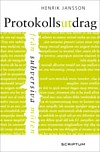
Henrik Jansson's 2007 novel Protokollsutdrag från subversiva möten, as it is called in the Swedish original, is a fine and unusual novel. It deserves not only to be translated, but also to be read in Sweden. Because this is a novel written by a Finland-Swede.

It will be argued that many Finland-Swedish authors have joint editions in both Finland and Sweden, for instance Lars Sund and Kjell Westö, but even by Finland-Swedish standards, Jansson's novel is published by a rather small press: Scriptum in Vasa. So it is unlikely that he will be widely read in Sweden.

The novel is nonetheless significant. It tells the story of how Communist youth from the 1970s grew disillusioned, but also weaves into the plot personal details from family life in the 2000s. The former aspect is the more important, perhaps, although Jansson's descriptions of his relationship in the 2000s are convincing.

The Communist youth movement in Finland was quite powerful. Maybe only Pirkko Saisio has written similar novels, but she wrote in Finnish. This is one of the very few Finland-Swedish novels that closely documents the feel, the music, the meetings, the trips to Tallinn, the blue-shirts and the red-shirts. Because even then the youth wings of the Communist movement were split in two. The so-called taistoiter, or hardline Communists, named after the leader of the hardline faction, Taisto Sinisalo, wore the uniform blue shirts, whilst the more liberal wing, which had the weekly Ny Tid as their mouthpiece, wore red uniform shirts.

I know all this because I was, at the time, the classic fellow-traveller. I sympathised with Communism, but could never bring myself to join any party. As I was living in Finland during the 1970s, first as a year-abroad student at Åbo Akademi, and later as an English conversation teacher in Jakobstad and Vasa, I experienced this whole ferment at first hand. When I left Finland in 1980 to go and teach in Umeå, Sweden, my friends were still fervent Communists. By the 2000s, they have become Greens, or have fallen silent.

But Jansson decided, very interestingly I feel, to document what it felt like to be a member of the Finland-Swedish wing of the Communist youth movement (blueshirts, as I believe) and how, in the early 1980s, he threw away all his written Communist material, including newspapers, magazines, minutes of meetings, and so on, something he now regrets. Because it was, to an extent, the documentation of his own life. But with only memory to go on, maybe Jansson has avoided getting bogged down in detail.

Henrik Jansson has always been keen on jazz and rock music. So there are plenty of mentions of Dylan, Donovan and John Coltrane, as well as home-grown bands and singers, plus leftwing composers and martyrs, such as Victor Jara and Theodorakis. And his protagonist has had good and bad relationships with women. So the actual number of political meetings described in detail are rather few, in comparison with the rest of the test.

Jansson swings, sometimes within the same paragraph, between the present (around 2005) and the distant 1970s. But the reader is not led into a labyrinth of narration. It is a readable book.

So I hope that those readers who saw the pathetic antics of the Russian provocateurs and their Finnish supporters today in Helsinki, by way of the online coverage, will one day read Henrik Jansson's novel to see at close quarters what drove young people in the 1970s, often from quite middle-class homes, to become Communists.