
Showing posts with label Magazines. Show all posts
Showing posts with label Magazines. Show all posts
Wednesday, 26 April 2017
Estonian Literary Magazine

Wednesday, 19 October 2011
New Danish writing
The latest issue of Danish Literary Magazine is now online. Among the works featured is the novel Gudfar (Godfather) by Dy Plambeck, which in three interlinked but also independent narratives offers an unusual view of Danish history, culture and society stretching over seven decades.
Friday, 8 July 2011
Vinduet 2/2011
The new issue of Norsk Gyldendal's literary magazine, Vinduet, is now published, and as its leading editorial proclaims it's something of a mixed bag (the phrase is used in English). The atmosphere of the magazine is as curious as ever - in the articles and associated graphics and photos there are occasional eerie cultural echoes of the 1960s and 70s, and one sometimes has the impression that in literary terms, at least. Norway has a secret hankering for that ground-breaking but also traumatic period in the country's history.
Britain's Poet Laureate (in Norwegian this becomes hoffpoet) Carol Ann Duffy is the subject of a fairly long article by author and journalist Jostein Sæbøe, who recently published a Norwegian translation of Duffy's collection Mean Time, and there's a version of her poem 'Oslo'. Dag Solstad, who is 70 this year, receives extensive treatment from several authors, including Trond Haugen, who contributes an interesting review of Espen Hammer's Solstad monograph. For Hammer, Haugen suggests, Solstad's progression from the literary absurdism of the 1960s to the Marxism/Maoism of the 1970s was not a major break, but in some senses merely represented an extension of the 'absurd' into the political realm. There's a tribute to Gunvor Hofmo, who is now 90, and a long feature on the Iranian writer Mahmoud Dowlatabadi. Christopher Hitchens, Lorrie Moore and Russian novelist Andrei Gelasimov are the focus of other prominent items in the issue.
Britain's Poet Laureate (in Norwegian this becomes hoffpoet) Carol Ann Duffy is the subject of a fairly long article by author and journalist Jostein Sæbøe, who recently published a Norwegian translation of Duffy's collection Mean Time, and there's a version of her poem 'Oslo'. Dag Solstad, who is 70 this year, receives extensive treatment from several authors, including Trond Haugen, who contributes an interesting review of Espen Hammer's Solstad monograph. For Hammer, Haugen suggests, Solstad's progression from the literary absurdism of the 1960s to the Marxism/Maoism of the 1970s was not a major break, but in some senses merely represented an extension of the 'absurd' into the political realm. There's a tribute to Gunvor Hofmo, who is now 90, and a long feature on the Iranian writer Mahmoud Dowlatabadi. Christopher Hitchens, Lorrie Moore and Russian novelist Andrei Gelasimov are the focus of other prominent items in the issue.
Wednesday, 19 January 2011
Hunger
Issue 14 of Absinthe is out, with among other things an essay by Thomas E. Kennedy recalling his first acquaintance with Knut Hamsun's Hunger, after seeing Henning Carlsen's 1966 film of the novel:
The film led me to read an SAS Airline bilingual publication (Scandinavian Words 15) of the first chapter, written by Hamsun in the late 1880s and later expanded to the novel.Kennedy compares Hamsun to Conrad, perceiving a journey to darkness at the heart of each author's work.
Saturday, 8 January 2011
A review and a story
There's a review of Tarkovsky's Horses and Other Poems in Evergreen Review, and Ólafur Gunnarsson has a new short story in Mayday Magazine.
Sunday, 7 November 2010
Ice Floe


The first issue of the new series of Ice Floe is now available from University of Alaska Press - the inaugural issue presents new poems as well as a selection of work from the first seven years of the publication's existence, and the poets represented hail from Alaska, Canada, Iceland, Norway, Sweden, Finland and Russia.
Thursday, 5 November 2009
Literary Dialogues
Swedish Book Review has published an anthology called Literary Dialogues: Contenporary Swedish Writing in English, edited by Sarah Death and Neil Smith. The book contains an introduction by Sir Michael Holroyd, and the featured writers and poets include Johannes Anyuru, Marjaneh Bakhtiari, Henning Mankell and Eva Runefelt. Among the translators are Sarah Death, B. J. Epstein, Tom Geddes and Tiina Nunnally. Copies can presumably be ordered from Swedish Book Review - see their website, though there doesn't appear to be any mention of the anthology there yet.
Sunday, 16 August 2009
Gunnar Harding poems
Salt magazine has published a selection of poems by the Swedish poet Gunnar Harding in translations by Roger Greenwald, who also provides an introduction.
Friday, 31 July 2009
Divided or united?
Swedish Book Review now remains the only English-language periodical that's focused exclusively on translations and reviews of Swedish literature. Books from Finland, with its coverage of Finnish and Finland-Swedish writing in English translation, is a close rival, but earlier this year discontinued print publication, and now concentrates all its energies on a WordPress-engined website. After a promising start, the site has recently shown some signs of uncertainty, with updates becoming less frequent (the last new item appeared on July 16), and it's to be hoped that the demise of the magazine's print version won't lead to a dissipation of the Web effort, too.
One big difference between the SBR and BfF sites is that the Finnish site offers some interactivity to its readers, with online comments boxes and the possibility of discussion. SBR's site, by contrast, is of the old-fashioned static kind, with plenty of text and information, but not much in the way of feedback and debate.
In some ways it seems a pity that Books from Finland has had to give up its print version entirely. If run concurrently with the online version, the magazine in its old paper format, even if it only appeared once or twice a year, would probably have a greater impact, and reach more readers.
Or is there perhaps an argument for thinking about the merging of both journals - SBR and BfF - into a single Nordic literature magazine project? This has been tried before, but didn't work out for various reasons. Maybe it's time to try again.
One big difference between the SBR and BfF sites is that the Finnish site offers some interactivity to its readers, with online comments boxes and the possibility of discussion. SBR's site, by contrast, is of the old-fashioned static kind, with plenty of text and information, but not much in the way of feedback and debate.
In some ways it seems a pity that Books from Finland has had to give up its print version entirely. If run concurrently with the online version, the magazine in its old paper format, even if it only appeared once or twice a year, would probably have a greater impact, and reach more readers.
Or is there perhaps an argument for thinking about the merging of both journals - SBR and BfF - into a single Nordic literature magazine project? This has been tried before, but didn't work out for various reasons. Maybe it's time to try again.
Tuesday, 9 June 2009
Poems and noems
Courtesy of Martin Aitken over at The Interlingual Zoo, some links to online publications of Danish poetry: Calque, a companion blog to the literary magazine of the same name, has posted some of Martin's translations of poetry by Per Højholt, and World Voices, the Web-based chapbook series edited by TLR's Walter Cummins and Thomas E. Kennedy, presents an entire collection of poems by Niels Hav, in translations by P. K. Brask, Patrick Friesen and Martin Aitken.
It's encouraging to find literary blogs that make room for translations of work by Nordic writers and poets, and the two blogs mentioned above have now been added to our growing Blog List (scroll down the page to see it).
It's encouraging to find literary blogs that make room for translations of work by Nordic writers and poets, and the two blogs mentioned above have now been added to our growing Blog List (scroll down the page to see it).
Wednesday, 27 May 2009
Norwegian literary websites, events, organisations
Thanks to the Lillehammer Norwegian literary festival website, my attention has been drawn to a Norwegian online poetry magazine called Nypoesi. There is also a site called Forlaget Attåt, which has links to what is termed the Tekstallianse 2009. This website states (my tr.):
Another organisation is Norsk Forfattersentrum. From their website:
During the weekend of 21st and 22nd August, over 120 small presses from Scandinavia and beyond, festivals, magazines, organisations and networks will meet at Litteraturhuset (Oslo). Tekstallianse is a book fair and festival that aims to show the breadth and variety of small, medium-sized and more or less independent and idealistic players within the field of literature, music, the visual arts and theatre. Common to all exhibitors is the wish to establish an alternative to the cultural community represented by the larger publishing houses and newspaper editors.A worthy aim. Let's see what it means in practice. One link here is to Litteraturhuset itself. This has a regular programme, a book café -- "Kafe Oslo" -- and a bookshop.
Another organisation is Norsk Forfattersentrum. From their website:
The Norwegian Writers' Centre" is an organization of Norwegian poets and fiction writers, founded in 1968 on the initiative of young Norwegian writers, in order to act as a linking body between writers and the general public. The Centre is not a writers’ union.It is non-commercial. By granting an amount of 8 million NOK a year, the Ministry of Culture covers most of the operating costs. It
·works out its own arrangements and tours all over the country.Finally for this time, the website of the Norwegian PEN Club is here. This organisation awards the annual Ossietzky Prize that aims to promote freedom of expression.
· keeps an office in Oslo and in 4 other cities (Bergen, Stavanger, Trondheim, Tromsø).
Wednesday, 20 May 2009
Shouting from Copenhagen
At the new Absinthe blog, U.S. expat writer and translator Thomas E. Kennedy contributes another of his Shouts from Copenhagen:
Here I can gaze across to a first floor apartment occupied more than 150 years ago by the father of existentialism Søren Kierkegaard, across from that The White Lamb serving house, shelled by the British in 1807, under orders of the Duke of Wellington, the year it opened. Now, 202 years later, Wellington is dust in his grave and The White Lamb continues to serve golden pints.
Sunday, 26 April 2009
Swedish Book Review 2009:1
The first issue of the Swedish Book Review for 2009 contains a variety of articles and came out just in time for the London Book Fair.
The first extract follows comments about translating Jonas Hassen Khemiri into English by translator Rachel Willson-Broyles. Some of the difficulties encountered involve his idiosyncratic use of compounds, some of which are neologisms.
David Lagercrantz has written a novel Syndafall i Wilmslow / Fall from Grace in Wilmslow about the Enigma code-breaking machine. Extract introduced and translated by Marlaine Delargy.
Tyst hav / Silent Seas is a book about overfishing, written by Swedish Green Party activist Isabella Lövin. Extract translated by Peter Linton.
Other extracts are from books by Fredrik Sjöberg, Maria Ernestam, Elin Wägner, plus an overview article, first published on the Eurozine, about recent Swedish books by DN editor Jonas Thente, intriguingly entitled Beyond Crime Fiction, Handbags and Designer Suits.
The Bookshelf section contains 15 short reviews of works by for instance Carina Burman, Theodor Kallifatides, Bo Carpelan, Per Wästberg and Robert Åsbacka.
The first extract follows comments about translating Jonas Hassen Khemiri into English by translator Rachel Willson-Broyles. Some of the difficulties encountered involve his idiosyncratic use of compounds, some of which are neologisms.
David Lagercrantz has written a novel Syndafall i Wilmslow / Fall from Grace in Wilmslow about the Enigma code-breaking machine. Extract introduced and translated by Marlaine Delargy.
Tyst hav / Silent Seas is a book about overfishing, written by Swedish Green Party activist Isabella Lövin. Extract translated by Peter Linton.
Other extracts are from books by Fredrik Sjöberg, Maria Ernestam, Elin Wägner, plus an overview article, first published on the Eurozine, about recent Swedish books by DN editor Jonas Thente, intriguingly entitled Beyond Crime Fiction, Handbags and Designer Suits.
The Bookshelf section contains 15 short reviews of works by for instance Carina Burman, Theodor Kallifatides, Bo Carpelan, Per Wästberg and Robert Åsbacka.
Wednesday, 22 April 2009
Out of Beta
The new Books from Finland website, which replaces the print version of the magazine, is now out of beta, and online. The editors write:
Our idea of what it is to read, and to read literature, has always been – and for many of us remains – bound up with the invention that made the development of western literature possible, the Gutenberg printing press and its successors.Apparently the intention is to publish new posts and articles every 7 days or so, which is quite a step up from the frequency that necessarily prevailed under the old quarterly print-based system. New material so far has included a dispatch from a Finnish TV journalist on "learning how to give and receive in the Russian way", though the report seems to focus on a bunch of nouveau-riche St Petersburg nightclubbers. Still, there's plenty of room for discussion there, and the BfF website comments section, though moderated, is open to all comers. There wasn't a comments section in the print-based version of the magazine...
In making this website, we have tried hard to fashion it as a place of repose as well as excitement, a location where the spirit and the imagination, as well as the intellect, can engage with what in the old days was called the printed word.
Saturday, 18 April 2009
Absinthe
Absinthe is a U.S.-based magazine of new European writing, much of it in translation. Edited by Dwayne David Hayes and Jessica Bomarito, the magazine appears twice yearly. The forthcoming issue includes a survey by Copenhagen-domiciled novelist, critic and translator Thomas Kennedy of new developments in contemporary Danish writing.
In Translation
The Brooklyn Rail is a U.S.-based magazine publishing "critical perspectives on arts, politics and culture". Recently it opened a new Web-exclusive section called In Translation which aims to expose its readers "to writers and writing they might not otherwise see, and translators, by making samples of their work accessible to those who may wish to publish it."
Hat tip: Brave New Words
Hat tip: Brave New Words
Friday, 17 April 2009
Horisont 1/2009 - Inga-Britt Wik
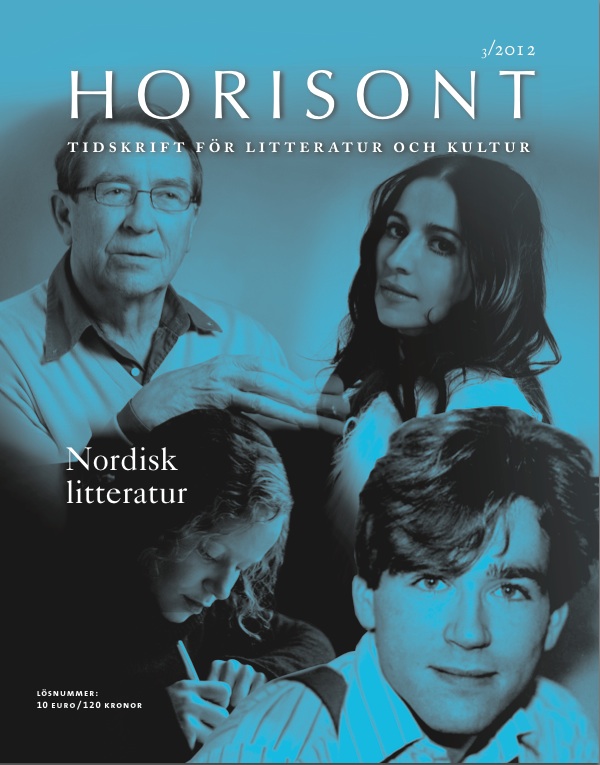
The Ostrobothnian-based literary magazine Horisont has been around for decades, and still now in 2009 four further issues are planned after the first, which appeared recently. The theme of this issue is the Finland-Swedish poet Inga-Britt Wik who died last year. To give some idea who she was, I will translate the small biographical note from Horisont:
Inga-Britt Wik was born 18th December 1930 in Vasa. Both parents were brought up in the countryside, her father as the son of fisherfolk and smallholders from the island of Replot in the Vasa archipelago. Her mother was the daughter of a so-called "America widow" from Vörå. (An America widow was similar to a "grass widow", except that the husband was living in America.) Her father Arvid Wik worked as a customs officer during the 1930s, while her mother ran a small grocer's shop. During the war years, her father was called up, and spent time in the army first in Hangö then, during the Continuation War, in the Karelian Isthmus.
Inga-Britt Wik moved to Helsinki in 1950, and graduated in philosophy in 1956. In 2003 she returned to Vasa. She was principally a poet, and all her books appeared with the Schildts publishing house in Helsinki. Key themes in her poetry are various women's rôles, love, feminism, the environment, but the basic tone of her poetry reflects nature.
She was married to the author and film producer Jörn Donner from 1954 to 1962, later marrying the children's psychiatrist Gustav Amnell. The marriage and separation from Donner caused her to write the books Ingen lycklig kärlek (No Happy Love; 1988) and Bryta upp (Breaking Up; 1996). She was also the editor of poetry by Solveig von Schoultz and Lars Huldén.
I shall be translating a couple of her poems from this issue of Horisont later in a new thread.
Inga-Britt Wik was born 18th December 1930 in Vasa. Both parents were brought up in the countryside, her father as the son of fisherfolk and smallholders from the island of Replot in the Vasa archipelago. Her mother was the daughter of a so-called "America widow" from Vörå. (An America widow was similar to a "grass widow", except that the husband was living in America.) Her father Arvid Wik worked as a customs officer during the 1930s, while her mother ran a small grocer's shop. During the war years, her father was called up, and spent time in the army first in Hangö then, during the Continuation War, in the Karelian Isthmus.
Inga-Britt Wik moved to Helsinki in 1950, and graduated in philosophy in 1956. In 2003 she returned to Vasa. She was principally a poet, and all her books appeared with the Schildts publishing house in Helsinki. Key themes in her poetry are various women's rôles, love, feminism, the environment, but the basic tone of her poetry reflects nature.
She was married to the author and film producer Jörn Donner from 1954 to 1962, later marrying the children's psychiatrist Gustav Amnell. The marriage and separation from Donner caused her to write the books Ingen lycklig kärlek (No Happy Love; 1988) and Bryta upp (Breaking Up; 1996). She was also the editor of poetry by Solveig von Schoultz and Lars Huldén.
I shall be translating a couple of her poems from this issue of Horisont later in a new thread.
Saturday, 11 April 2009
Estonian Literary Magazine
The Estonian Literary Magazine is already listed in the Links column to the right of the screen on this blog. But I feel it merits a small introduction. Because when you first access the website you are confronted with a bare list of 19 issues. This doesn't immediately reveal the full scope of this magazine.
Firstly, it's in English, which makes it widely accessible. Secondly, it cover classics, modern classics and contemporary Estonian literature. So anything written by any significant Estonian author between about 1890 and the present day could feature in an article or two. Prose excerpts and poetry, biographical articles, poems, a list of translations into other languages, and so on. And both exile Estonian authors and those that lived in the ESSR are discussed, plus all those that have emerged since independence. Articles are written both by Estonian scholars and foreign translators.
Only issues 8-27 are available online, starting with Spring 1999 and up to Autumn 2008, but that is more than enough to be getting on with.
For example, Issue 14 has an article about Swedish translations of Estonian literature, which is of course one way for Scandinavianists to access that literature, if an English translation does not yet exist. And Issue 17 mentions the biggest history of Estonian literature available in any larger European language: Geschichte der estnischen Literatur by Cornelius Hasselblatt, Walter de Gruyter, 2006.
The best way to find out the range of topics and authors is to click each issue and look at the various articles listed in the left-hand column. But the website does also have a search function, if you know what you're looking for.
Firstly, it's in English, which makes it widely accessible. Secondly, it cover classics, modern classics and contemporary Estonian literature. So anything written by any significant Estonian author between about 1890 and the present day could feature in an article or two. Prose excerpts and poetry, biographical articles, poems, a list of translations into other languages, and so on. And both exile Estonian authors and those that lived in the ESSR are discussed, plus all those that have emerged since independence. Articles are written both by Estonian scholars and foreign translators.
Only issues 8-27 are available online, starting with Spring 1999 and up to Autumn 2008, but that is more than enough to be getting on with.
For example, Issue 14 has an article about Swedish translations of Estonian literature, which is of course one way for Scandinavianists to access that literature, if an English translation does not yet exist. And Issue 17 mentions the biggest history of Estonian literature available in any larger European language: Geschichte der estnischen Literatur by Cornelius Hasselblatt, Walter de Gruyter, 2006.
The best way to find out the range of topics and authors is to click each issue and look at the various articles listed in the left-hand column. But the website does also have a search function, if you know what you're looking for.
Hjärnstorm - Swedish literary magazine
Hjärnstorm is one of those Swedish literary and cultural magazines that have survived against all odds. Smaller circulation literary magazines do not always last for more than a decade, but owing to a combination of subsidy and good editorship, Hjärnstorm (i.e. Brainstorm) has been going since 1977.
The issues of the magazine tend to be theme-centred, the latest (issue 96-97) being focused on the topic of suicide, which I hope does not presage an imminent departure from the Swedish literary scene. But the themes have been many, including psychedelia, Duchamp, Nietzsche, art criticism, pessimism, photography, Finland, the Sixties, Folkhemmet, the Weimar Republic, plus quite a few others. As can be seen, the magazine has an international outlook, but by no means neglects Sweden itself. So it can be a good windvane for translators who want to keep up with Swedish cultural trends.
As you can see from their website, it is sold at a number of outlets, scattered throughout Sweden, but mainly in Stockholm.
The issues of the magazine tend to be theme-centred, the latest (issue 96-97) being focused on the topic of suicide, which I hope does not presage an imminent departure from the Swedish literary scene. But the themes have been many, including psychedelia, Duchamp, Nietzsche, art criticism, pessimism, photography, Finland, the Sixties, Folkhemmet, the Weimar Republic, plus quite a few others. As can be seen, the magazine has an international outlook, but by no means neglects Sweden itself. So it can be a good windvane for translators who want to keep up with Swedish cultural trends.
As you can see from their website, it is sold at a number of outlets, scattered throughout Sweden, but mainly in Stockholm.
Saturday, 21 March 2009
Ny Tid & Kontur revisited
Issue 12-13 of the Finland-Swedish cultural weekly "Ny Tid" is a double one, plus 1/09 of the occasional insert or supplement "Kontur". There is an exceptional amount of literary material this time round.
Ny Tid
- Two items about the Swedish Nordic Council nominee Johan Jönson and his mammoth 800-page mixed genre work entitled Efter arbetsschema. Article by Lorna Bertram; review by poet Heidi von Wright.
- A review by Otso Harju of the first volume of Hjalmar Bergman's letters.
- An excerpt from Finland-Swede Kira Nalin's first novel Bultar som ett bläckfiskhjärta.
- An article by Claes Andersson entitled 'Navelskådning à la Norén', in effect a review of Lars Norén's En dramatikers dagbok.
- A review, entitled ' "Zur Judenfrage" - Randanmärkningar till ett filosemitiskt livsprojekt', of a book of essays by Mikael Enckell called Om konsten att älska skriften.
- A review by Kristina Rotkirch [pronounced: ROOT-cheerk] of Russian author Olga Slavnikova's prizewinning novel 2017.
- Irmelin Sandman Lilius writes an essay about King Arthur, Merlin and Guinevere.
- Emma Strömberg discusses a poetry forum on the internet.
- A review by Emelie Enckell of the poetry collection Muntliga dikter by Swedish author Andreas Björsten.
- Poems by Finland-Swede Torsten Pettersson.
- Two theatre reviews by Isabella Rothberg of the plays Blaue Frau by Mia Hafrén and Villans hemlighet by several women author-actors: Freja Appelgren, Kontur editor Malin Kivelä, Åsa Nybo and novelist Hannele Mikaela Taivassalo. The latter play is described as a "tvärkonstnärlig föreställning", and as Rothberg says, is full of absurd humour, mysterious women, with the smell of coffee all around. There is Gothic, Sylvia Plath and Jane Eyre among the associations raised.
- A debate article by regular contributor Trygve Söderling (who doubles up as editor of the Finland-Swedish literary periodical 'Nya Argus') about repressive legitimacy in the Finland-Swedish press and Merete Mazzarella's blog.
- A review by former editor, Peter Lodenius, of Czech author Jáchym Topol's new novel in Swedish translation Den gyllene huvudet.
Kontur
- Malin Kivelä discusses a new Swedish translation of Proust.
- An essay-article by Sven-Erik Klinkmann about death and Johnny Cash.
- Poetry by the Estonian author Elo Viiding in Peeter Puide's Swedish translation.
***
Ny Tid
- Two items about the Swedish Nordic Council nominee Johan Jönson and his mammoth 800-page mixed genre work entitled Efter arbetsschema. Article by Lorna Bertram; review by poet Heidi von Wright.
- A review by Otso Harju of the first volume of Hjalmar Bergman's letters.
- An excerpt from Finland-Swede Kira Nalin's first novel Bultar som ett bläckfiskhjärta.
- An article by Claes Andersson entitled 'Navelskådning à la Norén', in effect a review of Lars Norén's En dramatikers dagbok.
- A review, entitled ' "Zur Judenfrage" - Randanmärkningar till ett filosemitiskt livsprojekt', of a book of essays by Mikael Enckell called Om konsten att älska skriften.
- A review by Kristina Rotkirch [pronounced: ROOT-cheerk] of Russian author Olga Slavnikova's prizewinning novel 2017.
- Irmelin Sandman Lilius writes an essay about King Arthur, Merlin and Guinevere.
- Emma Strömberg discusses a poetry forum on the internet.
- A review by Emelie Enckell of the poetry collection Muntliga dikter by Swedish author Andreas Björsten.
- Poems by Finland-Swede Torsten Pettersson.
- Two theatre reviews by Isabella Rothberg of the plays Blaue Frau by Mia Hafrén and Villans hemlighet by several women author-actors: Freja Appelgren, Kontur editor Malin Kivelä, Åsa Nybo and novelist Hannele Mikaela Taivassalo. The latter play is described as a "tvärkonstnärlig föreställning", and as Rothberg says, is full of absurd humour, mysterious women, with the smell of coffee all around. There is Gothic, Sylvia Plath and Jane Eyre among the associations raised.
- A debate article by regular contributor Trygve Söderling (who doubles up as editor of the Finland-Swedish literary periodical 'Nya Argus') about repressive legitimacy in the Finland-Swedish press and Merete Mazzarella's blog.
- A review by former editor, Peter Lodenius, of Czech author Jáchym Topol's new novel in Swedish translation Den gyllene huvudet.
Kontur
- Malin Kivelä discusses a new Swedish translation of Proust.
- An essay-article by Sven-Erik Klinkmann about death and Johnny Cash.
- Poetry by the Estonian author Elo Viiding in Peeter Puide's Swedish translation.
***
Subscribe to:
Posts (Atom)